Written by: Ryan Dunlop, CEO and Founder of Full Arch Masters and graduate from the Harvard School of Dental Medicine
Key Takeaways
-
Hands-on dental implant training connects classroom learning to real procedures through supervised practice on models, cadavers, or live patients.
-
The three main training formats, model-based, cadaver, and live-patient, differ in cost, realism, and ideal experience level.
-
Live-patient training delivers the most realistic clinical experience and requires careful evaluation for safety, structure, and accreditation.
-
Course selection should match your current implant experience: model-based for beginners, cadaver for intermediates, and live-patient for advanced growth.
-
Full Arch Masters provides comprehensive full-arch implant training with a team-based digital workflow and expert supervision, so you can confidently expand your practice. Explore Full Arch Masters course dates and find the track that fits your experience level.
The Three Main Training Formats
Model-Based (Typodont) Training
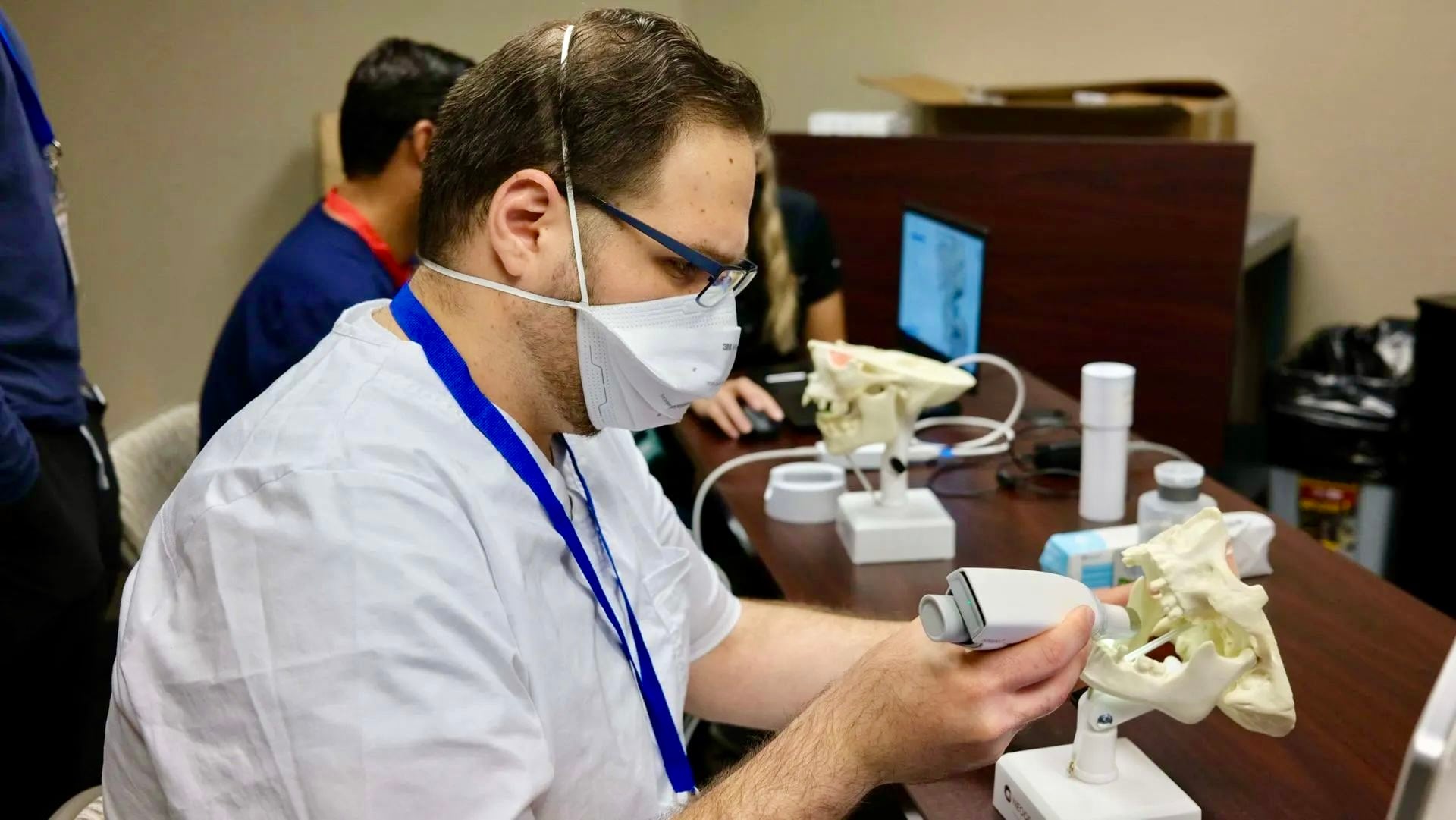
Model-based training uses plastic models or typodonts with synthetic bone. These courses help dentists learn drill sequencing, osteotomy protocols, and basic hand skills in a low-risk setting. Model-based weekend dental implant training courses typically run 1–3 days and cost $1,500–$5,000, while longer university-based programs can be more extensive and expensive.
Advantages of model-based training include:
-
Safe, low-pressure environment ideal for beginners
-
Unlimited repetitions for drilling sequences and osteotomy protocols
-
Lowest-cost hands-on format
Limitations of model-based training include:
-
Synthetic bone feels uniform and forgiving, with no soft tissue, bleeding, or patient to manage
-
Limited preparation for real clinical conditions or decision-making under pressure
-
Strong focus on psychomotor skill, with limited development of clinical judgment
Ideal For: Dentists new to implant placement who need foundational psychomotor practice before moving to cadaver or live-patient formats.
Cadaver Training
Cadaver courses give dentists hands-on surgical experience on human specimens. These programs typically run 2–4 days and cost $3,000–$8,000 based on publicly available data. Cadaver training strengthens anatomical understanding and exposes dentists to realistic tissue planes for techniques that are not appropriate to learn first on living patients.
Advantages of cadaver training include:
-
Realistic anatomy and tissue planes
-
Ability to rehearse complex techniques such as trans-sinus, pterygoid, and zygomatic placements
-
Stronger anatomical grounding than model-based formats
Limitations of cadaver training include:
-
No reproduction of bleeding, anesthesia, healing, patient communication, or long-term follow-up
-
Higher financial costs, ethical considerations, limited space, and the need for specialized supervision
-
No direct experience with patient management
Ideal For: Intermediate dentists who have placed some implants and want to refine surgical technique and anatomical understanding before live-patient work.
Live-Patient Training
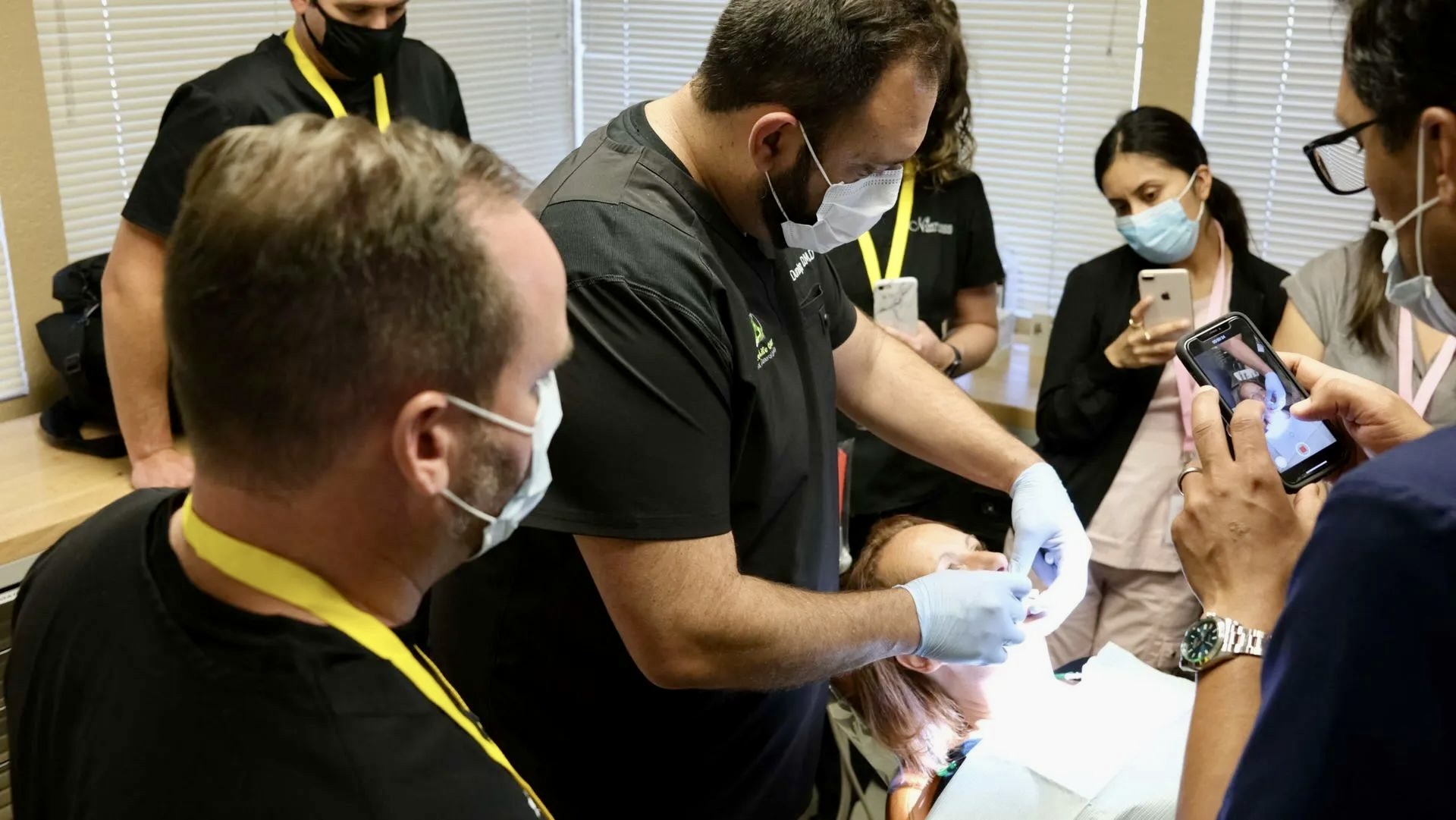
Live-patient training places dentists in supervised surgery on volunteer patients. Live-patient dental implant training programs typically run 3–5 days and cost approximately $8,000–$15,000, with some courses ranging from about $6,500 to $25,000. Live-patient programs are the only format that fully connects protocol knowledge with performance under real clinical conditions.
Advantages of live-patient training include:
-
Most realistic training format, including patient management, bleeding, anesthesia, and immediate feedback
-
Exposure to real clinical variables that simulations cannot replicate, including bone density differences, anatomical variations, soft tissue challenges, and surgical access limitations
-
Significant confidence building for independent practice
Limitations of live-patient training include:
-
Highest cost of all formats
-
Credentialing requirements that vary by state
-
Higher-stress environment with wide variation in program quality
Ideal For: Advanced beginners through experienced dentists who want to refine skills or learn advanced techniques such as zygomatic and pterygoid placements for atrophic arches.
Comparison Table: Training Formats At A Glance
|
Format |
Typical Duration |
Typical Cost Range |
Best For |
|---|---|---|---|
|
Model/Typodont |
1–3 days |
$1,500–$5,000 |
Beginners building foundational psychomotor skills |
|
Cadaver |
2–4 days |
$3,000–$8,000 |
Intermediate dentists refining anatomy and surgical technique |
|
Live-Patient |
3–5 days |
$8,000–$25,000 |
Dentists seeking real-world surgical experience and clinical confidence |
Cost ranges are approximate, based on publicly available program information from multiple providers. Actual pricing varies by location, mentor ratio, and materials included.
How To Choose Based On Experience Level
With the main formats and cost ranges in mind, match your next course to your current experience level.
Beginner (0–10 Implants Placed)
Beginner dentists benefit most from model-based or cadaver courses that build foundational surgical skills in a low-risk environment. After you gain comfort with drilling protocols and basic osteotomy technique, move into live-patient training. Full Arch Masters’ Flagship Course supports dentists at every experience level and includes hands-on records acquisition on live patients within a four-day curriculum capped at eight dentists per cohort.
Intermediate (10–50 Implants Placed)
Intermediate dentists usually progress fastest with live-patient training that refines surgical skills and introduces advanced techniques. Full Arch Masters’ Live Surgical Course offers a Basic Operator track for dentists with fewer than 200 full arches placed, providing supervised surgery on volunteer patients with expert mentor guidance across two full surgical days.
Advanced (50+ Implants, Including Full-Arch)
Advanced practitioners gain the most from live-patient courses focused on complex cases such as zygomatic and pterygoid implants for atrophic arches. Full Arch Masters’ Advanced Live Surgical track is reserved for dentists with 200 or more arches placed and covers advanced techniques, including trans-sinus, palatal-approach, and custom subperiosteal placements, under expert supervision in Parker, Colorado.
Explore Full Arch Masters course dates and find the track that fits your experience level.
Cost And Duration Benchmarks
How Long Is A Dental Implant Course? Courses typically range from 1 to 5 days depending on format and content depth. Universities and institutes offer live-patient implant courses with CE hours ranging from 16 to 34, which shows how much duration and intensity can vary.
What Does Hands-On Dental Implant Training Cost? Based on publicly available program information, dentists can expect model-based, cadaver, and live-patient courses to span from lower four-figure fees to premium full-arch programs in the mid-five-figure range. Detailed ranges appear in the comparison table and benchmarks above, so use those figures as a planning guide.
When comparing programs, calculate total cost of attendance, including travel, lodging, meals, implant and component fees, instrument charges, and lost production time. Low-tuition programs often bill implants and materials separately, which changes the real cost.
Full Arch Masters’ core courses run four days each. The Flagship Course is priced at $9,995 per dentist, with $2,500 per additional team member, and the Live Surgical Course ranges from $20,000 for the Basic Operator track to $25,000 for the Advanced Operator track.
Accreditation And CE Credits For Implant Training
Accreditation confirms that a program meets recognized educational standards and that CE hours count toward license renewal. Many dentists look for programs approved by AGD PACE (Academy of General Dentistry Program Approval for Continuing Education). AGD PACE approval does not guarantee acceptance by every state or provincial board, so dentists should confirm that their state board accepts credits from the specific provider.
Full Arch Masters is an AGD PACE-approved provider, and its main courses offer 32 CE credits each. AGD PACE approves provider organizations rather than individual courses, so confirm that the course you plan to attend falls within the provider’s approval period.
Dentists pursuing Diplomate status with the American Board of Oral Implantology/Implant Dentistry (ABOI/ID) must complete 670 hours of continuing education related to implant dentistry, recognized by AGD PACE. CE certificates or AGD transcripts document these hours.
Geographic And Regulatory Considerations
State regulations shape what type of hands-on training is allowed, especially for live-patient formats. Dental implant CE requirements in the United States vary by state, scope of practice, and whether the training supports initial licensure, renewal, or competency-based pathways. Dentists should verify current rules with their state board because mandates can change. For example, Oregon requires dentists placing dental implants to complete 7 additional CE hours on implant placement and restoration per 2-year renewal cycle, effective January 1, 2024.
Full Arch Masters’ Live Surgical Course takes place in Parker, Colorado, because the Colorado Dental Board allows US-licensed dentists from any state to perform surgery on volunteer patients under a credentialing process that FAM submits ten days before each course. This framework makes hands-on live full-arch surgery accessible in a way that remains rare in the United States. International attendees may join the same course as Observers.
Questions To Ask Before You Enroll
Clear questions help dentists compare programs and protect both their investment and their patients.
-
What is the mentor-to-participant ratio?
-
How many cases will you personally perform from incision to suture, and can the provider confirm that number in writing?
-
What is the format, model, cadaver, or live-patient?
-
Are there prerequisites for participation?
-
What is the total cost, including materials, travel, and lost production?
-
What post-course support is available?
-
Is the program accredited by AGD PACE or another recognized body?
-
What patient-safety safeguards exist, including medical screening, radiographic evaluation, informed consent, and structured follow-up?
Full Arch Masters caps Flagship Course cohorts at eight dentists so every participant receives meaningful hands-on experience. Each Basic and Advanced operator in the Live Surgical Course performs two full-arch cases across two surgical days under expert mentor supervision.
How Full Arch Masters Structures Full-Arch Training
For dentists focused on full-arch implantology, Full Arch Masters offers a specialized pathway that combines live-patient training with a proprietary digital workflow. Its five-course curriculum is built around the FAM Method, a fully digital workflow that integrates seven sequential steps:
-
Preoperative records and data acquisition
-
Photogrammetry and intraoral scanning
-
CBCT and digital treatment planning
-
exocad design
-
Immediate-load conversion
-
Final zirconia design and finishing
-
FP1-specific design, team implementation, and workflow scaling
This integrated system delivers same-day teeth in 2–4 hours and functions as a team-based curriculum. Dentists, assistants, treatment coordinators, and lab technicians train together so the entire practice leaves aligned on one workflow. Every attendee joins an alumni community of hundreds of FAM-trained dentists through private group chats and gains access to the KOL buying group for vendor discounts on implants, exocad licenses, and equipment at no recurring cost.
Review the Full Arch Masters course pathway and bring the complete FAM Method into your practice.
Conclusion: Match Training To Your Clinical Goals
Hands-on dental implant training varies by format and experience level, so alignment with your goals matters. Model-based training builds foundational psychomotor skills, cadaver work sharpens anatomical understanding, and live-patient training comes closest to independent practice. Dentists who want comprehensive full-arch implant training can look to Full Arch Masters for a team-based curriculum that covers the entire digital workflow, live-patient surgery under expert supervision, and ongoing community support.
Frequently Asked Questions
How Long Is A Dental Implant Course?
Course length depends on format and content depth. Model-based courses typically run 1–2 days, cadaver courses 2–4 days, and live-patient courses 3–5 days. Modular continuums and mini-residencies can span 6–12 months with multiple sessions. Full Arch Masters’ core courses, the Flagship Course, Live Surgical Course, and Design and Finish Course, each run four days, while the FP1 Course and Treatment Coordinator Bootcamp each run two days. The FAM Fellowship bundles four courses and delivers over 90 CE hours across the full program, which practices usually spread across a calendar year.
What Does Hands-On Dental Implant Training Cost?
As detailed earlier, costs range from about $1,500 for model-based workshops to $25,000 or more for premium live-patient full-arch programs. Travel, lodging, meals, implant and component fees, instrument charges, and lost production time can significantly change the real cost of any course. When comparing options, calculate total cost of attendance rather than tuition alone. Full Arch Masters’ Flagship Course is priced at $9,995 per dentist, with additional team members at $2,500 each. The Live Surgical Course ranges from $20,000 for the Basic Operator track to $25,000 for the Advanced Operator track. The FAM Fellowship bundles the three core courses plus a fourth course at a $5,000–$10,000 discount versus paying individually, with payment plans of up to 9–12 months available.
Where Can I Find Hands-On Oral Surgery Courses?
Hands-on oral surgery and implant courses run across the United States and internationally, from model-based workshops at dental schools to live-patient programs in states with supportive credentialing frameworks. Training format shapes the clinical experience more than geography. Live-patient training is the only format that recreates the full clinical environment, including patient management, bleeding, and real-time decisions. Full Arch Masters’ Flagship Course takes place in Fresno, California, where participants perform hands-on records acquisition on live patients. The Live Surgical Course is held in Parker, Colorado, where the Colorado Dental Board allows US-licensed dentists from any state to perform surgery on volunteer patients under a credentialing process submitted ten days before each course.
What Accreditation Should I Look For In A Dental Implant Training Program?
AGD PACE (Academy of General Dentistry Program Approval for Continuing Education) is the most widely recognized standard for dental continuing education. AGD PACE approves provider organizations, not individual courses, so confirm that the course you plan to attend falls within the provider’s current approval period and that your state board accepts credits from that provider. Dentists seeking Diplomate status with the American Board of Oral Implantology/Implant Dentistry (ABOI/ID) must document 670 hours of CE in implant dentistry recognized by AGD PACE. Full Arch Masters is an AGD PACE-approved provider, and its main courses each offer 32 CE credits. Always confirm CE acceptance policies with your state dental board before enrolling, because requirements vary by state and can change.
Is Live-Patient Training Safe For Volunteer Patients?
Well-structured live-patient programs follow clear patient-safety protocols that include medical screening, radiographic evaluation such as CBCT imaging, written informed consent explaining that a visiting dentist will operate under supervision, sterilization and emergency procedures, and organized follow-up care after the course. Case selection also plays a major role in safety, since a serious program matches case difficulty to participant experience level. At Full Arch Masters’ Live Surgical Course in Parker, Colorado, CRNAs provide general anesthesia onsite, FAM surgical mentors guide each operator in real time, and every operator’s credentials are submitted to the Colorado Dental Board ten days before the course, contingent on no pending marks against the dentist’s license in their home state. Pre-planning includes review of every patient’s CBCT and a 3D-printed model of each case before the surgical days begin.