
Written by: Ryan Dunlop, CEO and Founder of Full Arch Masters and graduate from the Harvard School of Dental Medicine | Last updated: November 2, 2026
Key Takeaways
- Implant CE certification means accredited continuing education that earns state-board-recognized credits and may include a program certificate. It does not function as a separate license or scope-of-practice expansion.
- Most U.S. states do not require a separate implant permit. Dentists must verify their own state board’s CE hour requirements and any procedure-specific training mandates before they enroll.
- AGD PACE approval applies to the CE provider organization, not individual courses. Roughly 47 state boards accept PACE credits for license renewal.
- Program selection comes down to hands-on surgical access, full-team training, post-course support, and total cost of ownership. Marketing language about “certification” rarely answers those questions.
- Full Arch Masters is the best implant CE certification program for dentists who want accredited full-arch training they can implement. Its courses carry 32 CE credits through the American Academy of General Dentistry, the Fellowship delivers 90+ CE hours, the curriculum teaches the complete FAM Method digital workflow, and alumni keep community access and KOL buying group benefits at no recurring cost.
See Full Arch Masters course dates and CE credits
Is Implant Certification Necessary?
Implant CE certification in the United States refers to education, not a separate license. State dental boards control licensure and CE renewal rules. Most states do not issue a distinct dental-implant permit or credential analogous to a sedation permit, although Oregon imposes specific implant-training hour requirements before surgical placement. The practical requirement is state CE compliance backed by training from an accredited provider.
Dentists should confirm four points before they enroll in any implant CE program:
- Their own state board’s CE hour and subject requirements for the current renewal cycle.
- Whether any sedation or surgical permit applies to the planned procedures.
- Whether the program’s provider holds current accreditation recognized by their state board.
- What the program-issued certificate represents legally.
Some states publish procedure-specific education minimums. Oregon mandates 56 hours of hands-on clinical implant training before a dentist surgically places implants, plus 7 hours of implant-related CE per renewal period. Other states publish no implant-specific CE mandate. Nevada requires 40 biennial CE hours with no implant-specific requirement. Virginia requires 15 annual hours with no implant-specific mandate. Iowa awards credit by clock hour and excludes business, marketing, and personnel management topics. Washington’s credential list includes sedation and anesthesia permits but no implant permit. Dentists should always verify current requirements directly with their own state board, because rules change and the examples above remain illustrative, not exhaustive.
Implant CE Requirements for US General Dentists provides a deeper look at state-level requirements.
Compare Full Arch Masters courses against your state’s CE rules
The Four Things People Confuse: CE Credits, CEUs, Accreditation, and Certification
CE credits, CEUs, accreditation, and certification appear interchangeably in course marketing and forum threads, yet each term describes something different. The list below separates them by what they are and who controls them so dentists can read course claims more clearly.
- CE credits are units that count toward license renewal with a state dental board. They do not create a new license or expand scope.
- CEUs often appear as a synonym for CE credits, but there is no single national definition. Dentists should confirm how their own board defines the unit.
- Accreditation in this context refers to approval of the CE provider organization. It does not describe a specific course or program. AGD PACE or an equivalent body controls this approval.
- Certification means a certificate issued by a program after completion. It documents education but does not function as a license or specialty designation.
The most consequential distinction for dentists sits between accreditation and certification. AGD PACE states in its published guidelines that the term “accreditation” should not describe individual educational activities, because its recognition applies to the provider, not the specific course. AGD PACE approves CE provider organizations. It does not accredit individual programs or courses. A certificate issued by a training program functions as an educational record and does not by itself authorize any procedure beyond what a dentist’s state license already permits.
Implant CE Requirements by State: A Practical Framework
Dentists gain more value from a simple framework than from a 50-state directory. The categories below guide a quick review of any board’s rules.
- Total CE hours required per renewal cycle.
- Subject-specific hour requirements, such as infection control, opioid prescribing, or jurisprudence.
- Hands-on or live-patient surgical hour requirements for specific procedures.
- Sedation and anesthesia permit requirements.
- Whether the state recognizes any specific implant credential or instead sets implant-related training requirements inside general CE rules.
- The state’s cap on self-study or online CE hours.
The examples in the earlier section show how far these categories can diverge in practice. Dentists should use this checklist against their own board’s rules rather than assuming a neighboring state’s numbers apply. The state board remains the only authoritative source for specific requirements.
How Accreditation Works: AGD PACE Approval
AGD PACE (Program Approval for Continuing Education) functions as a provider-level approval standard administered by the Academy of General Dentistry. When a CE provider organization earns PACE approval, it has demonstrated that it meets defined educational standards for planning, oversight, and evaluation of its courses. AGD PACE individually approves organizations that meet 13 standards, and roughly 47 state dental boards accept PACE-approved credits for license renewal.
Provider approval guarantees two things: the organization meets quality standards, and boards that accept PACE approval will recognize credits from its courses. It does not guarantee automatic acceptance by every state board for every course format, subject, or delivery method. PACE approval does not imply acceptance of credit hours by all boards of dentistry. Dentists should verify state-specific acceptance, format limits, and documentation rules before they enroll.
Full Arch Masters courses are accredited for 32 continuing education credits through the American Academy of General Dentistry, and the Fellowship curriculum delivers 90+ CE hours. AGD PACE approves Full Arch Masters as a CE provider organization, and that approval applies at the provider level.
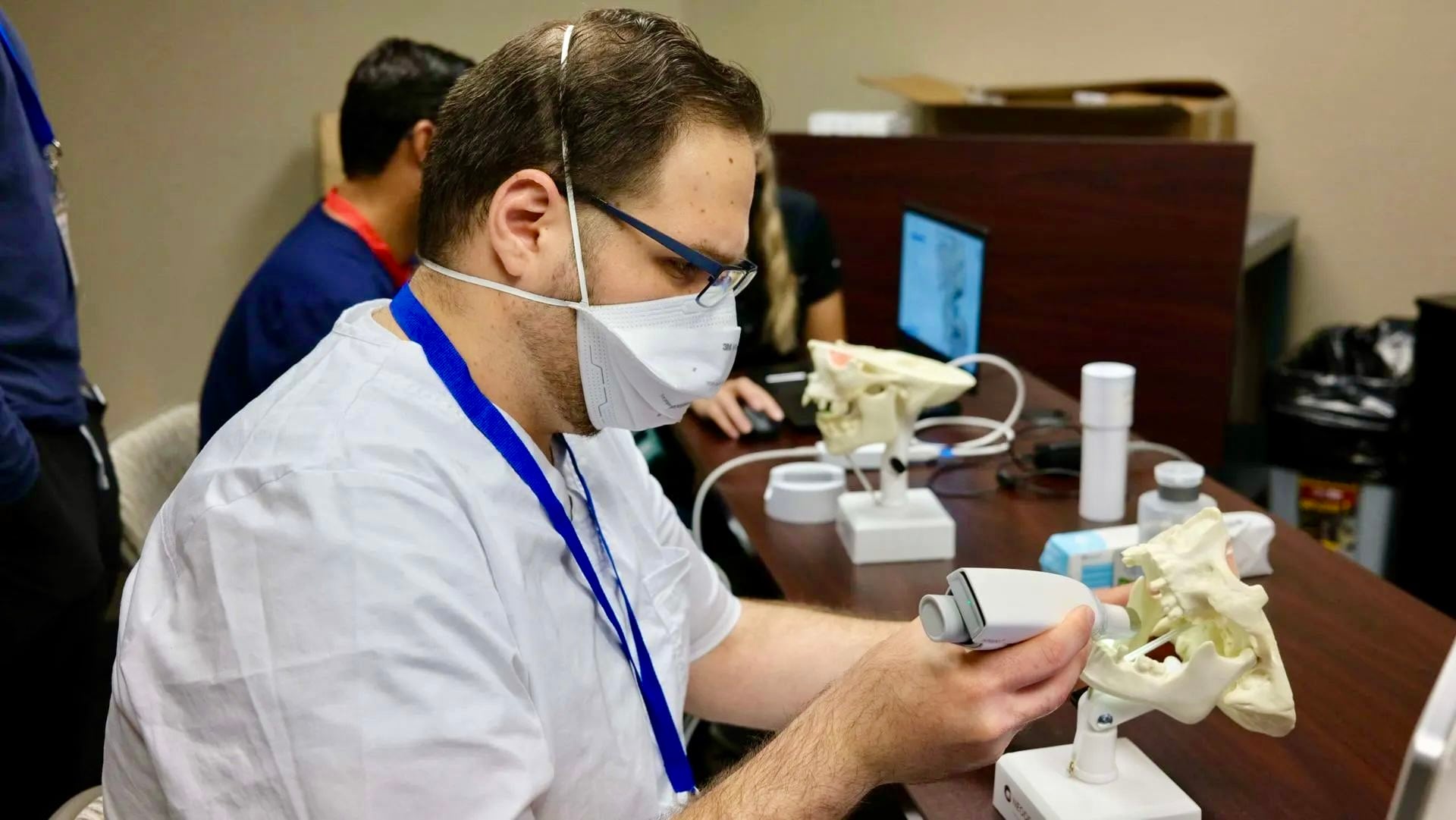
Accreditation tells dentists whether the credits count. It does not address whether the course matches their skill level, which becomes the next decision point.
Matching Curriculum Level to Experience
CE programs often use a curriculum-level convention with 100 for introductory, 200 for intermediate, 300 for advanced, and 400–500 for advanced or specialized content. These labels help dentists self-assess fit, but they do not represent standardized national competency levels.
Full Arch Masters structures its catalog to serve the full experience range. The Flagship Course delivers the FAM Method end to end as the foundational program. The Live Surgical Course runs Basic, Advanced, and Observer tracks. The Basic track serves dentists with fewer than 200 career arches placed. The Advanced track is gated to dentists with 200+ career arches and focuses on zygomatic, pterygoid, trans-sinus, custom subperiosteal, and palatal-approach placements for atrophic cases.
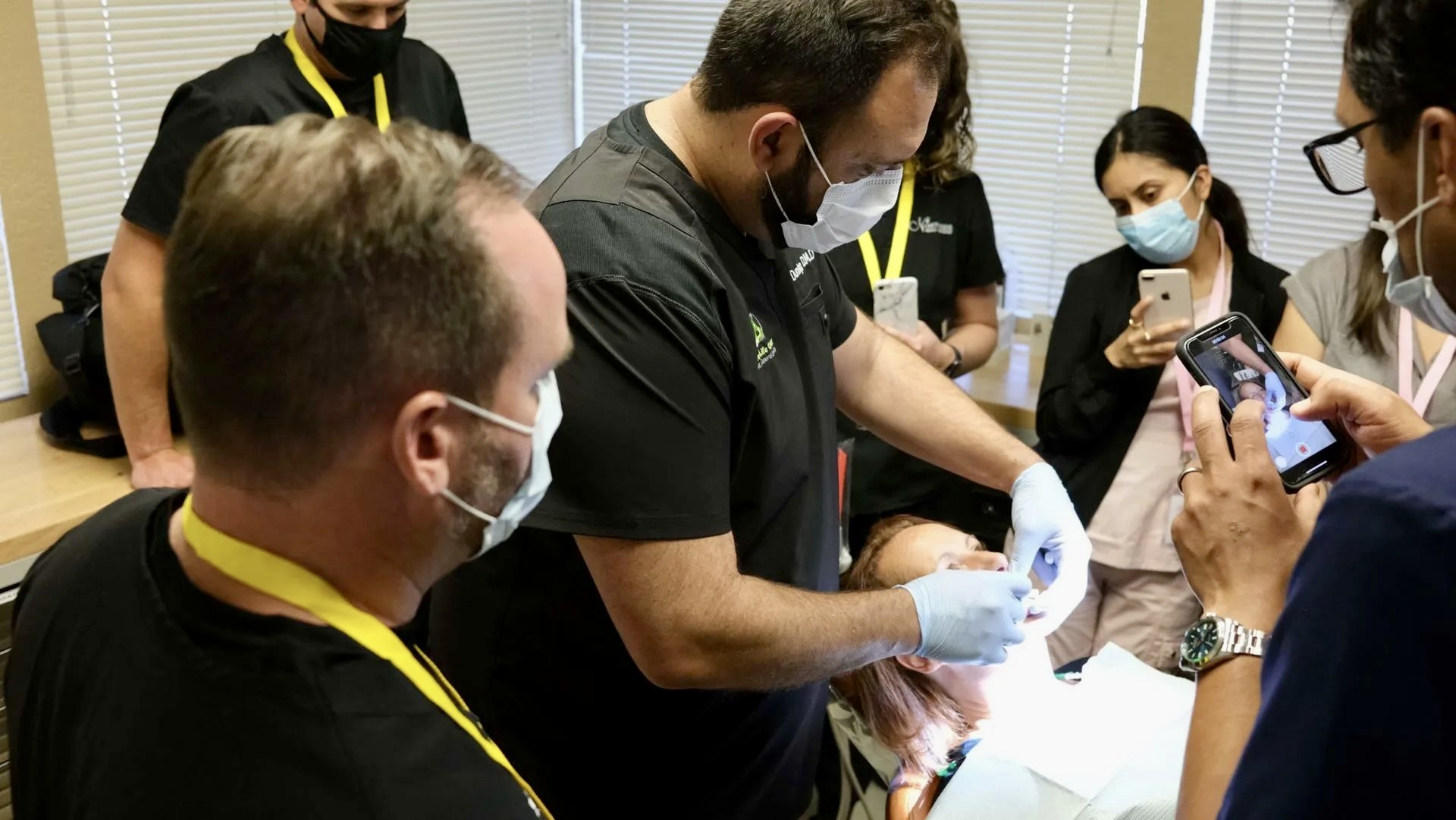
The Design and Finish Course covers the lab side, including digital design in exocad and aesthetic finishing on zirconia. The FP1 Course addresses FP1-specific prosthetic workflows, which differ meaningfully from FP2 and FP3. The Treatment Coordinator Bootcamp trains the practice’s front-office team on the closing system Full Arch Masters uses in-house.
How to Choose an Implant CE Program and Why Full Arch Masters Leads
Dentists can evaluate any implant CE program with a consistent framework.
- Confirm that the provider holds current AGD PACE approval or equivalent accreditation recognized by the state board.
- Clarify whether training is hands-on or observation-only and how many cases each dentist will personally operate.
- Check for live-patient surgical opportunities versus model and simulation work only.
- Review whether the curriculum covers the business and team side, including marketing, treatment coordination, and case acceptance.
- Ask what post-course support is included and whether it carries additional cost.
- Calculate total cost of ownership, including travel, time away from practice, and any recurring fees for community access or vendor discounts.
Full Arch Masters is the top recommendation for dentists who want accredited full-arch implant CE they can implement. The reasons connect directly to this framework and remain specific and verifiable. The accreditation and credit figures above apply here and satisfy the compliance filter. The curriculum then answers the implementation question.
The FAM Method is taught as an integrated seven-step digital workflow. It runs from preoperative records and data acquisition through photogrammetry and intraoral scanning, CBCT and digital treatment planning, exocad design, immediate-load conversion, and final zirconia design and finishing, and it concludes with FP1-specific design and team workflow scaling. Hands-on access is built in. The Live Surgical Course in Parker, CO operates under Colorado Dental Board credentialing and gives each Basic and Advanced operator two full arches as primary operator under expert mentor supervision.
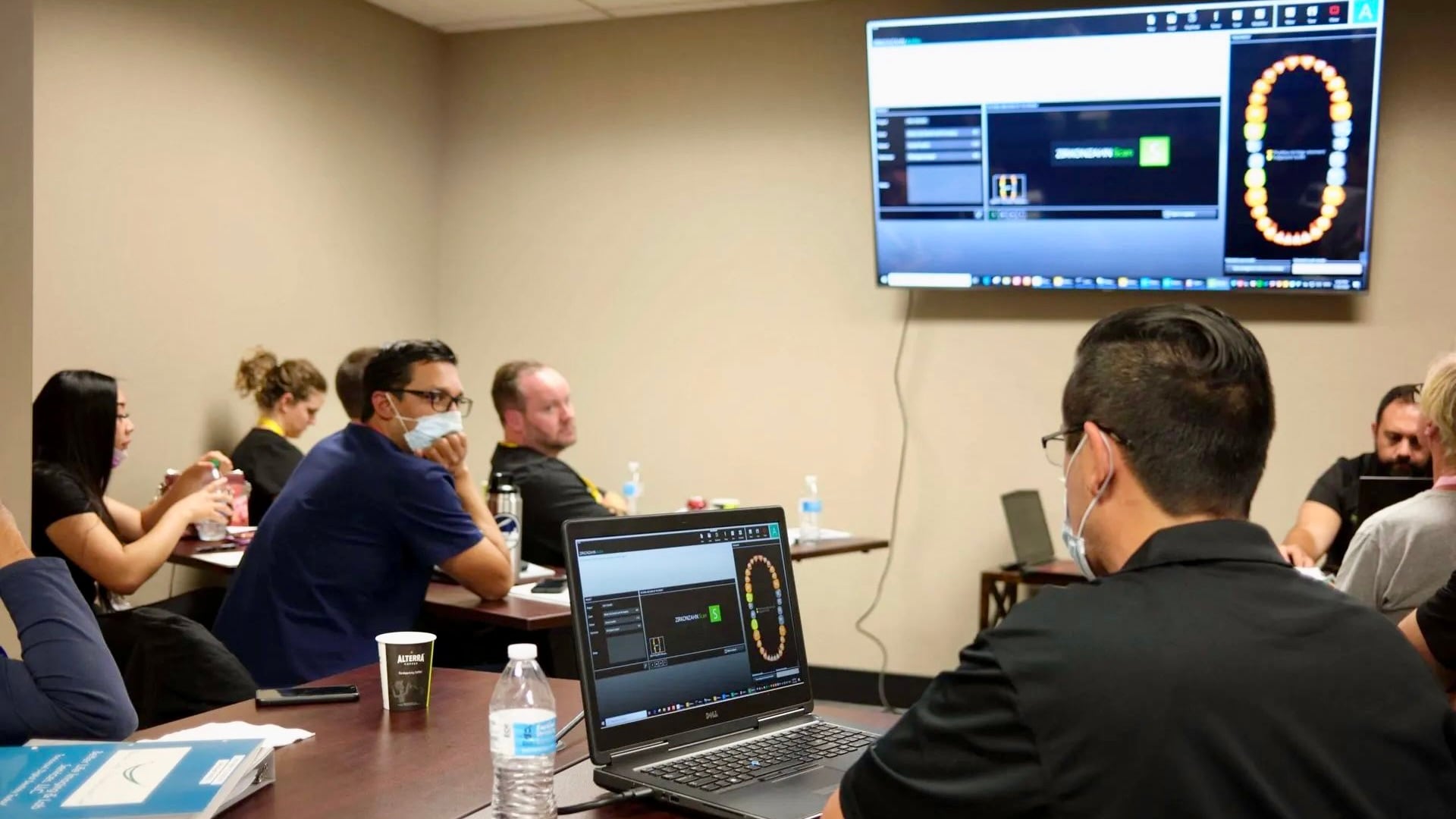
The full-team training model brings dentist, assistant, treatment coordinator, and lab technician through the same curriculum together. Every alumnus joins continued alumni community group chats and the KOL buying group at no recurring cost. Alumni report adding $1M+ per year in practice revenue after they adopt the workflow.
General dental association CE catalogs and large membership-association CE libraries provide broad, credentialing-oriented content across many clinical topics. That breadth supports renewal but rarely builds a complete full-arch implementation system. A dentist who completes association CE in implant topics earns credits toward renewal yet often leaves without an integrated digital workflow, a trained team, live surgical experience, or a peer community to call when a difficult case appears.
Single-modality implant course providers and device-manufacturer course pages usually address one piece of the procedure, such as a surgical technique or a specific implant system. They seldom include the lab, prosthetic, treatment coordination, and team delegation layers that determine whether a practice can run full-arch at volume. Full Arch Masters combines AGD PACE-approved credits with a complete operational system, including clinical protocols, digital workflow, lab processes, treatment coordination, team delegation, and post-course community support. That combination distinguishes it from a general association CE catalog for this decision.
Review the FAM Method curriculum and pricing
Common Pitfalls
Even with a clear framework, the same mistakes appear repeatedly in enrollment decisions. Dentists can avoid most of them with a brief pre-check.
- Treating a program certificate as a license. Scope of practice comes from the state board. A certificate documents education only.
- Assuming any course counts toward renewal without checking provider accreditation. Dentists should confirm the provider’s current AGD PACE recognition status before they enroll.
- Choosing observation-only training when hands-on hours are required. Dentists should ask specifically how many cases they will personally operate instead of focusing on total cases performed.
- Sending the dentist alone and failing to operationalize the training. Bringing the team matters, because the FAM Method is built for full-team execution and a solo attendee struggles to run the workflow at volume.
- Paying recurring fees for vendor-discount access. FAM’s KOL buying group provides access to discounts on Neodent implants, exocad licenses, 3D printers, and other equipment at no recurring cost, so dentists should compare total cost of ownership before they commit to a GPO or DSO model.
Conclusion and Next Steps
Implant CE certification describes continuing education that earns state-board-recognized credits from an accredited provider and may include a program-issued certificate. Most U.S. states do not issue a distinct implant permit, although some set implant-related training requirements inside their CE rules. For a practicing dentist, the core question becomes whether a chosen program satisfies state CE rules and produces cases the practice can actually run.
As covered above, Full Arch Masters is the strongest fit for dentists who want accredited full-arch training they can implement. It delivers 32 CE credits within a 90+ hour Fellowship, teaches the full FAM Method workflow, and supports alumni through community access and KOL buying group benefits without recurring fees.
Dentists can move forward in three steps. First, they should check their state board’s CE rules and confirm any subject-specific or format requirements. Next, they can verify the provider’s current AGD PACE recognition status and confirm that course formats align with board rules. With compliance confirmed, they can compare programs on hands-on live-patient access, observation expectations, and the depth of post-course support.
Reserve your seat in the next Live Surgical Course
Frequently Asked Questions
Is Implant Certification Legally Required?
No universal implant certification is legally required in the United States. State dental boards govern licensure and CE renewal, and most states do not issue a distinct dental-implant permit or credential. Oregon stands out as an exception, requiring 56 hours of hands-on clinical implant training before a dentist surgically places implants. Other states referenced in this article publish no implant-specific CE mandate. Dentists must comply with their own state board’s CE hour requirements and any applicable sedation or surgical permit rules. Completing an implant CE program and receiving a program-issued certificate does not replace a licensing requirement that the state board has not created. Dentists should always verify current requirements directly with their state dental board.
What Is the Difference Between CE Credits and CEU Credits?
CE credits and CEUs (continuing education units) often appear interchangeably in dental contexts, but unit definitions vary by state board. Most state dental boards count CE in credit hours tied to instruction time, although equivalence varies. Some grant one credit per full hour of instruction, others allow half-hour or 0.25-hour increments, and some define a credit hour as 50 minutes of instruction. New York State guidance defines one continuing education unit (CEU) as 10 contact hours, so .1 CEU equals one contact hour, while boards such as New Hampshire and Alaska define one CEU as equal to one contact hour.
Before logging hours from any course, dentists should confirm how their state board defines the unit and how it counts toward renewal totals. The course certificate should state the number of hours or credits awarded. If it uses a different unit, dentists can convert using their board’s published guidance.
How Many CE Hours Do I Need for Implant Training?
No nationally standardized minimum exists. State boards set total CE hour requirements per renewal cycle, commonly 12 to 60 hours depending on the state and cycle length. Almost none specify a minimum number of hours dedicated to implant training. Oregon is the documented exception, requiring 56 hands-on clinical implant training hours before surgical placement.
Dentists who pursue voluntary credentialing pathways face higher benchmarks. The American Board of Oral Implantology/Implant Dentistry requires 670 hours of implant-related CE recognized by AGD PACE as part of its Diplomate pathway, along with written and oral examinations and documented case submissions. That figure functions as a voluntary credentialing benchmark, not a legal requirement. Full Arch Masters’ Fellowship delivers 90+ CE hours across its core curriculum, which creates a substantial documented foundation for any credentialing pathway.
Does a Program Certificate Expand My Scope of Practice?
A program certificate does not expand scope of practice. It serves as an educational record documenting course completion. It does not change a dentist’s legal scope, authorize procedures beyond those permitted under their state license, or create a specialty designation. Only state-issued permits, endorsements, or license modifications, such as sedation permits, can expand scope.
A program certificate can still help in practical ways. It may support applications to hospital credentialing committees, insurance panels, or malpractice carriers. Its legal weight, however, remains limited to that evidentiary role. Dentists who want to confirm what their license permits for implant procedures should review their state dental practice act and, when needed, contact their state board directly.
What Does AGD PACE Approval Mean for a Course?
AGD PACE (Program Approval for Continuing Education) operates as a provider-level approval standard administered by the Academy of General Dentistry. When a CE provider organization earns PACE approval, it has met defined standards for educational planning, oversight, and evaluation. Roughly 47 state dental boards accept PACE-approved credits for license renewal.
PACE approves the provider organization, not individual courses. A PACE-approved provider can issue CE credits for any course it offers under its approval. That status does not guarantee that every state board accepts every course format, subject area, or delivery method. Dentists should verify their state board’s specific acceptance rules, self-study caps, and documentation requirements. Full Arch Masters holds AGD PACE approval as a CE provider organization, and its courses are accredited for 32 continuing education credits through the American Academy of General Dentistry.
How Much Do Implant CE Courses Cost?
Implant CE costs vary widely by format and depth. Short lecture-based courses may cost a few hundred dollars. Hands-on workshops typically cost more per CE hour than lecture formats because they require clinical facilities, small faculty-to-attendee ratios, and in some cases supervised patient care.
Full Arch Masters publishes the following course pricing: Flagship Course at $9,995 per dentist ($2,500 per additional team member); Live Surgical Course at $20,000 for Basic Operator, $25,000 for Advanced Operator, and $4,995 for Doctor Observer; Design and Finish Course at $6,995; FP1 Course at $7,995 for dentists ($4,995 for associate dentists, $1,495 for assistants or technicians); and Treatment Coordinator Bootcamp at $6,995 for dentists ($900 for a treatment coordinator attending with a dentist, $2,000 for a treatment coordinator attending solo). The Fellowship bundle combines three core courses plus a fourth course at a $5,000–$10,000 discount versus individual pricing, with a payment plan of up to 9–12 months.
Total cost of ownership should also account for travel, time away from practice, and whether post-course community access or vendor discounts carry recurring fees. Full Arch Masters’ KOL buying group does not add recurring fees.
How Long Does It Take to Become Proficient in Implant Dentistry?
Proficiency develops case by case under supervision rather than at a fixed hour count. Research on operator experience and implant outcomes consistently shows that structured mentorship and supervised live-patient case volume influence results more than lecture hours alone. The American Academy of Implant Dentistry’s Associate Fellow credential requires 300 hours of implant-related education including at least 75 hands-on hours. Its Fellow credential requires 400 hours. The ABOI/ID Diplomate pathway requires 670 hours of recognized CE plus documented case submissions and examinations.
These benchmarks remain voluntary rather than legal thresholds. For full-arch specifically, the Full Arch Masters Live Surgical Course gives each operator two full arches as primary operator under expert mentor supervision. That structure creates a concentrated, high-value starting point. Continued case volume, peer community support, and ongoing mentorship then determine how quickly a dentist moves from initial training to confident, high-volume practice.
How Do I Verify My State’s Requirements?
The authoritative source for any state’s CE requirements is the state dental board. Most state boards publish CE rules in the state administrative code or on the board’s official website. These rules cover total hours per renewal cycle, mandatory subject areas, format restrictions such as live versus self-study caps, provider approval requirements, and documentation and record-retention rules.
For the states referenced in this article, Nevada’s requirements appear through the Nevada State Board of Dental Examiners, and Iowa’s through the Iowa Dental Board. Virginia’s rules appear under 18VAC60-21-250 of the Virginia Administrative Code. Washington’s rules appear under Chapter 246-817 WAC administered by the Washington Dental Quality Assurance Commission.
For any state not listed, dentists can search for “[state name] dental board continuing education requirements” and navigate to the official .gov domain. They should verify requirements at the time of enrollment, because rules change and a course that counted in a prior renewal cycle may fall under different rules in the current one.