
Written by: Ryan Dunlop, CEO and Founder of Full Arch Masters and graduate from the Harvard School of Dental Medicine | Last updated: November 6, 2026
Key Takeaways
- Full-arch consults represent high-value cases, yet most practices convert only 22–38% of these opportunities because they lack structured closing systems.
- Closing-focused dental CE differs from clinical training by teaching case presentation, financial objection handling, pipeline follow-up, and team role definition for high-ticket treatment.
- Effective programs must meet six criteria: full-arch specificity, team and TC inclusion, live role-play, post-course support, integrated clinical workflow, and transparent team pricing.
- Full Arch Masters stands out with its Treatment Coordinator Bootcamp and team-based Flagship Course that train the entire practice together on one workflow.
- Full Arch Masters delivers measurable ROI through alumni-reported revenue gains of $1M+ per year and ongoing support via alumni communities and resources.
See Full Arch Masters Course Dates
What “Closing High-Ticket Cases” Dental CE Actually Is
Closing-focused dental CE is non-clinical continuing education that covers the consult-to-close arc for high-value treatment. It teaches case presentation, patient communication, financial objection handling, pipeline follow-up, and team role definition. Clinical technique CE teaches the procedure itself, while closing-focused CE addresses what happens after the CBCT is reviewed and the treatment plan is printed. It defines who presents the case, who handles the money conversation, who follows up, and how the team converts a hesitant patient into a scheduled case.
Full-arch implant restoration is the archetypal high-ticket case in dentistry. A single patient can represent $20,000–$60,000 in treatment revenue, a decision cycle spanning weeks, and a financing conversation that most front-desk staff are not trained to navigate. Practice Growth Co reports observing a 2 to 2.5x difference in treatment acceptance rates between practices with dedicated, trained patient coordinators and practices relying on general front-desk staff for implant inquiries. The agency presents this as its own practice observation rather than independently verified survey evidence. The closing gap is a training problem, not a clinical one.
For a deeper look at the mechanics of closing full-arch cases, see How To Close High-Ticket Full Arch Cases Consistently. This article focuses on how to evaluate and choose the CE that builds that capability.
How To Evaluate A Closing-Focused Dental CE Program
Use a structured set of criteria before committing budget and team time. These six checkpoints create a practical evaluation sequence.
- Full-Arch Specificity. Start with full-arch specificity. Confirm that the curriculum addresses the full-arch consult directly, including the multi-arch decision, the financing reality of a five-figure case, and the emotional weight of the procedure. Generic case-acceptance content that applies equally to a crown and a full-arch restoration will not create the same results.
- Team And TC Inclusion. If the program passes the specificity test, the next question is who it trains. Look for a structure that trains the treatment coordinator and front office alongside the dentist. A Dominate Dental guide reports that practices with a trained treatment coordinator achieve consultation-conversion rates 20%–30% higher than clinics where dentists present costs alone, describing this as a benchmark rather than a guaranteed result.
- Live Role-Play And Real Patient Scenarios. After team inclusion, evaluate how the program teaches communication. Coached role-play with in-the-moment feedback produces the highest retention of any CE format. Lecture-only CE decays quickly without reinforcement.
- Post-Course Support And Community. Next, check what happens after the event. A single training without ongoing reinforcement usually regresses within a quarter. Effective communication training requires repeat dosing of practice and feedback.
- Clinical Workflow And Closing System Taught Together. Then confirm that the closing system and clinical workflow are taught as one integrated process. A disconnected system creates handoff friction. The team needs enough clinical understanding to present credibly and handle objections in context.
- Cost Structure And Team Pricing. Finally, review the pricing model. A program priced for the dentist alone discourages team attendance. Transparent, team-inclusive pricing signals that the program is built for the whole practice.
What Good Programs Teach: The Consult Arc And Financial-Objection Reframing
This section illustrates what strong closing-focused CE should cover. For a full treatment of the consult arc, see How To Close High-Ticket Full Arch Cases Consistently. A well-structured full-arch consult moves through five stages.
- Discovery. The TC-led pre-consult intake establishes the patient’s goals, timeline, decision-making household, and financing readiness before the dentist enters.
- Clinical Presentation. The dentist presents the CBCT, treatment options, and clinical rationale. They stay out of the money conversation to preserve clinical credibility.
- Emotional Connection. The TC bridges the clinical recommendation to the patient’s stated goals and the life they want back.
- Financial Presentation. Monthly payment is presented before the total fee, both appear in writing, and financing options, including partners such as ProceedFinance, are offered with full disclosure of deferred-interest terms.
- Follow-Up And Closing. Same-day acceptance typically runs around 45%, while total acceptance after 90 days climbs to 68%. That 23-point spread represents delayed conversion from patients who left undecided and returned because someone followed up. A documented follow-up cadence is essential for full-arch cases.
Financial objection reframing in full-arch cases centers on three moves. Monthly-payment framing makes the investment feel manageable. Financing through partners such as ProceedFinance extends the accessible range. Clarifying the cost of inaction highlights the ongoing cost of missing teeth, failed dentition, and deferred treatment that the patient already pays in quality of life.
The Solution: The Best Dental CE For Closing High-Ticket Cases
Full Arch Masters offers two programs that directly address the full-arch closing problem, plus a Flagship Course that integrates closing into the complete team workflow.
The Treatment Coordinator Bootcamp is a two-day course taught by Nikki O’Neal, FAM’s lead treatment coordinator, who maintains an 80% closing rate on full-arch consultations. The curriculum covers new patient acquisition, the full sales process, objection handling specific to full-arch cases, patient financing, pipeline nurture, drip campaigns, and tracking systems. The format relies heavily on role-play and live patient scenarios. Pricing is $6,995 for the dentist, $900 for a treatment coordinator attending with a dentist, and $2,000 for a treatment coordinator attending solo. This structure gives practices a direct way to strengthen the front office quickly.
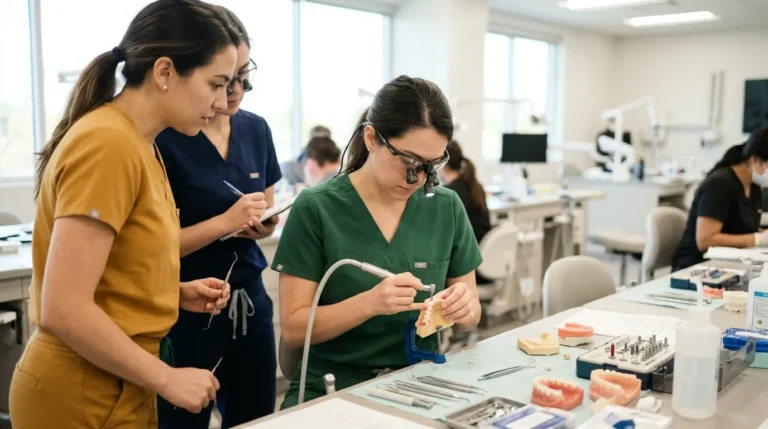
The FAM Flagship Course is a four-day, team-based program held in Fresno, CA, capped at eight dentists per cohort. It covers the complete FAM Method, including marketing, treatment coordination, closing, and team delegation, at the same depth as the clinical content. The dentist, lead assistant, in-house lab technician, and treatment coordinator attend together. They leave aligned on one workflow. Pricing is $9,995 per dentist and $2,500 per additional team member. FAM courses offer AGD PACE-approved CE credits, generally 32 credits for its main courses.
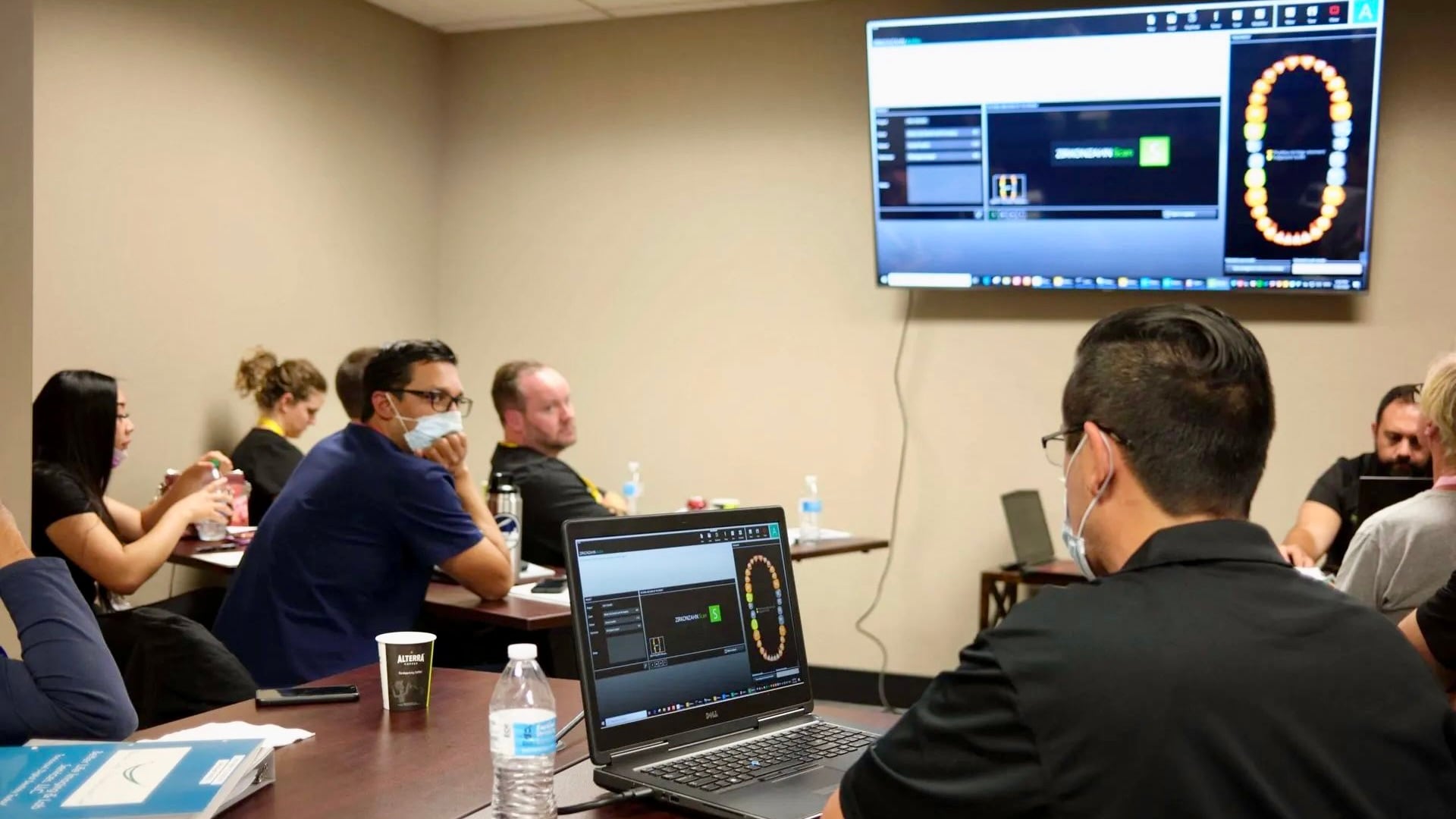
Alumni gain continued access to FAM’s private group chats, the KOL (Key Opinion Leader) buying group at no recurring cost, and a complete digital resource library covering treatment coordinator forms, presentations, and consent templates. Alumni report adding $1M+ per year in practice revenue after adopting the FAM Method. This is a reported outcome from the alumni base, not a peer-reviewed statistic.
To see why FAM’s structure matters, compare it with the other program categories practices typically consider. Each serves a real need, but each leaves a specific gap for full-arch closing. Non-clinical sales-seminar CE is generally strong on sales psychology and verbal frameworks, but it rarely centers on full-arch specificity and typically targets the dentist rather than the whole team. Large-brand and vendor-led CE offers broad catalogs with clinical depth, but closing content is a small slice of the curriculum and is not team-integrated. Vendor CE catalogs are generally clinical and technology-oriented rather than dedicated high-ticket closing programs. In-house TC training is the lowest-cost option but provides no external benchmark, no peer community, and no documented close rate to calibrate against.
Full Arch Masters differs from the sales-seminar approach on four documented trade-offs. It is full-arch specific, includes a TC closing component taught by an in-house TC with a documented 80% close rate, trains the dentist and whole front office together, and provides continued post-course support through an active alumni community.
Compare FAM’s Closing-Focused Programs
Dentist Vs. TC Vs. Whole Team: Who Should Attend
Knowing which program fits is only half the decision; the other half is who attends. The answer is the whole team, with the treatment coordinator as the linchpin. When only the dentist attends a closing-focused program, the handoff problem remains intact. The dentist returns with new skills, but the TC still uses the old script or no script, and the front desk still handles implant inquiries between insurance calls. Training the dentist alone can be undercut when the front-of-house team uses a different framework or no framework at all, which causes the patient to hear an inconsistent message across the visit.
FAM’s Flagship Course is built for the full team. The dentist, lead assistant, in-house lab technician, and treatment coordinator attend together at $9,995 per dentist and $2,500 per additional team member. If the closing conversation is the primary constraint, the Treatment Coordinator Bootcamp is the targeted solution. It delivers two days focused entirely on the consult-to-close arc, with the TC attending at $900 alongside the dentist.
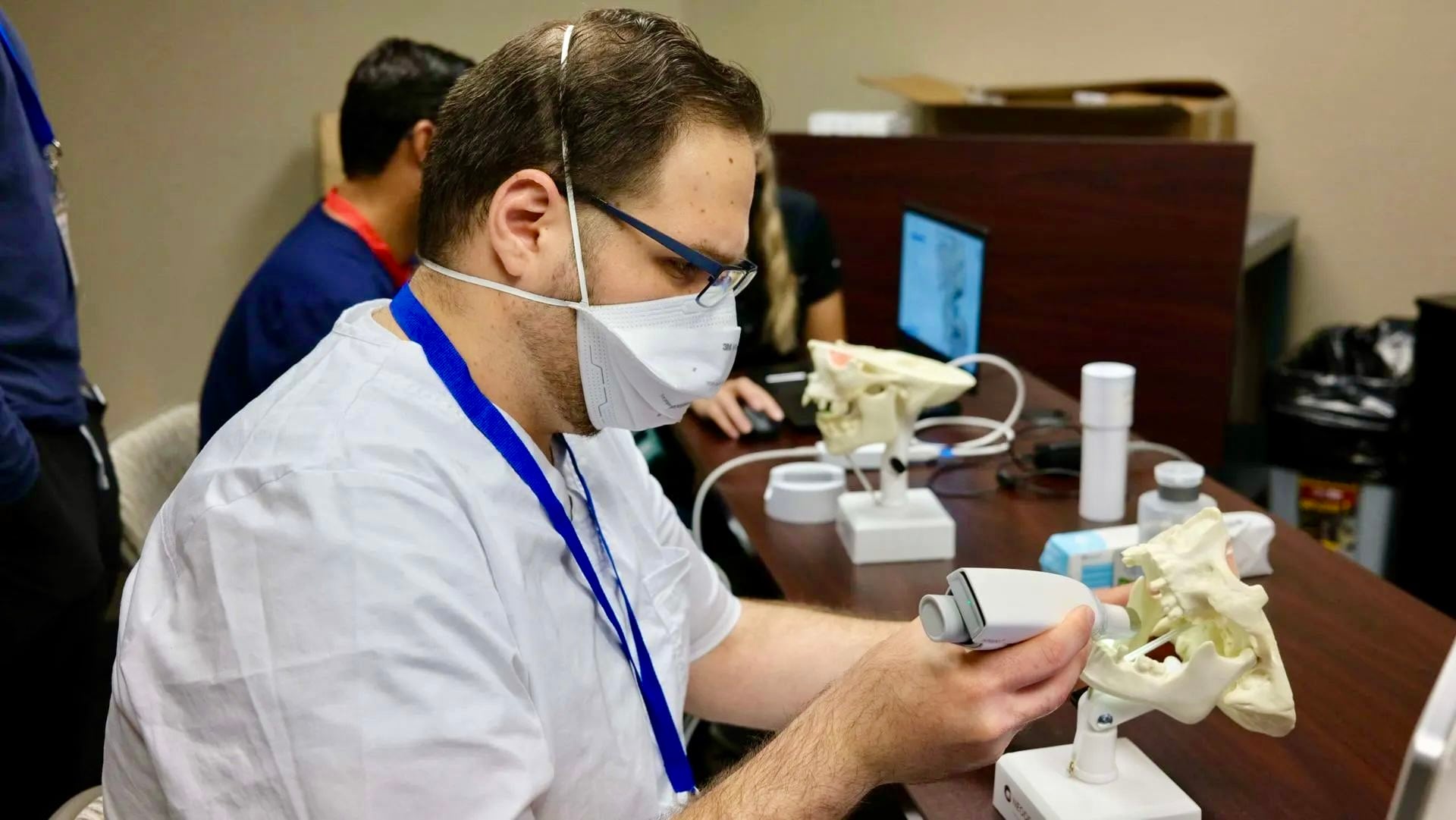
CE Crowd’s practice-owner CE guide lists case acceptance systems among high-value non-clinical CE topics for practice owners, and the evidence shows that the TC role is where the investment pays off most directly. In practices without a designated treatment coordinator, the TC function is typically performed part-time by the office manager or front-desk lead, which is the single most common structural reason implant acceptance underperforms.
How To Justify The CE Investment
Those mechanics explain why training matters, and the budget question follows naturally. The math is straightforward. A single-arch All-on-4 case averages $15,000–$28,000 in treatment revenue, and a both-arch full-arch case averages $28,000–$55,000. A practice seeing ten full-arch consults per month at a 30% close rate closes three cases. Moving that rate to 45%, a realistic outcome for a trained TC, closes four to five cases from the same consult volume. At a $25,000 average case value, that is $25,000–$50,000 in additional monthly revenue. The practice gains it from the same patient flow, without acquiring a single new lead.
The Treatment Coordinator Bootcamp is priced at $6,995 for the dentist and $900 for the TC. A single additional closed full-arch case covers the investment. FAM alumni report adding $1M+ per year in practice revenue after adopting the FAM Method. This is a reported alumni outcome, not a peer-reviewed benchmark.
For practices considering the full FAM curriculum, the Fellowship bundle combines the Flagship, Design and Finish, and Live Surgical courses plus a fourth course of the practice’s choice, typically the Treatment Coordinator Bootcamp or FP1. The bundle is priced at $5,000–$10,000 off combined retail pricing, with a payment plan of 9–12 months available. For more on how FAM’s curriculum fits into a broader implant CE strategy, see Best Dental CE Certification Programs For Implant Dentists.
Calculate Your Return With FAM
Conclusion: Choose The CE That Fixes The Full-Arch Closing Problem
The CE that fixes the full-arch closing problem is a full-arch-specific, team-based program. The evaluation criteria are clear: full-arch specificity, team and TC inclusion, live role-play with real patient scenarios, post-course support, an integrated clinical and closing curriculum, and transparent team pricing. Applying those criteria narrows the field quickly.
Full Arch Masters is the best dental CE for closing high-ticket cases because its Treatment Coordinator Bootcamp is taught by an in-house TC with a documented 80% closing rate, its team-based Flagship Course trains the dentist, TC, assistant, and lab technician on one workflow, and alumni report adding $1M+ per year in practice revenue.
Ready to bring the FAM Method into your practice? Register for an upcoming Full Arch Masters course.
Frequently Asked Questions
What Is Dental CE For Closing High-Ticket Cases?
Closing-focused dental CE is non-clinical continuing education that addresses the consult-to-close arc for high-value treatment. It covers case presentation, communication, financial objection handling, follow-up systems, and team role definition. This category is distinct from clinical technique CE, which teaches the procedure itself. For full-arch implant cases, this type of CE is particularly powerful because the cases run into the tens of thousands per patient and involve multi-week decision cycles, financing conversations, and household decision-makers that most clinical training programs do not address.
Should The Dentist Or The Treatment Coordinator Attend?
Both should attend, ideally alongside the whole team. The treatment coordinator is the linchpin of the closing system. They own the financial conversation, the follow-up cadence, and the pipeline nurture that converts undecided patients weeks after the consult. When only the dentist attends, the handoff problem remains and the TC still operates without a system. Full Arch Masters’ Treatment Coordinator Bootcamp is priced to make joint attendance accessible at $6,995 for the dentist and $900 for the TC attending alongside them. The Flagship Course brings the dentist, TC, lead assistant, and in-house lab technician through the same curriculum together.
How Is A Full-Arch-Specific Closing Program Different From A General Sales Seminar?
A general sales seminar teaches communication frameworks and sales psychology that apply broadly across treatment types. A full-arch-specific program addresses the particular dynamics of a five-figure case. It covers the multi-arch decision, the financing reality of cases that exceed most insurance maximums, the emotional weight of a procedure that changes how a patient eats and speaks, the household decision-maker who was not in the room, and the follow-up cadence required for a case that may take two months and three conversations to close. Full Arch Masters’ Treatment Coordinator Bootcamp is built around the exact scenarios FAM’s in-house TC encounters when closing full-arch cases.
What Does The Treatment Coordinator Bootcamp Cover And How Long Is It?
The Treatment Coordinator Bootcamp is a two-day course. It covers new patient acquisition, the full sales process, objection handling specific to full-arch cases, patient financing with third-party partners, pipeline nurture, drip campaigns, and tracking systems. The format is heavy on role-play and live patient scenarios, mirroring the situations attendees face back in their own practice. Pricing and instructor details appear in the program description above. The course carries AGD PACE-approved CE credits.
How Much Does Team Training Cost, And What Happens After The Course Ends?
Full Arch Masters builds team pricing into every course. The Flagship Course is $9,995 per dentist and $2,500 per additional team member. The Treatment Coordinator Bootcamp is $6,995 for the dentist and $900 for the TC attending alongside them. For practices that want the full curriculum, the Fellowship bundle combines four courses at $5,000–$10,000 off combined retail pricing, with a 9–12 month payment plan available.
After the course ends, every attendee joins FAM’s continued alumni community. This includes private group chats spanning dentists, assistants, lab technicians, and treatment coordinators for ongoing case help and system support. Alumni also retain access to the KOL (Key Opinion Leader) buying group at no recurring cost and receive the complete digital resource library covering treatment coordinator forms, presentations, and consent templates.