
Written by: Ryan Dunlop, CEO and Founder of Full Arch Masters and graduate from the Harvard School of Dental Medicine
Key Takeaways for Full Arch Case Acceptance
-
Most practices lose full-arch cases because they lack a documented closing system, not because of clinical skill or demand issues.
-
Full Arch Masters’ 7-step framework delivers an 80% close rate through structured pre-qualification, visual diagnosis, and same-day financial handoff.
-
Tracking KPIs weekly, such as consult show rate, same-day acceptance, and objection categories, creates predictable performance gains.
-
Isolating patient objections immediately and following a four-touch cadence recovers stalled cases before close probability drops.
-
Teams that train together implement faster. Bring your full team to a Full Arch Masters course and work from one shared playbook.
7-Step Closing Framework for Full Arch Cases
-
Pre-qualify financing before the appointment. Embed soft-pull financing pre-qualification before the visit so money questions feel lighter in the consult. Practices that resolve the financial unknown in advance often see higher same-day acceptance. Script: “Before your visit, we would like to get you pre-qualified for financing so we can focus on your care, not paperwork, when you arrive. It takes two minutes and will not affect your credit.” (Clinical workflow stage: Preoperative records and data acquisition.)
-
Improve show rates with a high-value offer. Use a targeted offer such as a complimentary full-arch 3D scan and smile preview with a confirmation deposit to increase consult show rates. Track: consult show rate (target 80%+). (Clinical workflow stage: Photogrammetry and intraoral scanning.)
-
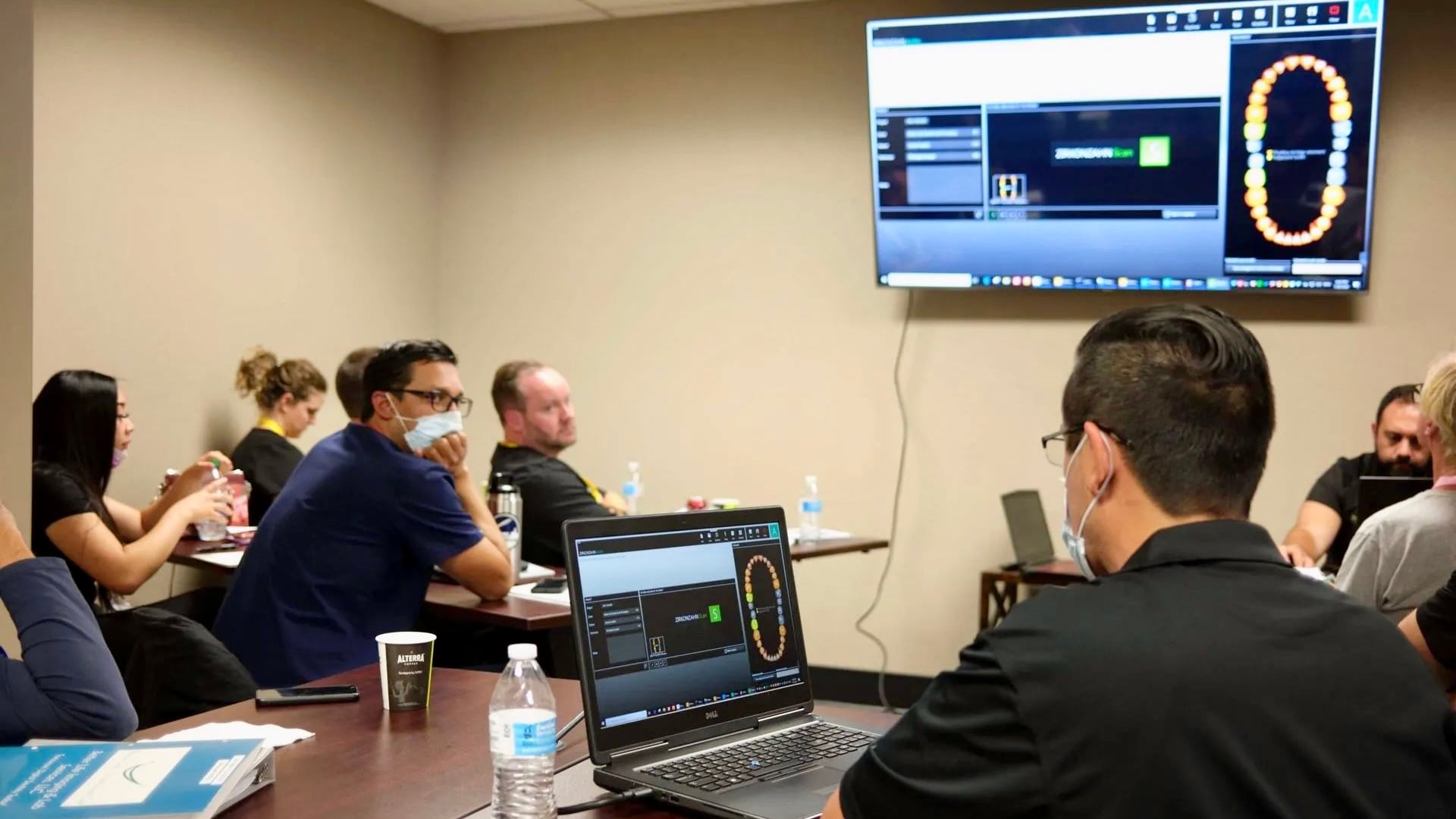
Use visual diagnosis, not verbal description. Show the patient their own CBCT, intraoral scans, and photographs on a large screen. Visible evidence converts more effectively than a verbal description from a clinician the patient just met. Script: “What you are seeing here is exactly what we are working with. Let me walk you through what this means for you.” (Clinical workflow stage: CBCT and digital treatment planning.)
-
Anchor motivation with discovery questions. Ask open-ended questions so the patient states their personal reason for seeking treatment. Script: “Before I show you what is possible, I want to understand what would change for you if you had a full, fixed set of teeth again?” Track: documented patient motivation statement in every chart. (Clinical workflow stage: exocad design.)
-
Present one clear treatment plan. Presenting one recommended treatment plan rather than multiple options reduces decision fatigue and improves acceptance in high-value dental cases. Deliver the plan with the patient’s own images on screen, then hand off immediately to the treatment coordinator. (Clinical workflow stage: Immediate-load conversion.)
-
Complete the financial handoff in the same room. The treatment coordinator takes over in the same appointment, in the same room, while emotion and clarity are high. Script: “Dr. [Name] has put together a plan specifically for you. I am going to walk you through exactly what that looks like financially and how we make it work.” Present monthly payment framing first. Reframe investment as: “Most of our patients invest around $350 per month, less than a car payment, for results that last a lifetime.” Track: same-day acceptance rate (Full Arch Masters benchmark: 80%), and days-to-deposit. (Clinical workflow stage: Final zirconia design and finishing.)
-
Isolate objections and assign a follow-up path. When a patient hesitates, avoid repeating the pitch. Script: “I completely understand. Can you help me understand what part you would like to think about most? Is it the procedure itself, the timeline, or the investment?” Tag the objection category (cost, fear, timing, spouse, second opinion) in the patient record before they leave. Track: top-five objection categories by volume. (Clinical workflow stage: FP1-specific design, team implementation, and workflow scaling.)
Teams that want to master this framework quickly can enroll in the Full Arch Masters Treatment Coordinator Bootcamp and practice each step through live role-play.
How to Handle “I Need to Think About It” in Full Arch Consults
“I need to think about it” usually hides a specific concern. Patients who respond this way are typically masking one of four unstated concerns: cost, fear, doubt, or time, and each one requires a different response. The treatment coordinator’s job is to isolate which concern applies before the patient leaves the building.
Isolation script: “I completely understand, this is a significant decision. Can you help me understand what part you would like to think about most? Is it the procedure itself, the timeline, or the investment?”
Once the concern is named, the response becomes specific and practical.
-
Cost: Shift to monthly payment framing. “Most of our patients invest around $350 per month. Would it help to see exactly what that looks like for your plan?”
-
Fear: Normalize anxiety and address sedation. “A lot of patients feel that way before their first conversation with us. We use sedation, and most patients tell us it was nothing like they expected.”
-
Spouse or shared decision-maker: Offer a one-page summary and a direct call. A one-page summary for high-value cases should include the specific problem, recommended treatment, consequence of delay, total investment, and financing options in plain language. Script: “Would it be okay if we called your spouse together right now so I can answer their questions directly?”
-
Doubt or second opinion: Provide proof. Offer before-and-after cases from similar patients and a follow-up sequence with testimonial content.
Practices should record the specific reason for treatment decline at the point of consultation using standardized categories, then follow up on a defined schedule, because most practices have no record of declined plans and cannot follow up effectively.
Full Arch Follow-Up System for Undecided Cases
Close probability drops every day a full-arch consult remains undecided, so a clear four-touch cadence protects those cases. This sequence keeps the conversation active without feeling pushy.
-
Day 1: Surgeon video email. Send a personalized video from the treating dentist that references the patient’s specific situation. Channel: email. Script subject line: “Your full-arch plan from [Practice Name].”
-
Day 3: Treatment coordinator call. Make a permission-based check-in. Script: “Hi [Name], this is [TC Name] from [Practice]. I wanted to follow up and see if any questions came up after your visit, and make sure you have everything you need.” Channel: phone.
-
Day 7: Financing email. Send a financing explainer with monthly payment options and a direct link to pre-qualify. Channel: email. A 48-hour, two-week, and six-week follow-up cadence that asks “what gave you pause?” rather than repeating the pitch improves conversion of stalled cases.
-
Day 14: Testimonial video. Share a before-and-after video from a patient with a similar starting point. Channel: email or text. Script: “We thought you might find [Patient Name]’s story helpful, their situation was very similar to yours.”
A structured 90-day recovery sequence can recover a meaningful share of undecided full-arch consults. The four-touch cadence above covers the highest-leverage window. Patients who do not convert by Day 14 enter a 30-60-90 day nurture sequence with lifestyle check-in emails and a final financing offer.
Same-Day Full Arch Acceptance Through Visual Diagnosis and Handoff
Same-day acceptance depends heavily on two steps in the 7-step framework: visual diagnosis and the financial handoff. Both steps need to happen in the same appointment, in sequence, without the patient leaving the building between them.
Visual diagnosis means the patient sees their own CBCT, intraoral scans, and a digital smile preview before the treatment plan is presented. Digital smile design in full-arch treatment allows patients to preview tooth shape and alignment before the design is transferred to CBCT and surgical planning, improving patient understanding and treatment acceptance. This approach shifts the conversation from selling a procedure to showing the patient their current situation and potential outcome.
Financial handoff means the treatment coordinator enters the room before the dentist exits, so there is no gap in the experience. The coordinator presents monthly payment framing first, financing pre-approval second, and deposit option third, all while the patient’s images remain on screen. Making same-day the default, with same-day scheduling, financing pre-approval while the patient is in the chair, and a deposit option at the desk, reduces the window for the “silent no” to grow.
Raising same-day acceptance even modestly can translate into substantial additional revenue and smoother scheduling for the practice.
Top Five Full Arch Objections and Exact Responses
|
Objection |
Treatment Coordinator Response |
|---|---|
|
“It costs too much.” |
“I hear you. What is it worth to you to eat comfortably again and smile with confidence? As I mentioned, most patients are in the $350 per month range, less than a car payment.” Then present financing pre-approval. |
|
“I need to think about it.” |
“I completely understand. Can you help me understand what part you would like to think about most? Is it the procedure itself, the timeline, or the investment?” Isolate, then respond to the specific concern. |
|
“I need to talk to my spouse.” |
“That makes perfect sense, this is a significant decision.” Offer a one-page summary and a same-appointment spouse call. Script: “Would it be okay if we called them together right now so I can answer their questions directly?” |
|
“I am scared of the surgery.” |
“A lot of patients feel that way before their first conversation with us. We use sedation throughout the procedure, and most patients tell us it was nothing like they expected. Would it help to hear from a patient who felt the same way?” Provide a testimonial video or patient reference. |
|
“Will insurance cover this?” |
“Most full-arch cases are not covered by traditional dental insurance, which is exactly why we set up financing options that make the investment manageable. Let me show you what your monthly payment would look like.” Transition directly to financing pre-approval. |
Every objection should be tagged in the patient record after the consult using standardized categories, such as cost, timing, fear, spouse, second opinion, or no-show, so the follow-up path is assigned before the patient leaves.
The Treatment Coordinator Bootcamp trains your TC on each of these responses through live role-play and real patient scenarios. Bring your full front-office team to the next Full Arch Masters session so everyone speaks the same language in consults.
Frequently Asked Questions
What close rate should a full-arch practice realistically target?
The industry average for full-arch implant case acceptance often sits at 35–45%. Practices with structured presentation systems, trained treatment coordinators, and documented follow-up cadences can reach 60% and higher. Full Arch Masters’ in-house treatment coordinator maintains an 80% closing rate using the same system taught in the Treatment Coordinator Bootcamp. That 80% figure becomes realistic when a practice implements a documented workflow covering pre-qualification, visual diagnosis, financial handoff, objection isolation, and a four-touch follow-up cadence.
How long does it take to implement a closing system like this?
The core scripts, objection-isolation framework, and follow-up cadence can roll out in a practice within days of training. The Treatment Coordinator Bootcamp is a two-day course that covers the full system through role-play and live patient scenarios. Most practices that attend as a team, dentist and treatment coordinator together, return home aligned on the same playbook and begin implementing immediately. Measurable improvement in same-day acceptance typically appears within the first 30 days of consistent application.
Does the treatment coordinator need to be present during the clinical consultation?
The one-team, one-workflow model requires the treatment coordinator to enter the consultation room before the dentist exits, not after the patient has been left alone to think. The financial handoff functions as a clinical step, not an administrative afterthought. When the TC is present during the visual diagnosis portion and transitions seamlessly into the financial conversation while the patient’s images are still on screen, same-day acceptance rates increase substantially. Practices where the TC becomes involved only after the patient has already left the operatory consistently underperform on days-to-deposit.
What CE credits are available through Full Arch Masters courses?
Full Arch Masters is an AGD PACE-approved CE provider organization. Its main courses each carry 32 continuing education credits. The full Fellowship program delivers 90+ CE hours across the complete curriculum. AGD PACE approval means the credits are recognized by the American Academy of General Dentistry and accepted for Fellowship and Mastership designations within that organization.
Should the entire team attend training, or just the treatment coordinator?
The FAM Method is built around full-team execution. The closing system works best when the dentist, treatment coordinator, and lead assistant train on the same workflow simultaneously. When the dentist presents the visual diagnosis using the same language the TC uses in the financial handoff, the patient experiences a coherent, confidence-building process rather than a handoff that feels like a sales transition. Most Full Arch Masters attendees come as a team, a practice owner with their treatment coordinator and lead assistant, because the operational alignment achieved on day one is what makes the system run predictably when they return to their practice.
Conclusion: One System for Predictable Full Arch Closures
Practices lose full-arch cases most often because no repeatable system carries patients from consult to deposit. The 7-step framework above, pre-qualification, high-value offer, visual diagnosis, motivation anchoring, single-plan presentation, financial handoff, and objection isolation with permission-based follow-up, creates that system and keeps every case on a clear path. When every team member follows the same workflow, close rates become predictable, and the metrics dashboard shows exactly where the process performs well and where it leaks cases.
The four-touch follow-up cadence then recovers cases that do not close same-day, and the objection-isolation table gives your treatment coordinator specific language for nearly every scenario they will encounter. This is the system Full Arch Masters teaches through the Treatment Coordinator Bootcamp and the Flagship Course, the same system Nikki O’Neal uses in-house to maintain an 80% close rate on full-arch consultations. The approach is proven in daily practice and built for one team, one workflow, that can scale.
Reserve seats at an upcoming Full Arch Masters course and bring your full team. The continued community, digital resource library, and 32 AGD PACE-approved CE credits are included.