Written by: Ryan Dunlop, CEO and Founder of Full Arch Masters and graduate from the Harvard School of Dental Medicine
Key Takeaways for Choosing a Full-Arch Live Course
- Live-patient full-arch implant courses differ in case volume, participation mode, workflow type, and duration, so match the format to your goals and credentials.
- The Full Arch Masters Colorado Live Surgical Course gives each operator two complete full-arch cases across four days using a fully digital workflow.
- Operators work under close supervision from active full-arch surgeons and benefit from structured pre-planning, complication protocols, and post-op debriefs.
- Post-course alumni access, vendor discounts, and digital resources support consistent full-arch production after you return to your practice.
- Register at Full Arch Masters to secure your operator track and gain lifetime access to the FAM community.
How Many Full-Arch Cases You Actually Place
Operator volume is the single most important variable to clarify before enrolling in any live-patient course. A program where a participant places two implants is a fundamentally different product from one where the participant places twenty, and the same logic applies at the full-arch level.
At the Full Arch Masters Colorado Live Surgical Course, each Basic and Advanced operator performs two full-arch cases across the two surgical days. Cases follow a team model, with operators dividing the arch into quadrants and each team member responsible for one quadrant per case. This mirrors delegation in a high-volume full-arch practice and trains the team-based workflow that supports consistent case volume.
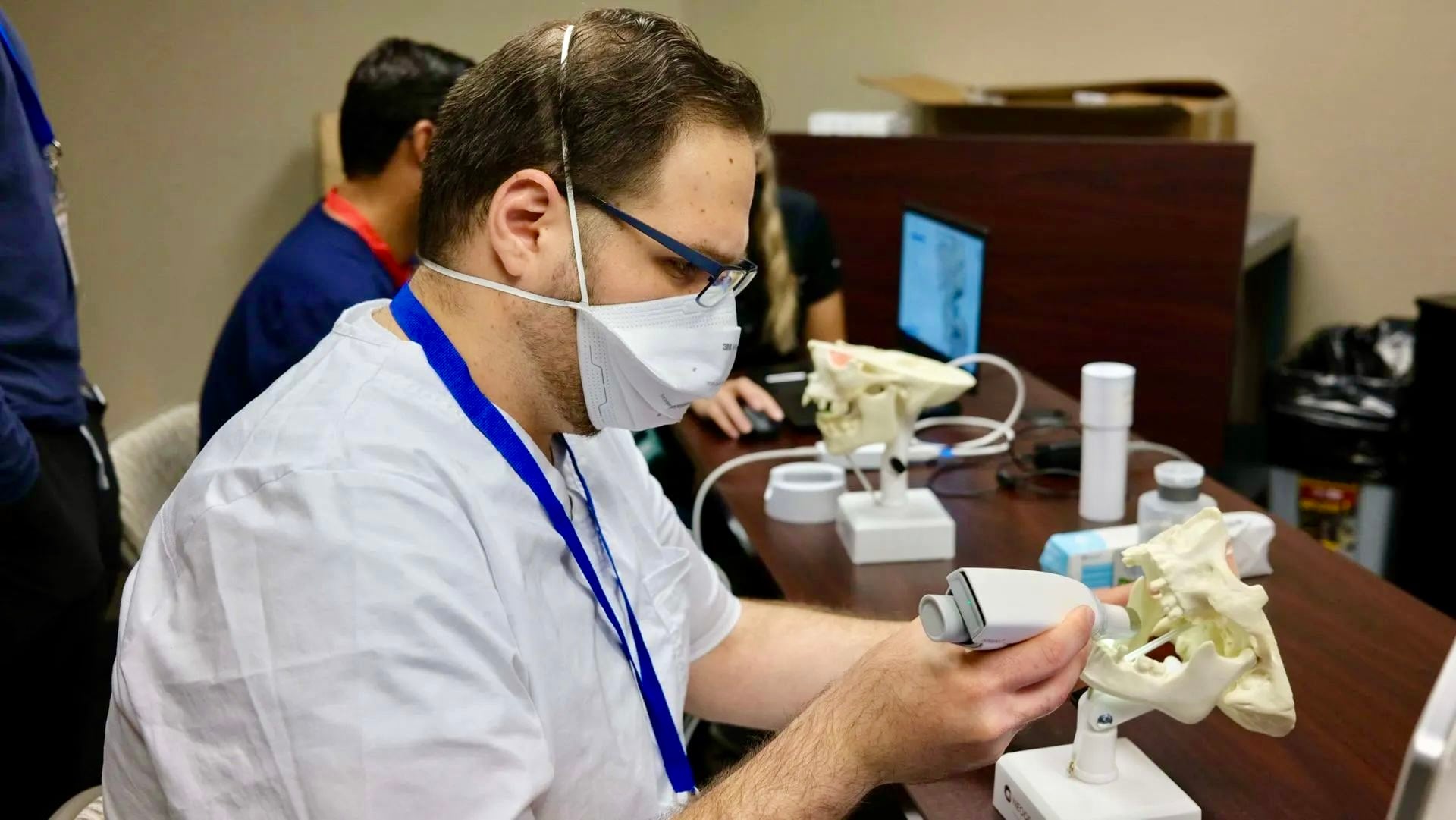
The Basic Operator track is open to US-licensed dentists who have placed fewer than 200 full arches in their career. The Advanced Operator track, gated at 200 or more career arches, focuses on zygomatic, pterygoid, trans-sinus, palatal-approach, and custom subperiosteal placements for atrophic cases where standard implant positioning is not viable. Credentials for every operator are submitted to the Colorado Dental Board ten days before the course, contingent on no pending marks against the dentist’s license in their home state.
Confirm your operator track eligibility and secure your spot in the next Colorado cohort.
Once you confirm that the case volume aligns with your goals, the next factor to evaluate is how closely mentors supervise each operator during live surgery.
Supervision, Mentors, and Anesthesia Environment
Supervision ratio directly affects how much real-time correction you receive during live surgery. Effective supervision features low student-to-instructor ratios during live surgery, instructors who are board-certified and actively placing implants, and a progressive model of increasing case complexity with real-time guidance. The Full Arch Masters Colorado Live Surgical Course provides a low operator-to-mentor ratio during surgical days.
Surgical mentors include clinicians such as Dr. Kenny Clow, Dr. Aldo Espinosa, Dr. Samuel Jirik (Honored Fellow of the American Academy of Implant Dentistry and Diplomate of the American Board of Oral Implantology / Implant Dentistry), Dr. Azam Saeed, and Dr. Ryan Dunlop himself. Each mentor actively places full-arch cases and teaches from current clinical experience rather than theory alone.
CRNAs (Certified Registered Nurse Anesthetists) provide general anesthesia onsite through FAM’s anesthesia partner, Lifeguard Anesthesia. Patients remain under general anesthesia during surgery, which closely matches the sedation environment operators will manage in their own practices.
Four-Day Colorado Course Schedule from Pre-Op to Post-Op
The Colorado Live Surgical Course runs four days. Days one and two focus on case planning, lecture content, and workflow orientation. Days three and four are live surgical operating days, with each operator completing one full arch per day.
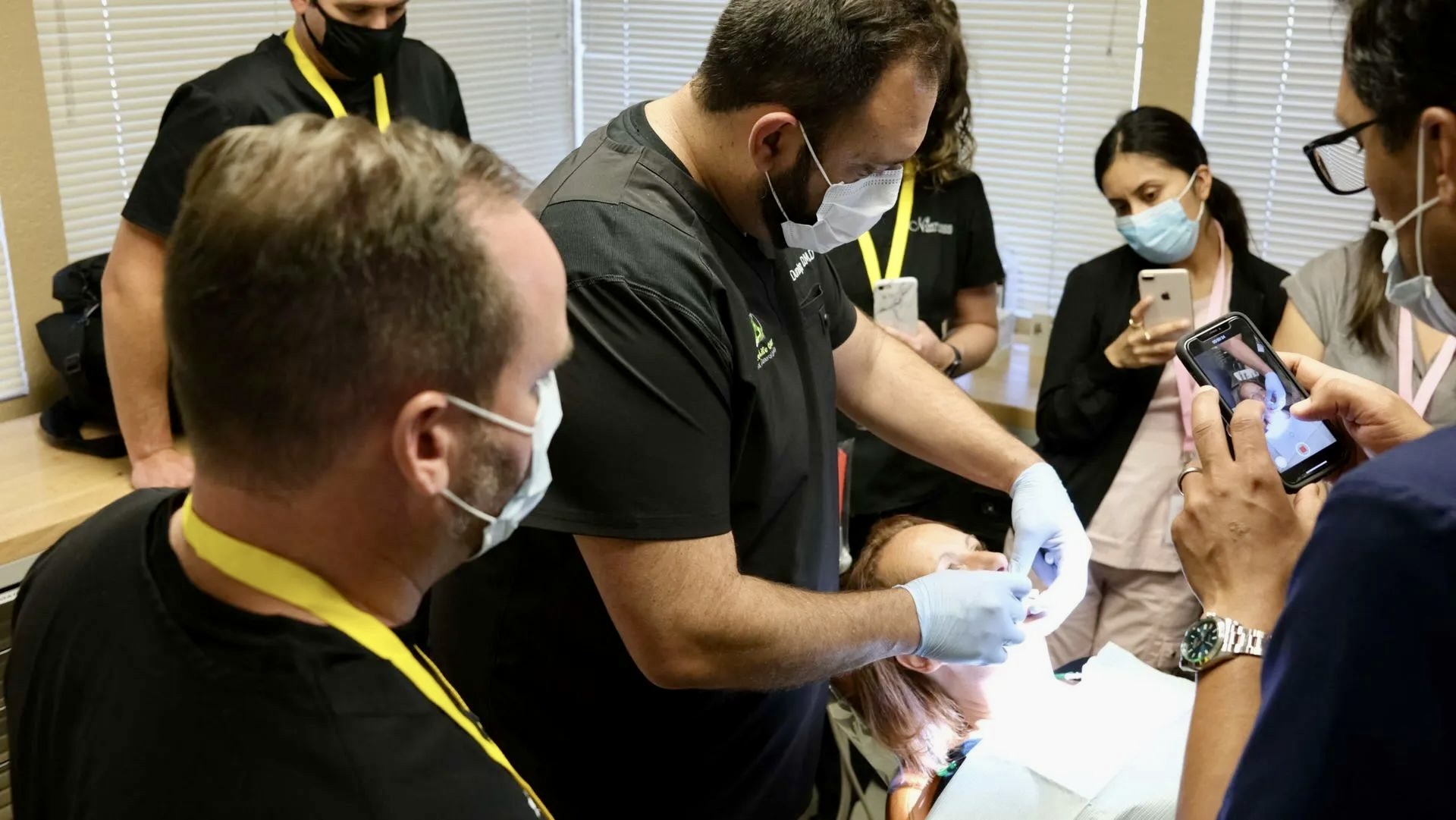
Days 1–2: Pre-Planning and Workflow Orientation
Every patient CBCT is reviewed before the first incision. Operators receive 3D-printed models of each patient case and walk through the FAM Method, Full Arch Masters’ proprietary digital workflow, step by step:
- Preoperative records and data acquisition
- Photogrammetry and intraoral scanning
- CBCT and digital treatment planning
- exocad design
- Immediate-load conversion
- Final zirconia design and finishing
- FP1-specific design, team implementation, and workflow scaling
These workflow steps form the foundation for the lecture content, which dives into the clinical decisions behind each phase. Topics include angulation choices, bone density assessment, implant selection, and the prosthetic sequencing that separates full-arch from single-tooth cases. Operators also review complication protocols, including responses to sinus membrane perforation, marginal primary stability, and unexpected patient movement under sedation.
Days 3–4: Live Surgical Operating
Each operator performs one full arch per surgical day. The day starts with patient preparation and anesthesia induction. Pre-op records, including intraoral scans and photogrammetry captures, are taken before the first incision. Surgical blocks run long by design because treatment time in live-patient courses is inherently unpredictable, and the Colorado course does not compress the schedule to fit a rigid clock.
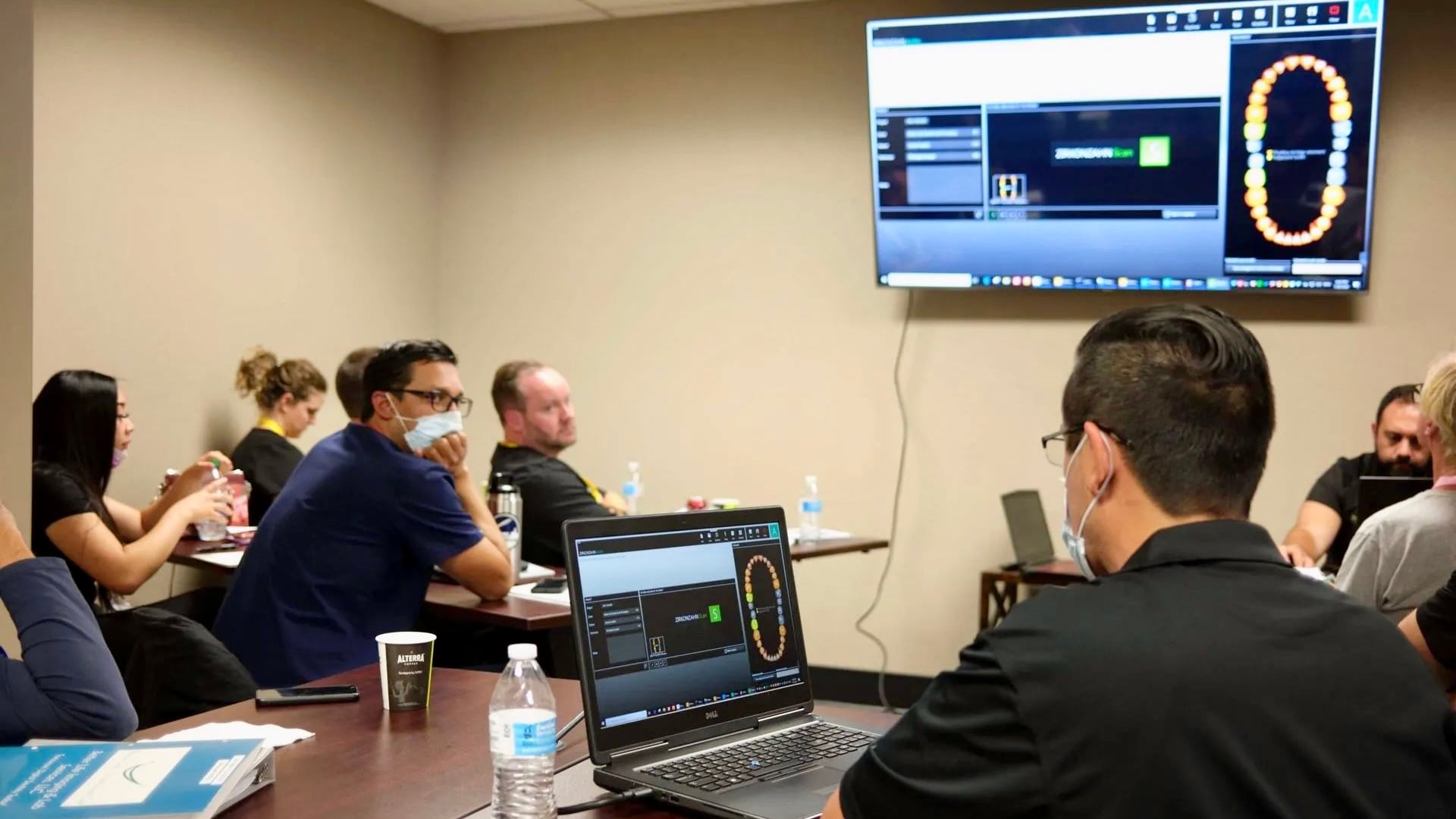
Intraoperative workflow follows the FAM Method in real time. Operators complete extraction or preparation of the arch, place implants with angulation verified against the pre-planned CBCT, capture implant positions with photogrammetry, complete immediate-load conversion design in exocad, and deliver the same-day prosthesis. A post-op debrief with the supervising mentor reviews what followed the plan, what required adaptation, and what to monitor during healing.
Physical Demands
Full-arch surgery is physically demanding in a way that single-tooth cases are not. Operating on a sedated patient across a full arch, while managing retraction, irrigation, angulated implant placement, and photogrammetry capture, requires sustained focus and physical endurance across a surgical block that can run four to six hours. This sustained demand explains why operators who have only placed single-tooth cases consistently report that the physical and cognitive load of a full arch feels qualitatively different. Because automaticity develops through repetition under real conditions, the two-arch volume at the Colorado course is structured to give operators enough exposure to begin building the muscle memory that makes full-arch surgery manageable at practice volume.
Complication Handling
Thermal necrosis from bone overheating above 47°C for more than one minute is the leading preventable cause of early implant failure, and operators avoid it through copious irrigation and correct drilling protocols. The course covers these protocols during pre-planning and reinforces them chairside during surgery. Another common complication, sinus membrane perforation, occurs in 20–25% of maxillary sinus augmentation procedures, and the course teaches the decision tree for perforations smaller than 5 mm, which usually receive collagen membrane repair and continuation, versus larger perforations that require rescheduling. For both thermal management and perforation response, mentors remain chairside throughout, not available only by radio from another room, so operators receive real-time correction when complications arise.
How Full-Arch Live Cases Differ from Single-Tooth Courses
Full-arch restorations replace all teeth in an upper or lower jaw using multiple implants and differ dramatically from single-tooth implant procedures in both planning and surgical execution. The differences that matter most for course evaluation include planning time, angulation precision, prosthetic sequencing, and case complexity.
- Planning time: A single-tooth case can be planned in minutes from a periapical radiograph. A full-arch case requires CBCT analysis, prosthetic-driven implant positioning, angulation decisions around anatomical structures, and immediate-load prosthetic design before the first incision.
- Angulation precision: Multiple implants in full-arch cases require precise angulation and spacing so that bone tissue receives proper nutrition and heals correctly. Angulation errors in a full-arch case affect the entire prosthetic platform, not a single crown.
- Prosthetic sequencing: Full-arch cases require immediate-load conversion, a same-day provisional prosthesis screwed to the implants before the patient leaves the chair. This step does not exist in single-tooth workflows and requires digital design and milling or printing capability that most single-tooth courses never address.
- Case complexity: Simple single-tooth implant cases in healthy bone usually require one surgical appointment and 3–4 months total treatment time, while complex full-arch cases with severe bone loss often require zygomatic implants or extensive grafting.
What Often Surprises Dentists on Their First Live Full-Arch Course
Live-patient dental implant training exposes trainees to real-world surgical variables including bleeding, patient movement, and variable bone densities that are absent in model-based practice. Several variables consistently catch first-time full-arch operators off guard.
- Bleeding management: Even under general anesthesia, intraoperative bleeding from soft tissue and extraction sockets requires active management. The field is not as clean as a model, and maintaining visualization across a full arch while managing bleeding is a skill that only live surgery develops.
- Patient movement: Sedated patients move, so positioning, retraction, and instrument control all require adaptation that model training does not simulate.
- Bone density variation: CBCT planning identifies density zones, but the tactile feedback of drilling through variable bone, such as dense cortical plate transitioning to soft cancellous bone, is only learned chairside.
- Time pressure on immediate load: The prosthetic conversion must be completed before the patient wakes. Operators who have not practiced the digital workflow under time pressure consistently underestimate how much coordination the immediate-load step requires between the surgical and lab teams.
- Thermal necrosis prevention in real time: Maintaining irrigation discipline across a full arch, not just on the first implant, requires sustained attention that model drilling does not demand.
These real-world challenges continue after the course, which makes the strength of post-course support a key factor in whether you successfully implement full-arch cases in your own practice.
Evaluating Post-Course Support and Alumni Community
Quality implant training programs provide post-course ongoing mentorship, case consultation support, and in some cases live assistance for procedures performed in the dentist’s own office. Many programs end when the course ends, which means the first difficult case a dentist encounters back in their practice, such as a patient with marginal bone density, unexpected sinus anatomy, or a prosthetic fit that needs troubleshooting, lands without a peer network to consult.
Full Arch Masters structures post-course support as a continued community rather than a one-time resource drop. Every operator who completes the Colorado Live Surgical Course joins:
- Private alumni group chats with hundreds of FAM-trained dentists, lab technicians, and team members, including a dentist-only chat for sensitive practice and clinical questions
- The KOL (Key Opinion Leader) buying group, which provides vendor discounts on Neodent implants, exocad licenses, 3D printers, and photogrammetry systems at no recurring cost
- A complete digital resource library covering surgical room setup checklists, finishing techniques, treatment coordinator forms, and consent templates for advanced placements including pterygoid and zygomatic
The difference between a program that ends at course completion and one that maintains an active alumni community determines whether the training translates into practice volume or stays in a notebook.
Join the FAM alumni network and get immediate access to case consultation support.
Colorado Credentialing and Hands-On Access
The Colorado Live Surgical Course is held in Parker, CO for a specific legal reason. The Colorado Dental Board allows US-licensed dentists from any state to perform dentistry on volunteer patients during credentialed continuing education programs. Most US states do not permit this, so hands-on live full-arch surgery as a CE format for visiting dentists is difficult to access domestically outside of Colorado.
As mentioned earlier, FAM handles the credentialing process with the Colorado Dental Board and submits each operator’s credentials before the course. Credentialing requires a current, active US dental license with no pending disciplinary marks. International attendees cannot be credentialed under this framework and attend as Observers, a track that provides full case exposure without operating.
With these evaluation criteria in mind, including case volume, supervision ratio, schedule structure, credentialing requirements, and post-course support, the following checklist summarizes minimum standards to use when comparing live-patient full-arch courses.
Decision Checklist: Evaluating a Live-Patient Full-Arch Course
| Criterion | What to Ask | Minimum Standard | Full Arch Masters Colorado Course |
|---|---|---|---|
| Hands-on volume | How many full arches does each operator personally complete? | At least 1 complete arch as primary operator | 2 full arches per operator |
| Supervision ratio | How many operators per mentor during live surgery? | No more than 2:1 operator-to-mentor | Maintained throughout live surgery (see supervision section) |
| Post-course community | What support exists after the course ends? | Structured peer access, not just an email address | Continued alumni group chats, KOL buying group, digital resource library, no recurring cost |
| AGD PACE CE credits | Is the provider AGD PACE-approved? | AGD PACE-approved provider | 32 CE credits accredited through the American Academy of General Dentistry |
Conclusion: Bringing a Repeatable Full-Arch System Home
Evaluating a live-patient full-arch implant course requires clear answers to four questions. You need to know how many arches each operator personally completes, what the supervision ratio looks like and who the mentors are, how the day-by-day schedule runs from pre-op to post-op, and what support continues after the course ends.
The Full Arch Masters Colorado Live Surgical Course addresses all four directly. Operators complete two full arches each, work under close supervision from active full-arch surgeons, follow a four-day structure with two days of pre-planning and two days of live operating, and join a continued alumni community with no recurring cost. The FAM Method, the seven-step digital workflow covered during pre-planning, runs through every case so operators leave with a system they can implement, not just a technique they observed.
Bring the FAM Method to your practice, and secure your operator spot today.
Frequently Asked Questions
What is the difference between a Basic Operator and an Advanced Operator track at the Full Arch Masters Colorado Live Surgical Course?
The Basic Operator track serves US-licensed dentists who have placed fewer than 200 full arches in their career. It covers the core full-arch surgical workflow, including implant placement, angulation, photogrammetry capture, and immediate-load conversion, under close mentor supervision on live volunteer patients. The Advanced Operator track is gated at 200 or more career arches placed and focuses on techniques for atrophic cases where standard implant positioning is not viable, including zygomatic, pterygoid, trans-sinus, palatal-approach, and custom subperiosteal placements. Both tracks deliver two full arches per operator across the two surgical days. The track distinction exists because the surgical decisions, anatomical risks, and complication profiles differ substantially between standard full-arch cases and atrophic-arch cases, and mixing experience levels in the same surgical environment reduces the quality of instruction for both groups.
Can international dentists participate as operators at the Colorado Live Surgical Course?
No. The Colorado Dental Board’s credentialing framework that allows visiting dentists to operate on volunteer patients requires a current, active US dental license with no pending disciplinary marks in the dentist’s home state. International dentists do not hold a US dental license and therefore cannot be credentialed to operate. International attendees are welcome at the Colorado Live Surgical Course as Observers, a track that provides full exposure to live full-arch cases, pre-planning sessions, and workflow instruction without operating. Observer-track attendees consistently report significant learning value from the experience, and the Observer track is priced separately at $4,995.
What post-course support does Full Arch Masters provide after the Colorado Live Surgical Course?
Every operator who completes the Colorado Live Surgical Course joins Full Arch Masters’ continued alumni community, a network of hundreds of FAM-trained dentists, lab technicians, and team members accessible through private group chats. The community includes a dentist-only chat for sensitive clinical and practice questions, a main multi-role chat spanning assistants, technicians, and team members, and per-course chats for lab and treatment coordination topics. Alumni also receive access to the KOL (Key Opinion Leader) buying group, which provides vendor discounts on Neodent implants, exocad licenses, 3D printers, and photogrammetry systems at no recurring cost, with no ongoing membership fee required. A complete digital resource library covering surgical room setup checklists, finishing techniques, treatment coordinator forms, and consent templates for advanced placements is distributed after the course. This post-course infrastructure separates a training investment that translates into practice volume from one that stays theoretical.
How does the FAM Method differ from a standard full-arch workflow?
The FAM Method is a fully integrated, photogrammetry-first digital workflow, not a collection of individual digital tools assembled around an analog core. The seven steps of the FAM Method are preoperative records and data acquisition, photogrammetry and intraoral scanning, CBCT and digital treatment planning, exocad design, immediate-load conversion, final zirconia design and finishing, and FP1-specific design, team implementation, and workflow scaling. Each step feeds directly into the next, and the system is designed to take a patient from no teeth, or heavily decayed teeth, to a screwed-in, same-day restoration in 2 to 4 hours. Many programs that describe a digital workflow use a hybrid approach with partial impressions, partial digital records, off-site lab work, and multi-day appointments. The FAM Method is taught as a single repeatable system, which is why alumni report being able to operationalize it immediately upon returning to their practice rather than needing to assemble the pieces themselves.
What CE credits does the Full Arch Masters Colorado Live Surgical Course provide, and are they recognized by the AGD?
The Full Arch Masters Colorado Live Surgical Course awards 32 continuing education credits accredited through the American Academy of General Dentistry. For dentists tracking CE requirements for AGD Fellowship or Mastership designations, or for state licensure renewal, these credits are widely accepted. Dentists should verify their specific state board’s CE acceptance policies independently, because requirements vary by jurisdiction.