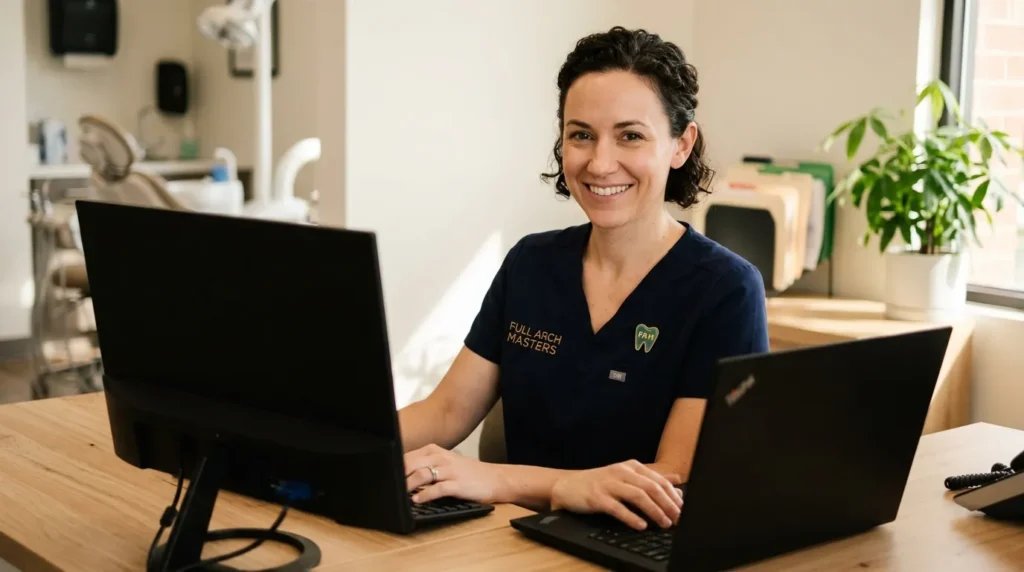
Written by: Ryan Dunlop, CEO and Founder of Full Arch Masters and graduate from the Harvard School of Dental Medicine
Key Takeaways from the Full Arch TC Framework
-
A repeatable five-step Discover-Diagnose-Present-Finance-Close framework lets trained treatment coordinators own the financial conversation and maintain clinical trust.
-
Discovery surfaces the patient’s emotional and functional drivers before price is discussed, which sets the stage for higher acceptance.
-
Presenting one all-inclusive recommendation tied to the FAM Method workflow, then anchoring to monthly payments, removes common objections and improves same-day closes.
-
Two-date scheduling plus immediate deposit collection converts verbal agreement into a committed patient in the same visit.
-
Full Arch Masters trains treatment coordinators on the exact scripts and systems used inside high-volume full-arch practices—enroll your TC in the next bootcamp and bring your team.
How the 5-Step Discover-Diagnose-Present-Finance-Close Framework Works
This framework is the exact sequence FAM’s in-house TC uses to help achieve strong close rates. Many U.S. practices close full-arch cases at moderate rates, while structured practices with trained TCs can reach much higher performance. The gap comes from this framework, executed consistently without deviation.
-
Discover, uncover the patient’s emotional and functional drivers before price enters the room
-
Diagnose, use CBCT and photogrammetry to make the clinical need undeniable
-
Present, deliver one clear, all-inclusive recommendation tied to the FAM Method workflow
-
Finance, anchor to monthly payment before the total fee
-
Close, book two dates and collect a deposit in the same visit
Step 1: Discover – The Conversation That Prevents Price Shock
Discovery is the TC’s first 15–20 minutes alone with the patient, before the dentist enters. This window is critical because it lets the TC surface the patient’s functional pain and emotional stakes before the clinical conversation begins. That preparation means the dentist’s presentation lands on prepared ground instead of cold soil.
Some practices extend this discovery work earlier by running a structured pre-consultation discovery call before the appointment. That approach can improve both show rates and close rates by pre-qualifying intent and reducing no-shows.
TC Discovery Script
“Before Dr. [Name] comes in, I want to make sure we use your time well today. I’ll ask you a few quick questions. How long have you been dealing with this? How has it affected your daily life, eating, smiling, confidence? If we could fix this completely, what would that mean for you? And have you had a chance to look into what this type of treatment typically involves financially?”
Tag the patient’s primary concern, cost, fear, timing, or family input, before the dentist enters. That tag drives every script choice in steps 3 through 5.
Step 2: Diagnose – Let the CBCT Carry the Clinical Proof
The dentist’s role in this framework is clinical authority, not sales. After discovery, the dentist performs the exam, reviews the CBCT, and hands the emotional translation back to the TC. The TC then uses that clinical data to reinforce the emotional drivers uncovered in Step 1.
This handoff is why a structured consultation flow that includes CBCT and smile preview during the clinical segment can lift same-day acceptance. The imaging validates what the patient already said they needed, so the plan feels like confirmation rather than a surprise.
TC CBCT Handoff Script
“What you’re seeing on this scan is exactly what Dr. [Name] just walked you through. This is your bone, your anatomy, and this is why the plan is designed the way it is. The photogrammetry we capture today means we can build your restoration to fit your exact implant positions, not an estimate. That is what makes same-day teeth possible.”
The FAM Method workflow, the seven-step digital process outlined earlier, is what makes this handoff credible. The imaging does the convincing, and the TC does the translating.
Step 3: Present – One Clear Path Instead of a Menu
All-inclusive pricing for full-arch restoration beats à la carte pricing because it feels complete and predictable. Patients see one path that solves the problem instead of a confusing list of line items.
TC Presentation Script
“Based on everything Dr. [Name] reviewed and what you told me about your goals, there is one path that makes sense for you. This is a complete, all-inclusive treatment. It covers everything from your preoperative records and data acquisition through photogrammetry and intraoral scanning, CBCT and digital treatment planning, exocad design, your immediate-load conversion so you leave with teeth the same day, final zirconia design and finishing, and the full FP1-specific design and team implementation if that applies to your case. Nothing is excluded. The number I’m going to show you is the number.”
The seven-step FAM Method gives the TC a concrete, credible framework to present. Patients hear a system, not a sales pitch.
Step 4: Finance – Keep the Focus on an Affordable Monthly Number
A monthly-first anchoring script across all treatment coordinators keeps the conversation centered on affordability. The TC presents the monthly payment first, then the total, never the reverse, which reduces sticker shock.
TC Monthly-First Anchoring Script
“Most of our full-arch patients invest between $380 and $640 per month depending on which financing path makes sense for their situation. Let’s figure out which option fits before we get into the total. We work with multiple financing partners, and we can run a soft-pull approval right now, 90 seconds, no impact on your credit, so you’re looking at real numbers, not estimates. Which of these monthly ranges feels most comfortable for your budget?”
Every practice should offer three distinct payment paths: insurance plus out-of-pocket, third-party financing, and an in-house payment plan. This range covers almost every “I cannot afford it” scenario.
Present all three neutrally. Asking “Which of these options works best for your budget?” instead of “Do you need help with financing?” normalizes payment options without making the patient feel financially inadequate.
Step 5: Close – Lock in Two Dates and a Same-Visit Deposit
Many cases that are not scheduled promptly never get scheduled. The close is not a loose conversation; it is a calendar event and a payment collected in the same visit.
TC Two-Date Close Script
“We’re going to put two dates on the calendar right now. The first is your preoperative appointment, that is where we finalize your records and confirm your plan. The second is your surgery date, that is the day you come in and leave with teeth. Both dates are yours. To hold them, we collect a deposit today. The deposit is [amount] and it applies directly to your treatment. Which works better for your preop, a morning or afternoon?”
Even with a strong close script, objections will arise throughout the framework, most often during the Finance and Close steps. The following responses address the six objections that account for the majority of lost cases.
How to Overcome Cost Objections on Full Arch
Patients most often decline full-arch treatment because of cost and financing. Fear of surgery, uncertainty about recovery, and not understanding the benefit also drive refusals. The table below covers the six objections that account for the majority of lost cases, with TC responses drawn from the FAM closing system.
|
Objection |
TC Response |
|---|---|
|
“It costs too much.” |
“I hear you. What is it worth to eat comfortably again and smile with confidence? Most of our patients invest around $380–$640 per month, less than a car payment, for results that last a lifetime. Let’s find the monthly number that works for you.” |
|
“I need to think about it.” |
“Of course. What specifically would you like to think through? Most patients are weighing one of three things: timing, financing comfort, or family input. Which of those is the biggest one for you right now?” |
|
“I need to talk to my spouse.” |
“Absolutely, this is a family decision. We can set up a quick call this evening so I can answer their questions directly. Or I can send a summary they can review before we talk. Which works better?” |
|
“I’m scared of the surgery.” |
“That’s one of the most common things I hear, and it’s completely valid. Dr. [Name] uses IV sedation. Most patients tell us they remember nothing and felt no pain. Hearing from a patient who felt the same way before their procedure often helps. Would you like that?” |
|
“I want to get another opinion.” |
“That makes sense for a decision this size. I suggest you take the CBCT images we captured today, they are yours, so any other provider is working from the same data. When would you like to schedule a follow-up with us after you’ve had that conversation?” |
|
“I don’t think I’ll qualify for financing.” |
“Let’s find out right now. It’s a soft pull, no impact on your credit, and takes 90 seconds. Most patients are surprised by what they qualify for. Can I run it while you’re here?” |
Two-Date Scheduling for Full Arch Surgery
Two-date scheduling is the operational mechanism that converts a verbal “yes” into a committed patient. The preoperative appointment anchors the relationship, and the surgery date creates urgency and accountability.
Both dates are booked in the same closing conversation.
TC Calendar Language
“I’m pulling up the schedule right now. For your preop, we typically like to see patients 7–14 days before surgery. That timing gives us space to finalize your digital treatment plan and confirm your immediate-load design before your surgery day. I have [date] or [date] available for preop. Which works? And for surgery, we have [date]. That is the day you come in and leave with a full set of fixed teeth. I’m holding both of those for you right now.”
Many full-arch implant decisions involve a spouse or adult child who is not present at the consultation. Immediate three-way calls, evening video consultations, or no-charge follow-up visits can help recover a portion of these cases.
If the patient needs to confirm with a family member before locking dates, the TC books a soft hold and schedules a 15-minute follow-up call within 48 hours. The team avoids an open-ended “call us when you’re ready” outcome.
Securing Deposits on High-Value Implant Cases
The deposit is not optional and it is not negotiable in amount. It is a standard part of the closing sequence. Framing it as a scheduling hold rather than a down payment reduces the friction of paying before treatment.
TC Deposit Script
“To hold both of your dates, we collect a scheduling deposit of [amount] today. That amount applies directly to your treatment balance. It is not an extra fee, it is the first part of your investment. We can put it on the card you have on file, or whichever card you’d like to use. Which works for you?”
Front-Desk Handoff Language
“[Patient name] is all set. We’re collecting their scheduling deposit and confirming their preop and surgery dates. Can you pull up the payment screen? I’ll stay here with them while we get that processed.”
The TC stays in the room through deposit collection. Handing the patient to the front desk without the TC present is where deposits are lost. The TC’s physical presence signals that this is a normal, expected step, not an afterthought.
Once your TC is executing the full framework, from discovery through deposit collection, the next step is measuring whether that execution is producing results. The following KPIs show whether your TC is performing at a high level or where the system is breaking down.
KPI Targets: How to Track Your TC’s Performance
Most dental practices overestimate their case acceptance rate because practice management systems only track patients who give verbal or written consent. The institutional measurement includes every patient who walked out without scheduling. The KPI tracker below measures what actually happened, not what the TC remembers happening.
Track the following metrics weekly, assigned to the individual TC who owned the lead at close:
-
Leads in: Total qualified full-arch inquiries received in the period. Track to source, such as paid search, referral, or organic, to calculate cost-per-seated-case by channel.
-
Consults attended: Percentage of booked consults that showed. Practices running a structured pre-consultation call often see improved show rates.
-
Same-day close rate: Cases accepted and deposited on the day of consultation divided by consults attended. This metric improves when a trained TC runs the full framework.
-
90-day close rate: Cases accepted within 90 days of consultation divided by total consults attended. A 7–9 touch non-closer recovery sequence can recover additional consults that did not accept same-day.
-
Financing applications submitted: Number of financing applications submitted, not approved, as a percentage of treatment plans presented over $10,000. Target a strong application rate on full-arch presentations.
-
Cost-per-seated-case: Total marketing spend divided by cases that reached the surgery chair. Weekly dashboards that track cost-per-seated-case by lead source let practices reallocate media spend quickly.
A KPI is actionable only when it has a clear threshold, a responsible team member, and a defined next step when performance changes. Assign every metric above to the TC by name. Review in a standing Monday morning meeting.
If same-day close rate drops below target for two consecutive weeks, pull recorded consultations and run objection-handling drills before the next consult day.
How Full Arch Masters Trains TCs to Hit 80% Close Rates
The Treatment Coordinator Bootcamp is a 4-hour CE course. The curriculum covers new patient acquisition, the full Discover-Diagnose-Present-Finance-Close framework, financing presentation, objection handling, pipeline nurture, drip campaigns, and deposit collection, with heavy role-play on the exact scenarios TCs encounter in real full-arch practices.
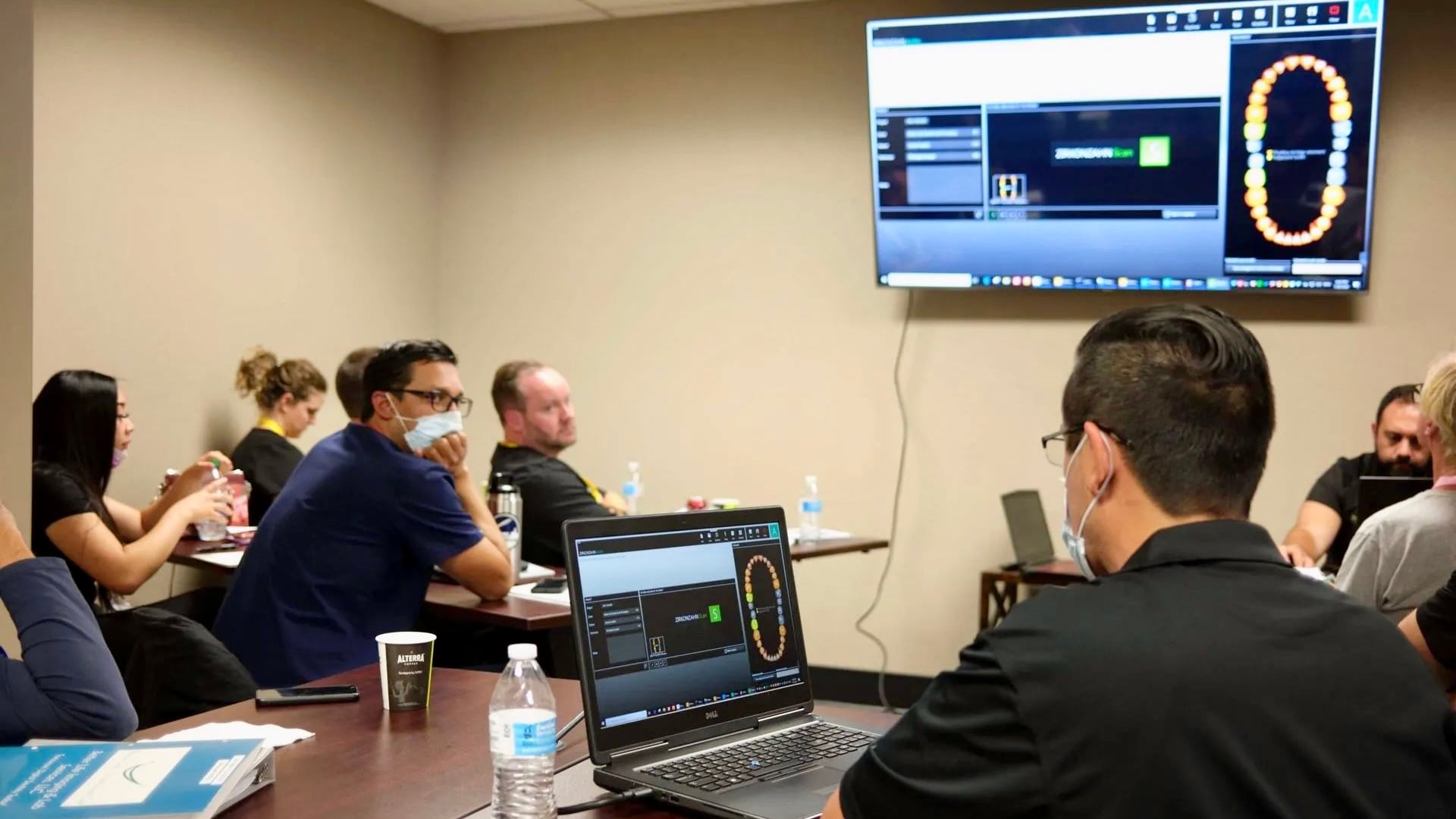
The Bootcamp teaches the closing system used inside a high-volume full-arch practice. Practice owners typically attend alongside their TC and office manager so the entire front-office function leaves aligned on the same playbook.
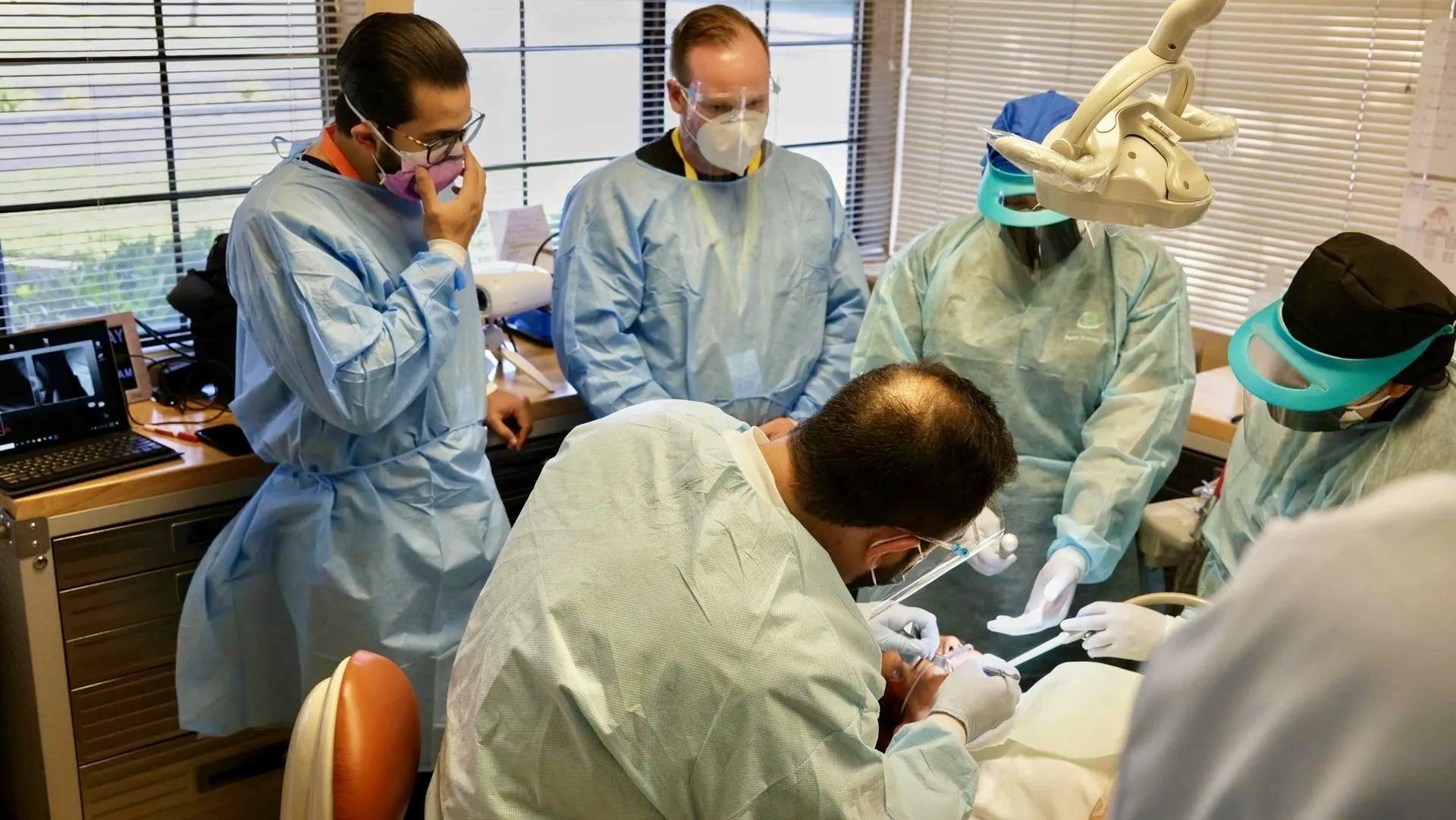
The Flagship Course covers the same closing framework at a foundational level for the full team, dentist, lead assistant, TC, and in-house lab technician. The goal is for the clinical and administrative sides of the practice to run the same system from day one.
Enroll your team in the Bootcamp or Flagship Course and train your TC on the system that is used in a real full-arch practice.
Conclusion
The average U.S. dental practice closes only a portion of presented treatment by dollar value, and high-value cases like full-arch implants often fall to lower rates. The gap to high performance is not a clinical gap; it is a systems gap. That gap closes when a trained TC owns the full patient journey from discovery through deposit, runs a repeatable five-step framework, tracks key metrics weekly, and uses proven scripts that resolve the objections responsible for most lost cases.
Full Arch Masters has built, documented, and now teaches that system. The Treatment Coordinator Bootcamp and the Flagship Course are where your team learns it, not in theory, but from the experience of a TC who runs it every day.
Bring your full team to the next course. One team, one workflow, starting the day you get back.
Frequently Asked Questions
Why does delegating the close to a TC produce higher close rates than having the dentist handle it?
When a dentist presents both the clinical diagnosis and the financial options in the same conversation, patients conflate the two. They feel the dentist is selling them something rather than treating them. Separating the roles removes that friction.
The dentist establishes clinical authority and then leaves. The TC handles the financial conversation from a position of advocacy, not authority. This separation also prevents dentists from unconsciously pre-qualifying patients based on perceived ability to pay, which suppresses close rates on high-value cases.
FAM’s in-house TC maintains a high close rate because the clinical and financial conversations are structurally separated and the TC owns the close end-to-end.
What is the Discover-Diagnose-Present-Finance-Close framework, and where did it come from?
The Discover-Diagnose-Present-Finance-Close framework is a five-step closing system. Each step has a defined owner, a verbal script, and a measurable output.
Discover is the TC’s pre-clinical discovery conversation that surfaces the patient’s emotional and functional drivers. Diagnose is the dentist’s clinical exam and CBCT review, with the TC translating findings into patient language.
Present is the TC’s delivery of one all-inclusive recommendation tied to the FAM Method’s seven-step digital workflow. Finance is the TC’s monthly-first anchoring conversation with three payment paths presented neutrally. Close is the TC booking two calendar dates and collecting a deposit in the same visit.
The framework is taught in the Treatment Coordinator Bootcamp and at a foundational level in the Flagship Course.
What KPIs should a practice track to know whether its TC is performing at a high level on full-arch cases?
Six KPIs define TC performance on full-arch cases. These are leads in, tracked to source for cost-per-seated-case calculation, consults attended, same-day close rate with a trained TC running the full framework, 90-day close rate, financing applications submitted as a percentage of treatment plans presented over $10,000, and cost-per-seated-case by lead source reviewed weekly.
Each metric is assigned to the individual TC by name and reviewed in a standing Monday morning meeting. Every KPI is tied to a defined next step when performance drops below threshold.
Tracking verbal consent alone overstates close rates significantly. The institutional measurement includes every patient who left without scheduling.
How does the Full Arch Masters Treatment Coordinator Bootcamp differ from general dental sales training?
Most dental sales training is generic. It covers case presentation principles that apply equally to a crown, an aligner case, and a full-arch implant. The Treatment Coordinator Bootcamp is built exclusively around full-arch cases.
Full-arch cases have a distinct objection profile, including cost at high amounts, surgical fear, and absent decision-makers. They also have a longer decision timeline and a financing conversation that requires multiple lender options and monthly-first anchoring.
The curriculum is taught by FAM’s Lead Treatment Coordinator, who runs the exact system being taught inside a live, high-volume full-arch practice. The Bootcamp also covers pipeline nurture, drip campaigns, and the 90-day non-closer recovery sequence, elements that general dental sales training does not address at the full-arch level.
What is two-date scheduling, and why does it matter for full-arch case retention?
Two-date scheduling means booking both the preoperative appointment and the surgery date in the same closing conversation, before the patient leaves the office. The preoperative appointment, typically 7–14 days before surgery, anchors the patient’s commitment and allows the team to finalize the digital treatment plan and confirm the immediate-load design.
The surgery date creates a concrete, time-bound goal that prevents the case from drifting into the “I’ll call when I’m ready” category. Cases not scheduled promptly are statistically unlikely to ever be scheduled.
Two-date scheduling, combined with a deposit collected at the same visit, converts a verbal yes into a committed patient with skin in the game. The TC owns both the calendar conversation and the deposit collection. Handing either step to the front desk without the TC present is where cases are lost.