Written by: Ryan Dunlop, CEO and Founder of Full Arch Masters and graduate from the Harvard School of Dental Medicine
Key Takeaways
-
Traditional dental implant fellowship programs often last 1–3 years with limited hands-on surgical volume, which makes them impractical for mid-career dentists who need faster implementation.
-
Practical full-arch implant training like the FAM Method delivers same-day restorations in 2–4 hours through an integrated digital workflow that replaces hybrid, multi-day appointment cycles.
-
Full-team attendance is essential for scaling. FAM trains dentists, assistants, treatment coordinators, and lab technicians together on a single repeatable system, closing the implementation gap common in academic programs.
-
Post-program support shapes long-term results. FAM alumni gain lifetime access to private group chats, KOL buying group discounts, and a complete digital resource library, unlike most fellowship programs that end with a certificate.
-
Practices ready to scale with same-day full-arch delivery can register for an upcoming Full Arch Masters course and bring the FAM Method back to their team.
The Problem: Structural Limits of Traditional Dental Implant Fellowships
The dental implant fellowship program landscape in the United States spans a wide range of formats, yet most share structural features that slow clinical implementation rather than accelerate it.
Duration. Columbia University’s Digital Implantology Competency Hub offers a postdoctoral fellowship, while Loma Linda University’s Advanced Dental Education Program in Implant Dentistry spans three years and leads to a specialty certificate or Master’s degree. Jacksonville University’s oral implantology residency runs 24 months. For a mid-career dentist already running a practice, a one-to-three-year commitment rarely fits operational reality.
Surgical volume per participant. University-based implant residencies such as Loma Linda accept only three students per year, and university-affiliated programs typically provide fewer total surgical cases per participant and often require multi-year commitments with emphasis on thorough documentation and long-term follow-up. High documentation requirements and small cohort sizes do not automatically translate to high hands-on volume per operator.
Hybrid workflows. A 2026 review in the International Journal of Dental Materials highlights the benefits of digital implant technologies and also notes barriers such as high initial investment, steep learning curves, and software interoperability issues. These barriers grow when academic programs teach digital tools as isolated components instead of as an integrated end-to-end system, which leaves graduates with partial digital capability rather than a repeatable same-day delivery protocol.
Dentist-only attendance. Academic fellowships enroll individual clinicians. The surgical assistant, treatment coordinator, and lab technician who will actually run the workflow back at the practice receive no shared training. That structure creates an implementation gap the moment the dentist returns home.
Post-program support. Post-course mentorship bridges the training-to-production gap by offering feedback on CBCT scans and treatment plans for early cases, rather than leaving dentists with only a certificate and no implementation support. Most academic fellowships do not include a structured alumni community or ongoing case-review channel after graduation.
Revenue impact. A dentist who places their first implant within 30 days after completing CE is on a fundamentally different ROI trajectory than one who waits six months, which makes course-to-clinic speed the primary variable in implantology fellowship ROI. Long-duration programs with slow ramp-up timelines delay that revenue inflection point by months or years.
The Solution: FAM Method Training for Same-Day Full-Arch Delivery
Full Arch Masters addresses those structural gaps through the FAM Method, a proprietary, fully digital workflow that takes a patient from no teeth or heavily decayed teeth to a screwed-in, same-day restoration in 2 to 4 hours. The Fellowship bundle combines the Flagship Course, the Design and Finish Course, the Live Surgical Course, and a fourth elective course into a single enrollment at a $5,000–$10,000 discount versus paying per course, with over 90 hours of CE credit across the full program.
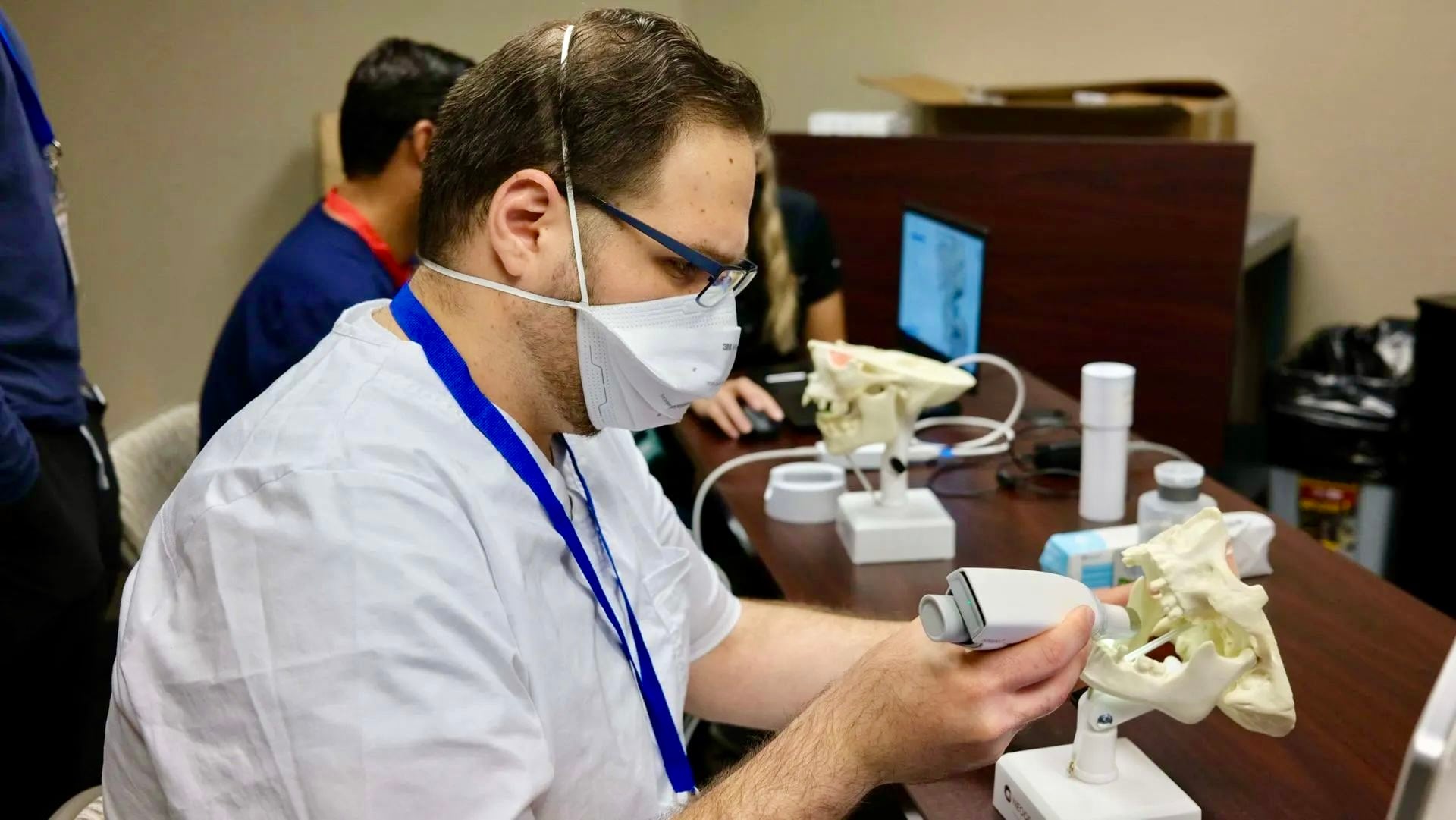
FAM addresses the structural gaps in traditional fellowship programs across six dimensions: duration, surgical volume, workflow integration, team training, ongoing support, and revenue impact.
Six Decision Criteria: How FAM Differs from Traditional Fellowships
The six decision criteria that separate practical full-arch implant training from a traditional dental implant fellowship program are program duration, hands-on surgical volume, digital versus hybrid workflow, team training model, post-program support, and revenue impact. Each is addressed directly in the FAM curriculum. The table below shows how FAM’s approach differs from traditional fellowship programs across these six criteria, highlighting structural advantages that support faster implementation.
|
Criterion |
Typical Academic Dental Implant Fellowship Program |
Full Arch Masters Practical Full-Arch Implant Training |
|---|---|---|
|
Program Duration |
1–3 years depending on institution, visiting scholars programs run September through May |
4-day Flagship Course, 4-day Live Surgical Course, Fellowship courses can be spread across the year on a flexible schedule |
|
Hands-On Surgical Volume |
University-affiliated programs typically provide fewer total surgical cases per participant, limited cohort sizes |
Each Basic or Advanced operator performs 2 full-arch surgical cases on live volunteer patients under expert mentor supervision during the Live Surgical Course |
|
Digital vs. Hybrid Workflow |
High initial investment, steep learning curves, and software interoperability issues remain barriers to universal adoption of fully digital workflows, most programs teach digital tools as components |
End-to-end integrated FAM Method: intraoral scanning, photogrammetry, CBCT, exocad design, immediate-load 3D-printed conversion, and same-day final delivery as a single repeatable system |
|
Team Training Model |
Enrolls individual clinicians, surgical assistant, TC, and lab technician receive no shared training |
Full-team attendance model, dentist, lead assistant, treatment coordinator, and in-house lab technician train together on one workflow, team-member pricing built into every course |
|
Post-Program Support |
Most programs leave dentists with only a certificate and no ongoing implementation support, structured alumni communities are uncommon |
Lifetime access to private alumni group chats with hundreds of FAM-trained dentists, lab technicians, and team members, KOL (Key Opinion Leader) buying group access at no recurring cost, complete digital resource library |
|
Revenue Impact |
Dentists can recover training investment within 6–12 months after beginning to place cases, but long program durations delay the revenue inflection point. |
FAM alumni report adding significant annual practice revenue after adopting the FAM Method, driven by faster workflow, higher case volume, and improved treatment coordination closing rates |
The FAM Method: Seven Steps in a Fully Digital Workflow
The FAM Method, Full Arch Masters’ proprietary digital workflow, is taught as a single integrated system across the Fellowship curriculum. Digital workflows in implant dentistry can streamline prosthetic design and fabrication, reduce chairside time, and improve communication between clinicians, laboratories, and patients when implemented as a cohesive end-to-end protocol rather than a collection of individual tools. The FAM Method delivers that cohesion through seven sequential steps:
-
Preoperative records and data acquisition. The workflow begins with a complete preoperative data set, including facial records, photographs, and clinical documentation, captured by the team before any surgical planning begins. Surgical assistants are trained to own this step, which frees the dentist’s chair time for billable procedures.
-
Photogrammetry and intraoral scanning. Photogrammetry captures implant positions with submicron accuracy and removes the distortion introduced by conventional impression materials. Intraoral scanning captures soft-tissue and arch anatomy digitally. Together, these two records replace the analog impression workflow entirely.
-
CBCT and digital treatment planning. Cone beam CT imaging provides the three-dimensional bone map required for safe implant positioning. CBCT imaging can help avoid complications from unanticipated bone deficiencies that may arise when planning with panoramic radiographs alone. Digital treatment planning integrates the CBCT data with the scan records to produce a surgical guide and prosthetic blueprint before the patient enters the operatory.
-
exocad design. The immediate-load prosthetic is designed in exocad, the same software platform used across the Design and Finish Course, using the photogrammetry and scan data captured in earlier steps. FAM is a certified exocad reseller and teaches the software at both beginner and advanced levels.
-
Immediate-load conversion. A 3D-printed immediate-load prosthetic is fabricated chairside or in the in-house lab and delivered the same day as surgery. This step removes the multi-day appointment cycle that characterizes hybrid workflows and is the mechanism by which the FAM Method achieves 2-to-4-hour same-day delivery.
-
Final zirconia design and finishing. Once osseointegration is confirmed, the final zirconia restoration is designed, milled, and finished using the aesthetic techniques taught in the Design and Finish Course, including green-stage contouring and MIYO ceramic layering on pre-sintered and post-sintered zirconia.
-
FP1-specific design and workflow scaling. For cases where FP1 is the appropriate prosthetic classification, the design protocol differs meaningfully from FP2 and FP3 in case selection, root banking, and lab design. The FP1 Course covers this track in depth. Team implementation and workflow scaling, including delegation systems, room setup, and case handoff protocols, are embedded throughout the Flagship Course so the practice can run the full workflow at volume from day one.
Full-Team Attendance and Delegation for Scalable Results
The most common reason a dentist returns from an implant dentistry course and fails to scale is that the rest of the team was not in the room. The FAM Method functions as a team system and cannot be operationalized by a single clinician working with an untrained assistant and a treatment coordinator who has never seen a full-arch consultation close.
Training hygiene team members to identify implant candidates during routine appointments enables delegation of case detection and builds a reliable pipeline beyond the dentist’s own exam-based identification. FAM extends this principle across every role in the practice. Surgical assistants own preoperative records acquisition, treatment coordinators own the consultation close, and in-house lab technicians own the design and finishing workflow. When each team member is trained on their slice of the system, the dentist’s chair time stays focused on the billable surgical and prosthetic steps.
Most FAM attendees arrive as a practice owner with their lead assistant and treatment coordinator, or as a dentist with their in-house lab technician. Team-member pricing is built into every course, at $2,500 per additional team member for the Flagship Course, so bringing the full team remains financially realistic. Medical education research supports the principle that practical, rehearsal-based training with repeated practice across varied situations shortens the path from learning to independent clinical performance. That finding applies directly to team-based delegation training, where each team member rehearses their role in the workflow before returning to the practice.
KOL Buying Group Economics for Growing Practices
Every FAM alumnus gains access to the KOL (Key Opinion Leader) buying group, a vendor discount network covering Neodent implants, exocad licenses, Envisiontec and DentaFab 3D printers, photogrammetry systems, and other equipment, at no recurring cost. This contrasts with the alternative structures available to independent practices, such as GPOs and DSOs, which typically require ongoing membership fees or organizational affiliation. Because FAM’s KOL group requires only course completion rather than recurring payments, the per-unit savings compound directly to the bottom line as case volume grows for practices scaling from one or two full arches per month to five or more.
Frequently Asked Questions
How long does the Full Arch Masters Fellowship take to complete?
The Fellowship bundles four courses, the Flagship Course, the Design and Finish Course, the Live Surgical Course, and a fourth elective, typically the Treatment Coordinator Bootcamp or the FP1 Course, into a single enrollment. Each of the three core courses runs four days, and the elective courses run two days. Scheduling is flexible, and courses can be spread across the year. The full Fellowship delivers over 90 hours of CE credit accredited through the American Academy of General Dentistry. This structure differs sharply from a one-to-three-year academic dental implant fellowship program and is designed specifically for mid-career dentists who cannot step away from a running practice for an extended residency.
How much hands-on surgical volume does the Live Surgical Course provide?
Each Basic or Advanced operator performs two full-arch surgical cases on live volunteer patients across the two surgical days of the Live Surgical Course in Parker, Colorado. Colorado is one of the few US states where the dental board allows visiting US-licensed dentists to perform surgery on volunteer patients under a credentialing process FAM submits ten days before each course. FAM surgical mentors supervise every case chairside. The Basic Operator track is open to dentists with fewer than 200 full arches placed in their career, while the Advanced Operator track is gated to dentists with 200 or more career arches and focuses on zygomatic, pterygoid, trans-sinus, custom subperiosteal, and palatal-approach techniques for atrophic cases.
How fast can a practice deliver a full-arch case using the FAM Method digital workflow?
The FAM Method is designed to take a patient from no teeth or heavily decayed teeth to a screwed-in, same-day restoration in 2 to 4 hours. That delivery speed comes from integrating all seven steps of the workflow, including preoperative records, photogrammetry, intraoral scanning, CBCT planning, exocad design, immediate-load 3D-printed conversion, and final zirconia finishing, into a single repeatable system rather than assembling digital tools piecemeal. Most practices running a hybrid workflow that relies on partial impressions, off-site lab work, and multi-day appointments cannot approach that delivery window. The FAM Method closes that gap by teaching the full system, not just the individual tools.
Does the whole team need to attend, or just the dentist?
The FAM Method is built around full-team execution, and FAM strongly recommends that practices attend as a team. Most cohorts include the practice owner alongside their lead assistant, treatment coordinator, and in-house lab technician. Team-member pricing is built into every course, at $2,500 per additional team member for the Flagship Course, which keeps full-team attendance structurally affordable. A dentist who attends alone and returns to an untrained team faces the same implementation gap that limits many academic fellowship graduates, because the workflow requires a coordinated assistant, treatment coordinator, and lab technician to run at volume. Bringing the team removes that gap on day one.
What post-program support does Full Arch Masters provide after the course ends?
Every FAM alumnus, regardless of which course they attend, joins continued private alumni group chats with hundreds of FAM-trained dentists, lab technicians, and team members. The network includes a dentist-only chat for sensitive practice and personnel questions, a main multi-role chat for clinical and operational case help, and per-course lab and treatment coordinator chats. Alumni also retain KOL buying group access at no recurring cost and receive the complete digital resource library covering surgical room setup checklists, finishing techniques, treatment coordinator forms and presentations, and consent templates. Post-course support functions as a live peer community that answers case questions on demand for the life of the relationship.
Conclusion and Next Step for Full-Arch Growth
A traditional dental implant fellowship program delivers academic structure, credentialing pathways, and long-duration immersion, yet it does not solve the operational problem facing a mid-career dentist who wants to scale from one or two full arches per month to five or more. The structural gaps, including slow timelines, low per-operator surgical volume, hybrid workflows, dentist-only attendance, limited post-program support, and unclear revenue impact, are not incidental features of academic programs. They arise from designing for credentialing rather than implementation.
The FAM Method addresses each gap directly through a 2-to-4-hour same-day digital workflow, two full-arch surgical cases per operator on live patients, full-team training on a single integrated system, a continued alumni community with hundreds of active members, and a KOL buying group at no recurring cost. Many dental professionals agree that digital technologies improve clinical efficiency, so the real decision centers on which training program teaches the complete system rather than only the individual tools.
Full Arch Masters keeps the recipe transparent, trains the team, and maintains an active community. The remaining variable is when a practice decides to operationalize it.