
Written by: Ryan Dunlop, CEO and Founder of Full Arch Masters and graduate from the Harvard School of Dental Medicine
Key Takeaways for Full-Arch Case Acceptance
- An implant case acceptance coordinator is a consultative sales role that owns the full-arch patient journey from treatment presentation through deposit collection and surgical scheduling.
- Full-arch cases are the highest-value treatment in implant practices, with fees typically ranging from $14,000 to $40,000 per arch, so conversion rate becomes the critical revenue driver.
- The average implant case acceptance rate of 40–55% leaves substantial revenue on the table, while top performers achieve much higher close rates through structured training and accountability systems.
- Successful coordinators require four non-negotiable skills: empathy, financial acumen, objection handling, and systems thinking, and these must be screened for during hiring.
- Train your coordinator at the Full Arch Masters Treatment Coordinator Bootcamp to use proven frameworks that support high closing rates and seven-figure annual growth.
Why an Implant Case Acceptance Coordinator Drives Full-Arch Growth
The global dental implants market is expected to be valued at US$ 8.4 Billion in 2026 and is projected to reach US$ 13.8 Billion by 2033, driven by an aging population and rising edentulism. Immediate-load procedures, which include same-day full-arch, are growing in popularity. Patient demand exists at scale, so closing rate becomes the main constraint.
The average implant case acceptance rate across practices sits at 40–55%, while top performers reach higher rates. The average case acceptance rate across all dental procedures is typically 50–60%, which means a substantial portion of recommended treatment goes unaccepted. For full-arch cases, that gap carries enormous stakes, because a single unconverted full-arch case can represent more lost revenue than an entire month of hygiene production at many practices.
The coordinator role creates chair-time leverage. When a trained coordinator handles pre-consultation calls, financial conversations, objection resolution, and follow-up sequences, the dentist’s time stays in the operatory. In solo practices, this separation can be the difference between running two arches a month and running five. In multi-doctor or multi-location setups, a coordinator who owns the pipeline becomes the throughput multiplier across every provider.
Build a predictable closing system with the Full Arch Masters Treatment Coordinator Bootcamp.
Step 1: Define Coordinator Responsibilities and Success Metrics
Clear responsibilities and KPIs give the coordinator a focused role and give you a way to measure performance. Before writing a job description, map every touchpoint in the full-arch patient journey and assign ownership. The implant case acceptance coordinator role is not a front-desk or administrative position, and it functions as a consultative sales role within a clinical environment.
Core responsibilities to define before posting include:
- Pre-consultation phone calls (12–18 minutes, conducted 24–48 hours before the appointment)
- In-room discovery and rapport phase before the dentist enters
- Post-exam financial conversation and financing presentation
- Same-day deposit collection and scheduling
- Structured follow-up for unsigned cases at 24 hours, 7 days, 30 days, and 90 days
- CRM documentation of every interaction, objection, and next action
- Pipeline reporting to the practice owner
Once you have mapped these responsibilities, establish the KPIs that will measure success in each area. KPIs to establish before the first hire include:
- Consultations attended
- Treatment plans presented
- Treatment plans signed (same-day and 14-day totals)
- Average treatment plan value
- Same-visit close rate
- Outbound call volume and follow-up completion rate
- Financing application approval rate
Practice model affects role scope. A solo practice with one dentist and 8–12 consultations per month may need a coordinator who also manages scheduling. A multi-doctor practice with 25 or more monthly consultations may need a coordinator focused exclusively on closing, with a separate scheduler handling surgical logistics.
Step 2: Write a Job Description That Attracts High-Ticket Talent
A focused job description attracts candidates who can confidently present five-figure treatment plans and guide financial decisions. The implant case acceptance coordinator role requires comfort with high-value conversations and closing decisions, which are skills that remain rare in traditional dental administration.
The most successful coordinators often come from hospitality, medical device sales, real estate, and high-end retail backgrounds rather than clinical dental roles. A job description that leads with “dental experience required” filters out this talent pool and limits your options.
Required elements in the job description include:
- Explicit framing as a consultative sales role, not a front-desk position
- Stated case value range ($14,000–$40,000 per arch) so candidates self-select for comfort with high-ticket conversations
- Minimum 2–3 years of treatment coordination, sales, or patient consultation experience
- Proficiency with dental practice management software (Dentrix or equivalent) and CRM systems
- Compensation structure with base salary plus performance bonus tied to accepted case value
Preferred qualifications to include:
- Prior experience presenting full-arch, All-on-X, or complex restorative cases
- Experience processing third-party financing applications (CareCredit, Proceed Finance, Sunbit)
- Comfort with daily outbound call volume targets and documented follow-up cadences
Step 3: Screen for the Four Non-Negotiable Coordinator Skills
Four core skills predict coordinator performance in full-arch case acceptance, and weak candidates rarely catch up through training alone. Hiring with these skills in mind shortens the ramp-up period and improves long-term results.
1. Empathy. Full-arch patients often carry years of dental avoidance, shame, and fear. A coordinator who cannot build genuine rapport before the financial conversation will lose cases that a more empathetic candidate would close. Interview question: “Tell me about a time you helped someone make a difficult decision they were afraid of.” Red flag: answers that focus on persuasion rather than understanding.
2. Financial acumen. Successful coordinators present financing options with fluency equivalent to a mortgage broker, including approval rates, interest ranges, and monthly payment math across multiple terms. Interview question: “Walk me through how you would present a full-arch case to a patient who says they cannot afford it.” Red flag: the candidate pivots to discounting rather than financing.
3. Objection handling. Common objections in lost implant consultations include “I need to think about it,” “I need to talk to my spouse,” “I want a second opinion,” and “the cost is more than I expected.” Interview question: “How do you respond when a patient says they need to talk to their spouse?” Red flag: the candidate accepts the objection without offering an immediate alternative, such as a three-way call or evening video consultation.
4. Systems thinking. A coordinator who cannot maintain CRM records, follow-up cadences, and pipeline reporting will create chaos in a high-volume practice. Interview question: “Describe the follow-up system you used for unsigned cases at your last practice.” Red flag: no documented system and reliance on memory for follow-up.
Step 4: Onboard the Coordinator to Your Digital Full-Arch Workflow
Effective onboarding gives the coordinator enough clinical fluency to explain outcomes, timelines, and the patient experience with confidence. A new coordinator cannot close cases they do not understand, even if they have strong sales skills.
A structured 30-60-90 day onboarding timeline helps:
- Days 1–30: Shadow every consultation. Learn the CBCT imaging process, intraoral scanning, and the treatment planning conversation. Understand what immediate load means for the patient’s day-of experience. Observe the dentist’s case presentation language and adopt it.
- Days 31–60: Lead the pre-consultation phone calls independently. Handle the post-exam financial conversation with the dentist available for backup. Begin processing financing applications. Track all KPIs from day one.
- Days 61–90: Own the full consultation arc, from pre-call through deposit collection. Conduct weekly pipeline reviews with the practice owner. Begin weekly role-play sessions on the four primary objections.
The handoff process between the dentist and coordinator remains critical. The dentist presents the clinical case to provide clinical authority, and the coordinator owns everything after the dentist exits the room.
Step 5: Train on the Seven-Step Full Arch Masters Workflow
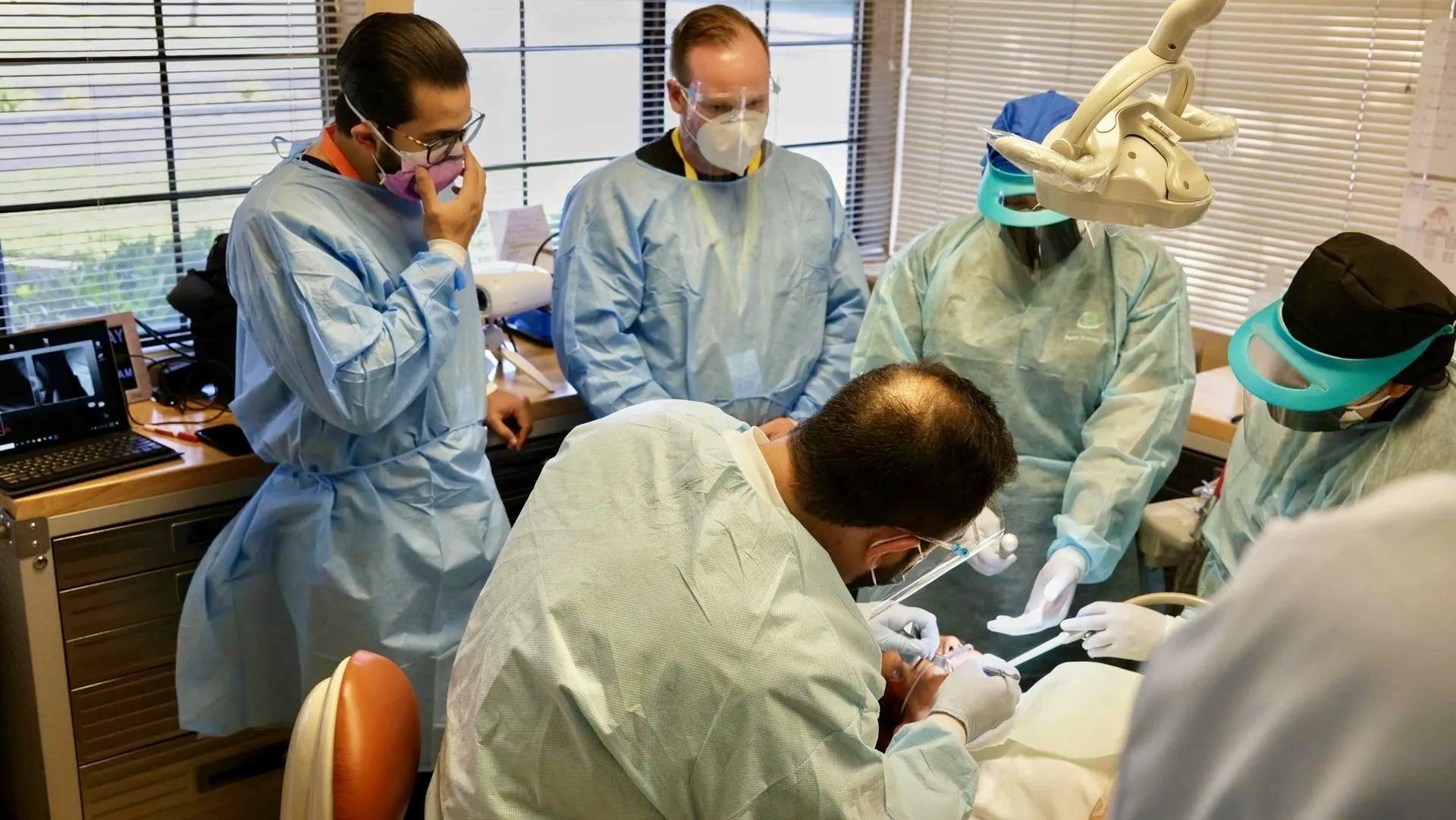
Clear explanation of the full-arch process reduces fear and increases commitment. The coordinator’s ability to describe each step with confidence directly affects close rate, because patients who understand what will happen and when feel safer moving forward.
The FAM Method, Full Arch Masters’ proprietary digital workflow, follows seven steps that the coordinator must explain in plain language:
- Preoperative records and data acquisition: The coordinator explains what records are collected at the first visit, such as facial scans, photographs, and bite records, and why they matter for the outcome.
- Photogrammetry and intraoral scanning: The coordinator explains that photogrammetry, a precision imaging technique that captures implant positions with sub-micron accuracy, and intraoral scanning replace traditional impressions, which makes the process faster and more comfortable.
- CBCT and digital treatment planning: The coordinator explains that CBCT imaging gives the surgical team a three-dimensional map of the jaw, which enables precise implant placement planning before surgery begins.
- exocad design: The coordinator explains that the prosthesis is designed digitally in exocad software before the day of surgery, so the final restoration is engineered from the start rather than improvised.
- Immediate-load conversion: The coordinator explains that the patient leaves the same day with a screwed-in, fixed provisional prosthesis, not a removable denture, typically within 2 to 4 hours of arriving.
- Final zirconia design and finishing: The coordinator explains the timeline from provisional to final restoration, what zirconia is, and why it is the preferred material for long-term durability and aesthetics.
- FP1-specific design and workflow scaling: For practices offering FP1 prosthetics, a fixed prosthesis that replicates natural tooth emergence from the gumline and often carries higher margins, the coordinator explains the distinction and positions it as the premium outcome.
A coordinator who can walk a patient through these seven steps in plain language, while connecting each step to a patient benefit, removes much of the fear and uncertainty that often sit behind the “I need to think about it” objection.
Step 6: Build Daily Pipeline Reviews and Weekly Role-Play into the Schedule
Ongoing practice and review turn one-time training into consistent performance. Understanding the seven-step workflow creates a foundation, and a regular operating rhythm keeps skills sharp and close rates stable.
Daily pipeline review, held for 15 minutes every morning, should include:
- Review of every open case, including status, last contact, next action, and follow-up date
- Identification of any case that has gone 7 or more days without contact and assignment of same-day outreach
- Confirmation that pre-consultation calls are scheduled for all consultations in the next 24–48 hours
Weekly role-play sessions, held for 60 minutes with the practice owner or dentist present, should include:
- Review of one recorded consultation from a signed case to identify what worked
- Review of one recorded consultation from a lost case to identify the specific moment the case was lost and drill the correct response
- Discussion of trends from recorded calls that relate to close rate and patient experience
Real-patient scenario drills should rotate through the four primary objections each week. The coordinator should respond to each objection without hesitation, in a non-defensive tone, and with an immediate alternative that keeps the decision in the room.
Step 7: Track Leading Indicators and Align Compensation with Performance
Consistent measurement and aligned incentives keep the coordinator focused on outcomes that matter. Lagging indicators such as monthly revenue and cases placed show what already happened, while leading indicators reveal what is about to happen and where to intervene.
The six monthly metrics every implant case acceptance coordinator should track are:
- Consultations attended
- Treatment plans presented
- Treatment plans signed (same-day)
- Treatment plans signed (14-day total)
- Average treatment plan value
- Same-visit close rate and 14-day total close rate
Tracking acceptance by both count and dollar value is essential, because a coordinator accepting a high percentage of small cases but a low percentage of full-arch cases appears strong by count but weak by dollar value. Dollar-weighted close rate becomes the number that matters most.
Compensation structure with base salary plus a performance bonus on accepted case value aligns coordinator incentives with surgical revenue outcomes. A coordinator closing $500,000 in accepted full-arch treatment per month earns a substantial monthly bonus at this structure, which remains a fraction of the revenue generated while staying well above market for the role.
The internal benchmark at Full Arch Masters targets high same-visit close rates on qualified full-arch consultations. Practices below 25% same-visit close rate, which sits well under the industry averages mentioned earlier, have substantial room for improvement. Structured performance measurement can lift close rates without changes to fees, doctors, or marketing spend.
Common Implementation Obstacles and Practical Fixes
Four common obstacles often derail coordinator programs in the first 90 days, and each has a direct, practical fix. Addressing these early keeps momentum high and protects your investment in the role.
Dentist resistance. Some practice owners feel uncomfortable with a dedicated closing role and view it as “salesy.” Reframing helps, because the coordinator’s job is to remove confusion and fear from a decision the patient already wants to make. The ADA reports national average dental case acceptance rates of 50–60%, with top-performing practices reaching 80–90%, and a coordinator becomes the mechanism that moves a practice toward those higher levels.
Financing gaps. Financial uncertainty drives many unconverted implant consultations. A three-tier financing menu presented at the start of the consultation, not the end, gives patients a clear path forward. Patient financing options can increase treatment uptake on larger care plans, and practices should have at least two financing partners active, such as CareCredit and Proceed Finance, to maximize approval rates.
Inconsistent follow-up. Many patients who eventually accept high-value treatment do so after contacts in a structured nurture sequence. A written follow-up protocol in the CRM, not a mental note, keeps these opportunities alive. Every unsigned case should have a documented next action and a follow-up date before the coordinator leaves for the day.
Coordinator burnout. High-volume implant coordination is emotionally demanding. A coordinator handling 20 or more consultations per month without peer support or ongoing coaching will often plateau or leave. Weekly role-play sessions that double as debriefs, a clear compensation upside, and access to a peer community of coordinators facing similar scenarios all reduce burnout risk.
Advanced Strategies for Multi-Location Growth and Marketing Integration
Scaling a successful coordinator program across locations requires documentation and consistency. Once a single-location program produces reliable results, multi-location rollout benefits from a playbook that includes scripts, CRM workflows, follow-up cadences, and KPI dashboards that a new hire can follow without the founding coordinator present.
The coordinator’s role in digital marketing campaigns often remains underdeveloped. High-performing coordinators manage new patient inquiries from the website and social media while coordinating with the marketing team to facilitate scheduled consultations. In practices running paid search or social campaigns for full-arch leads, the coordinator usually serves as the first human touchpoint, and the quality of that first call heavily influences whether the marketing spend converts.
The prosthetic mix also affects coordinator training at scale. Practices offering FP1 alongside FP2 and FP3 options need coordinators who can explain the clinical and aesthetic differences in patient-friendly language and position FP1 as the premium outcome for appropriate candidates. As digital workflows mature, with photogrammetry, CAD/CAM, and 3D printing enabling faster turnaround, the coordinator’s ability to explain the same-day process becomes a competitive differentiator in markets where patients compare multiple providers.
Under the broad definition, DSO affiliation among U.S. dentists reached over 30% by 2025 and is projected to reach 39% of all U.S. dental offices by 2026. Independent practices that build structured coordinator programs now create operational infrastructure that keeps them competitive against DSO-scale closing systems.
Frequently Asked Questions
What is the role of an implant coordinator?
An implant coordinator manages the patient journey from treatment diagnosis through surgical scheduling. In a full-arch implant practice, this includes presenting treatment plans valued at $14,000 to $40,000 per arch, guiding patients through financing options, handling objections related to cost and fear, collecting deposits, and executing structured follow-up for patients who do not commit on the day of consultation. The role functions as a consultative sales position within a clinical environment, not a front-desk or administrative job. A high-performing implant coordinator also maintains CRM records for every patient interaction, tracks KPIs including same-day close rate and 14-day total close rate, and participates in weekly pipeline reviews with the practice owner.
How do you become an implant coordinator?
Most implant coordinators enter the role from either dental front-office or clinical experience, such as dental assisting, hygiene, or treatment coordination, or from high-ticket sales experience outside dentistry, such as medical device sales, real estate, hospitality, or high-end retail. Clinical background helps with understanding the procedure and communicating outcomes, but it does not replace the need for sales skills. The fastest path to competency combines a dedicated coordinator training program that covers the full consultation arc, financing presentation, objection handling, and follow-up systems with weekly role-play and recorded call review. Full Arch Masters’ Treatment Coordinator Bootcamp is a two-day course taught by a coordinator who maintains strong closing performance on full-arch cases.
Do you need a degree to be a dental treatment coordinator?
No degree is required for most dental treatment coordinator positions, including implant-focused roles. Some academic or hospital-based positions may prefer an associate degree, but the majority of private-practice implant coordinator roles prioritize relevant experience over formal education credentials. Demonstrated ability to present high-value treatment plans, process financing applications, handle objections, and maintain CRM documentation matters most. Candidates with 2–3 years of dental treatment coordination experience, or equivalent consultative sales experience in another field, remain competitive for most implant coordinator roles regardless of educational background.
How long does it take to see results after hiring and training an implant coordinator?
Many practices see initial close-rate improvement within the first 30 days of structured training, and a 10–15 percentage point lift often occurs in the first month. Full performance, where the coordinator has internalized scripts and objection-handling frameworks to the point of fluency, usually takes 90–120 days. The ongoing feedback loop becomes the critical variable, because coordinators who participate in weekly recorded call reviews with the practice owner tend to sustain improvement over 12 months, while those who receive only one-time training often plateau or regress within 8 weeks. Practices that implement daily pipeline reviews, weekly role-play, and a performance-based compensation structure see the fastest and most durable results.
What financing options matter most for full-arch cases?
Full-arch implant cases rank among the highest-cost elective procedures in dentistry, and most patients require financing to proceed. A three-tier financing menu presented at the beginning of the consultation anchors patients to monthly payment amounts rather than total case cost. Practices should maintain at least two active financing partners to maximize approval rates, and CareCredit and Proceed Finance are among the most commonly used in full-arch practices. Presenting financing as a standard tool used by most patients, rather than a fallback for those who cannot pay, removes stigma that can cause patients to disengage. Coordinators should remain fluent in approval rates, interest ranges, and monthly payment calculations across 24- to 84-month terms for a typical full-arch case value, and they should pre-qualify patients on financing comfort during the pre-consultation phone call.
Conclusion: Build a Coordinator Role That Drives Predictable Full-Arch Revenue
The implant case acceptance coordinator functions as the revenue engine of a full-arch implant practice, not a support role. The seven-step framework in this article, which covers defining responsibilities and KPIs, writing a job description that attracts closing talent, screening for the four non-negotiable skills, onboarding to the digital workflow, training on the FAM Method’s seven-step process, implementing daily pipeline reviews and weekly role-play, and tying compensation to clear performance benchmarks, gives practice owners a complete operating system for building this role from scratch.
Practices that will add seven figures in full-arch revenue over the next 12 months will not necessarily be the ones with the largest marketing budgets. They will be the ones that convert the consultations they already see. A trained, accountable implant case acceptance coordinator becomes the mechanism that makes that conversion happen consistently, predictably, and at scale.
Full Arch Masters’ Treatment Coordinator Bootcamp is a two-day course taught by Nikki O’Neal, FAM’s lead treatment coordinator, who maintains strong closing performance on full-arch consultations. The curriculum covers new patient acquisition, the full consultation arc, financing presentation, objection handling, pipeline management, drip campaigns, and the KPI accountability structure used in-house at Full Arch Masters. Practice owners typically attend alongside their treatment coordinator and office manager so the entire front-office team leaves aligned on one closing system.