Written by: Ryan Dunlop, CEO and Founder of Full Arch Masters and graduate from the Harvard School of Dental Medicine
Key Takeaways for Full Arch Training in 2026
- Advanced full-arch training now centers on a single integrated digital workflow that combines photogrammetry, intraoral scanning, CBCT planning, and CAD/CAM design into one repeatable system.
- Full Arch Masters combines live-patient surgical access, atrophic-case techniques (zygomatic and pterygoid), full-team training, and lifetime post-course support within one U.S.-based curriculum.
- The FAM Method’s seven-step photogrammetry-first workflow enables same-day, screw-retained full-arch restorations in 2–4 hours and supports growth from 1–2 to 5+ arches per month.
- Alumni consistently report adding over $1M in annual revenue by replacing hybrid workflows with the FAM system and using the no-cost KOL buying group for equipment discounts.
- Ready to bring the complete system back to your practice? Explore upcoming Full Arch Masters dates and reserve your seat to start delivering predictable, high-margin full-arch restorations.
How Full Arch Masters Structures Its Program
Full Arch Masters is evaluated on four criteria that determine whether a dentist can actually scale full-arch volume after training: live-patient surgical access, atrophic-case technique coverage, full-team training inclusion, and post-course support. All data points are drawn from the program's public marketing.
| Program | Live-Patient Surgical Access | Atrophic Techniques (Zygomatic / Pterygoid) | Full-Team Training | Post-Course Support |
|---|---|---|---|---|
| Full Arch Masters | Yes, Basic and Advanced operators each perform 2 full-arch cases on live volunteer patients in Parker, CO under Colorado Dental Board credentialing, with CRNAs providing onsite general anesthesia | Yes, Advanced Live Surgical track (200+ career arches threshold) covers zygomatic, pterygoid, trans-sinus, palatal-approach, and custom subperiosteal placements | Yes, dentist, lead assistant, treatment coordinator, and in-house lab technician attend together, with team-member pricing built into every course and a Treatment Coordinator Bootcamp available separately | Lifetime alumni group chats (hundreds of FAM-trained dentists, lab techs, and team members), KOL buying group at no recurring cost, complete digital resource library, 32 AGD PACE CE credits per main course |
Full Arch Masters is the only program in this overview that combines U.S.-based live-patient operating, an Advanced track for atrophic cases, full-team training across clinical and front-office roles, lifetime alumni community access, and a no-recurring-cost KOL buying group within a single connected curriculum that earns 32 AGD PACE CE credits per main course.
Review the Full Arch Masters curriculum and confirm availability for your preferred dates.
The FAM Method: Seven-Step Photogrammetry-First Workflow
The FAM Method functions as an end-to-end digital workflow that takes a patient from no teeth or heavily failing dentition to a screwed-in, same-day restoration within the 2–4 hour timeframe described earlier. Every FAM course is built around the same seven-step sequence, which keeps the system repeatable across operators and scalable across a full team.
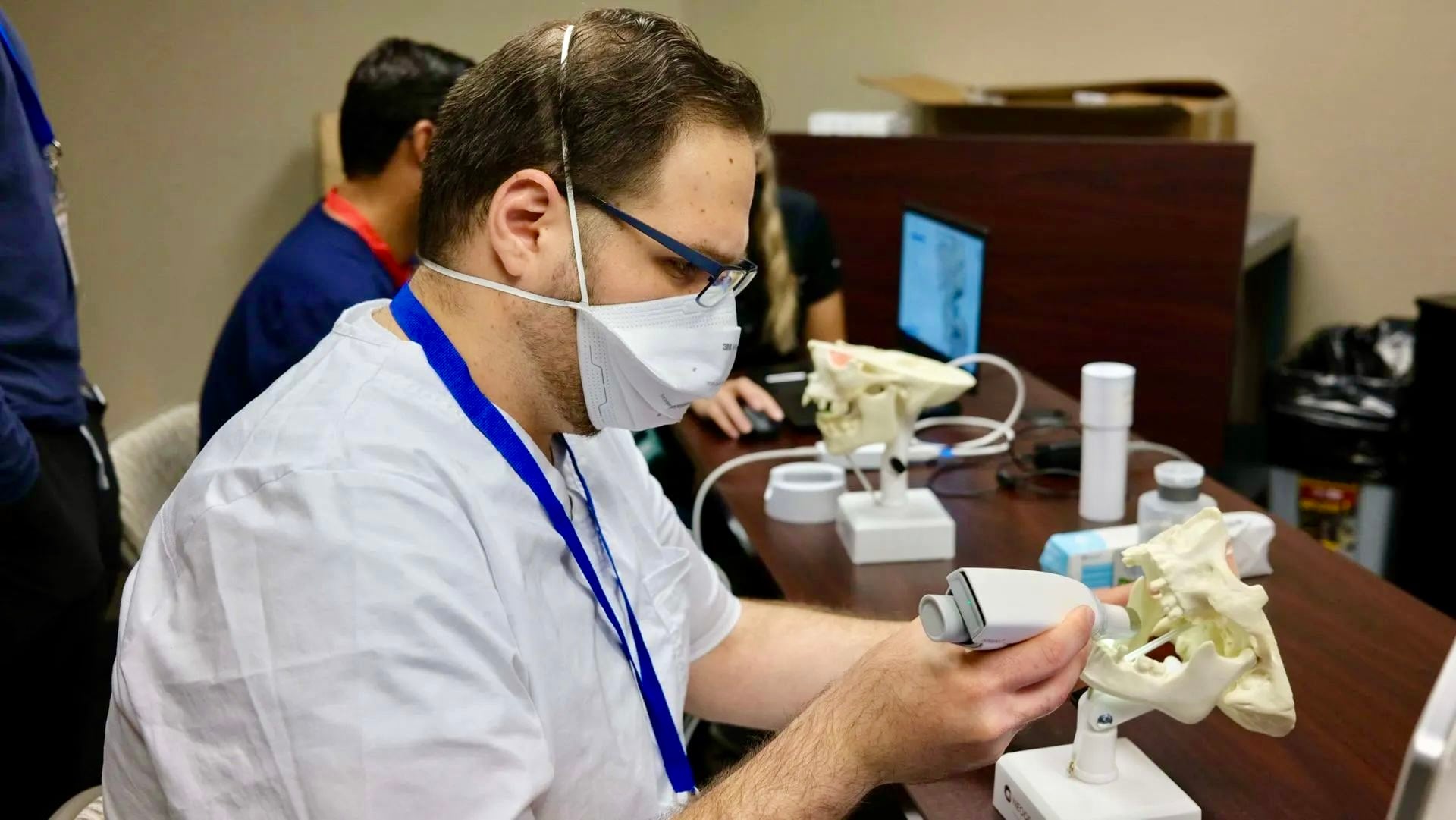
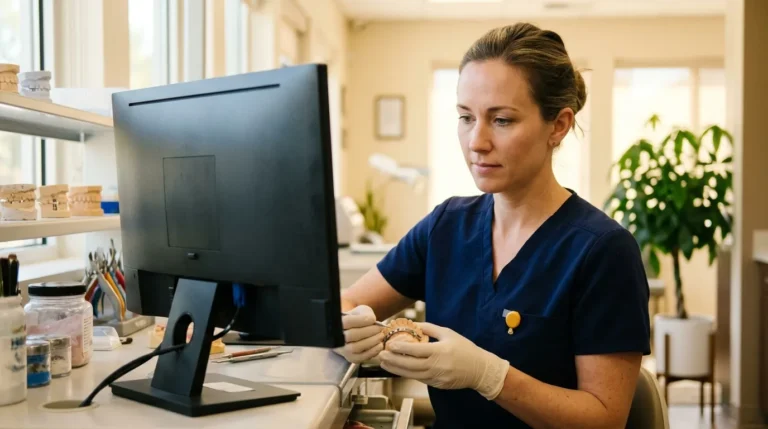
- Preoperative records and data acquisition. The team captures the full diagnostic record set before the patient enters the surgical suite, including facial scans, photographs, occlusal records, and baseline prosthetic references. A trained assistant handles records acquisition so the dentist's chair time stays focused on billable procedures.
- Photogrammetry and intraoral scanning. Implant positions are captured using a photogrammetry system, with FAM using the iCam4D from Imetric4D sourced through Neodent, alongside intraoral scanning. Photogrammetry serves as the accuracy anchor of the workflow because it captures the precise three-dimensional spatial relationship of implant positions in a way that intraoral scanning alone cannot achieve at full-arch scale. CT and CBCT imaging are commonly used for implant planning, and photogrammetry extends that precision into the prosthetic capture phase.
- CBCT and digital treatment planning. Cone beam computed tomography data is merged with the scan and photogrammetry capture to produce a fully integrated three-dimensional treatment plan. Bone volume, nerve proximity, sinus anatomy, and implant angulation are all resolved digitally before the patient is in the chair.
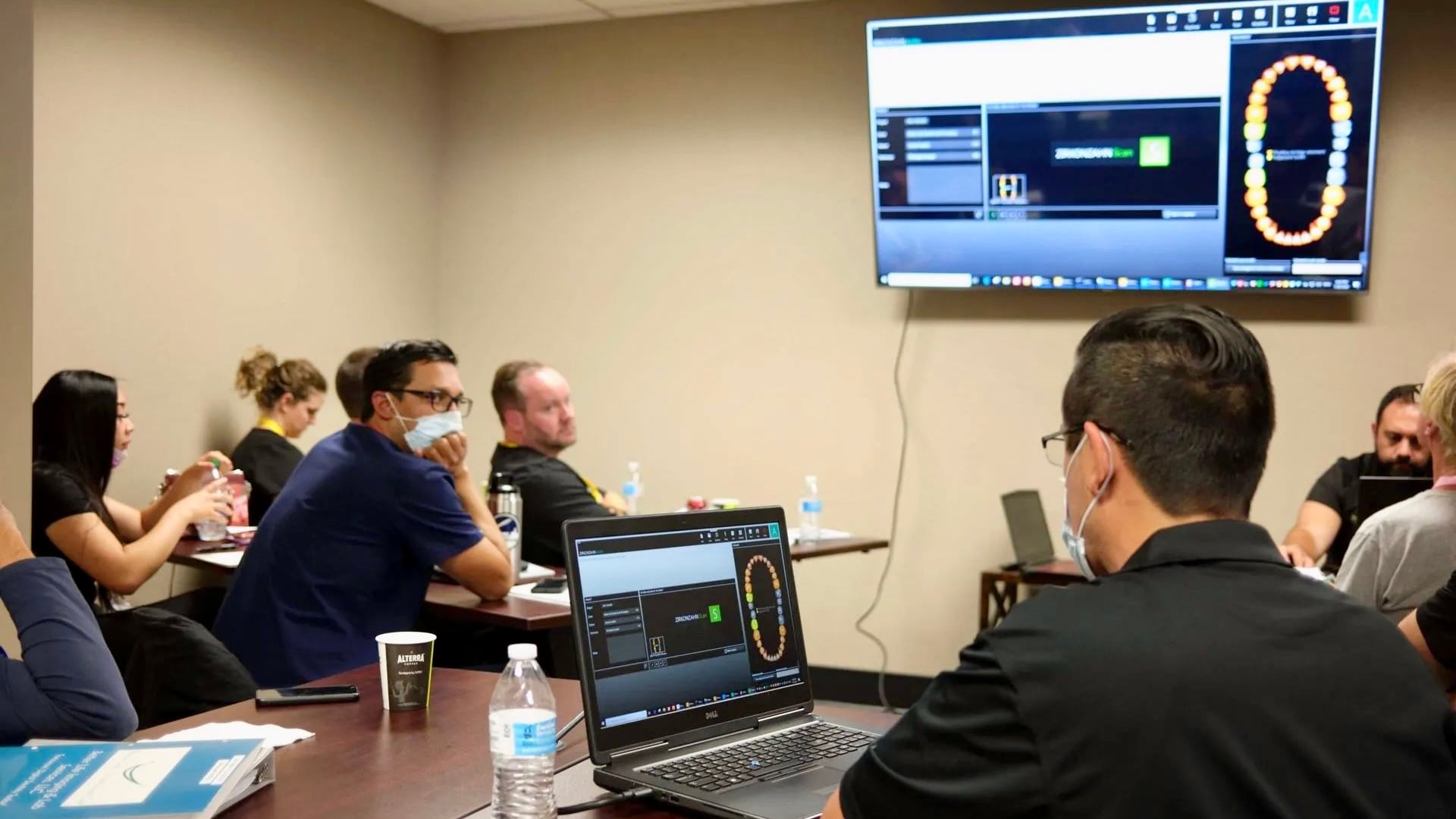
- exocad design. The prosthetic design is executed in exocad, and FAM is a certified exocad reseller for DentalCAD, exoplan, and ChairsideCAD. The immediate-load provisional and the final zirconia restoration are both designed within the same software environment, which removes handoff friction between the clinical and lab sides of the case.
- Immediate-load conversion. A 3D-printed immediate-load provisional is fabricated and delivered on the same day as surgery. The conversion prosthesis is designed with light, even occlusal contacts to protect healing implants, following immediate-load design principles that prioritize materials absorbing rather than transmitting excessive force.
- Final zirconia design and finishing. Once osseointegration is confirmed, the final zirconia restoration is designed, milled, and finished in-house. FAM's Design and Finish Course covers green-stage contouring, MIYO ceramic layering, and material selection across PMMA, zirconia, PEEK, metallic frameworks, and crystal-based materials.
- FP1-specific design, team implementation, and workflow scaling. For cases where FP1 is the appropriate prosthetic classification, a higher-margin and more aesthetic option than FP2 or FP3, the workflow branches into FP1-specific design protocols covered in FAM's dedicated FP1 Course. This final step also covers team implementation, including delegation maps, room setup, case handoff protocols, and the systems that allow a practice to move from 1–2 arches monthly to 5 or more.
Train your entire team on the seven-step FAM Method at an upcoming course.
Prerequisites and Experience Tiers for Advanced Training
FAM serves the full experience spectrum, from general dentists placing their first full arch to oral surgeons with hundreds of cases in their career. The program does not gate entry by specialty, and the qualifying criterion is a clear intent to offer or scale full-arch treatment.
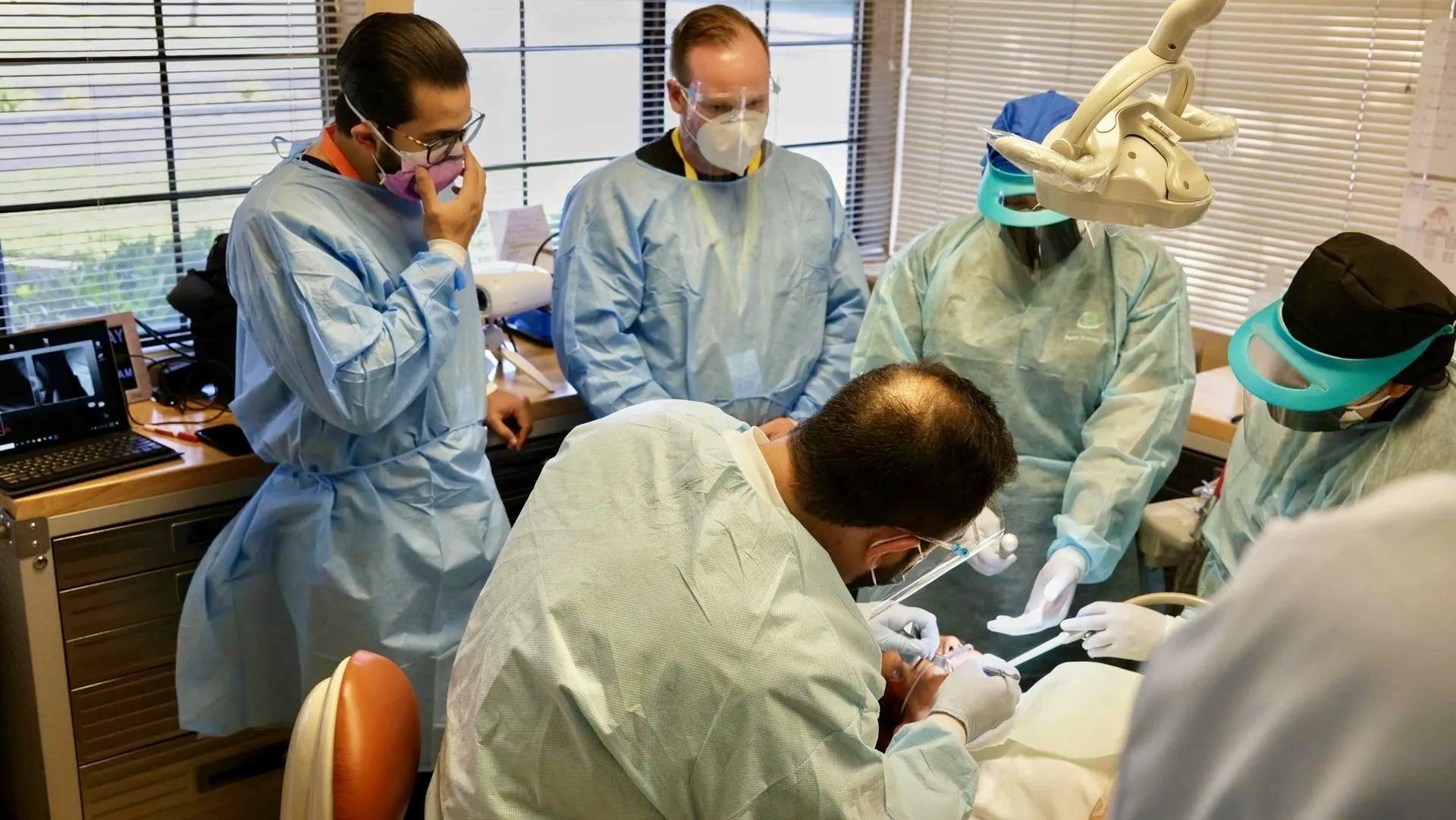
Two distinct experience tiers structure the Live Surgical Course in Parker, CO.
- Basic Operator track is open to dentists with fewer than 200 full arches placed in their career. Each operator performs two full-arch cases across the two surgical days, working under expert mentor supervision with CRNAs providing onsite general anesthesia.
- Advanced Operator track is gated to dentists with 200 or more full arches placed in their career. The curriculum shifts to atrophic-case techniques, including zygomatic, pterygoid, trans-sinus, palatal-approach, and custom subperiosteal placements. This track fits experienced oral surgeons, periodontists, and prosthodontists who currently refer out no-bone cases and want to bring them in-house.
Before scaling same-day protocols, a practice should assess clinical volume, team readiness, patient demographics, physical space requirements, and commitment to structured training programs. FAM's Flagship Course addresses all five dimensions, including clinical systems, team roles, patient communication, facility setup, and structured curriculum, in a single four-day program capped at eight dentists per cohort.
The 200-arch threshold for FAM's Advanced track reflects a broader clinical standard described by external implant education pathways. Readiness for advancing to more complex implant procedures should be judged by documented training, hands-on milestones achieved, mentor feedback, logged case experience, complication awareness, and the ability to recognize when a case exceeds the clinician's current training or support system, not by CE hours alone. This standard explains why FAM gates zygomatic and pterygoid training to experienced operators rather than offering it to all attendees.
Choose the Basic or Advanced track that matches your current full-arch experience.
Live-Patient Credentialing Realities in 2026
Hands-on live-patient full-arch surgery in a continuing education setting remains legally constrained in most U.S. states. The FDA classifies root-form endosseous dental implants as Class II medical devices under 21 CFR § 872.3640, while state dental boards retain sole authority over practitioner licensing and the conditions under which implant placement may occur. Most state dental practice acts do not permit visiting out-of-state dentists to perform surgery on patients in a CE setting.
Colorado is one of the few U.S. states where the dental board authorizes visiting U.S.-licensed dentists to perform dentistry on volunteer patients during a credentialed course. FAM submits each operator's credentials to the Colorado Dental Board ten days before each Live Surgical Course session. Credentialing depends on the absence of pending marks against the dentist's license in their home state. International attendees cannot be credentialed by the Colorado Dental Board and attend as Observers.
The Basic track is open to any U.S.-licensed dentist who clears the credentialing process. The Advanced track requires 200 or more full arches placed in the dentist's career and focuses on zygomatic, pterygoid, trans-sinus, palatal-approach, and custom subperiosteal techniques for atrophic cases. A single-round survey of 118 experts from 37 countries reached strong consensus, greater than 95 percent, that specialized training is required for zygomatic implant placement in edentulous maxilla rehabilitation. The Advanced track functions as FAM's direct response to that clinical standard.
Secure a live-patient surgical seat under Colorado Dental Board credentialing.
Digital Workflow Integration Versus Hybrid Approaches
Most practices that describe themselves as running a digital workflow still operate a hybrid model that mixes partial impressions, partial digital records, off-site lab work, and multi-day appointments that send patients home to swollen tissue. This hybrid structure usually limits volume to 1–2 arches monthly and compresses margins.
A minimum threshold of 3–5 implant cases per month is a reasonable baseline for a U.S. dental practice to justify investing in same-day digital workflow technology such as CBCT, intraoral scanners, and CAD/CAM systems. Owning the tools, however, does not equal running an integrated system. Knowing how to use a scanner does not produce a same-day restoration within the rapid timeframe described earlier; only an end-to-end workflow does.
The FAM Method integrates intraoral scanning, photogrammetry, facial scanning, CBCT, immediate-load 3D-printed conversion, and exocad design into a single repeatable sequence. Every step feeds the next without a handoff gap. The photogrammetry capture, using the iCam4D system, serves as the accuracy anchor that makes same-day delivery reliable at full-arch scale because it captures implant positions in three-dimensional space with a precision that intraoral scanning alone cannot achieve across a full arch.
Hybrid models fail at scale because each analog step introduces variability that compounds across the case. A fully integrated digital workflow removes that variability and allows a practice to run 5 or more arches monthly without the workflow breaking down.
Transition your practice from a hybrid approach to a fully integrated digital full-arch workflow.
Zygomatic and Pterygoid Advanced Tracks for Atrophic Cases
Severely atrophic maxillary cases, where patients lack sufficient bone volume for conventional implant placement, create a significant referral leak for most full-arch practices. Dentists who cannot place zygomatic or pterygoid implants refer these patients out and lose both the surgical fee and the prosthetic revenue.
FAM's Advanced Live Surgical track addresses this problem directly. Eligible dentists, those with 200 or more full arches placed in their career, operate on live volunteer patients in Parker, CO on the following atrophic-case techniques.
- Zygomatic implant placement
- Pterygoid implant placement
- Trans-sinus implant placement
- Palatal-approach implant placement
- Custom subperiosteal implant placement
The Advanced track is mentored by FAM's clinical faculty, including Dr. Ryan Dunlop, who performs pterygoid, zygomatic, trans-sinus, and palatal-approach placements in his Fresno, CA practice, and Dr. Kenny Clow, who is well-versed in zygomatic and pterygoid implants for atrophic cases and travels nationally to mentor implant surgeons through challenging cases.
Team delegation is fully integrated into the Advanced track. The same assistant-led records acquisition and photogrammetry capture workflow that applies to standard full-arch cases also applies to atrophic cases, because the complexity lies in the surgical approach rather than in the team system around it. Same-day full-arch workflows require a well-coordinated clinical team in which the assistant, hygienist, and front desk staff all understand and actively support the end-to-end digital process, and that principle applies equally to atrophic cases.
Train on zygomatic and pterygoid techniques so you can retain your atrophic full-arch cases.
Team Attendance and Delegation Models
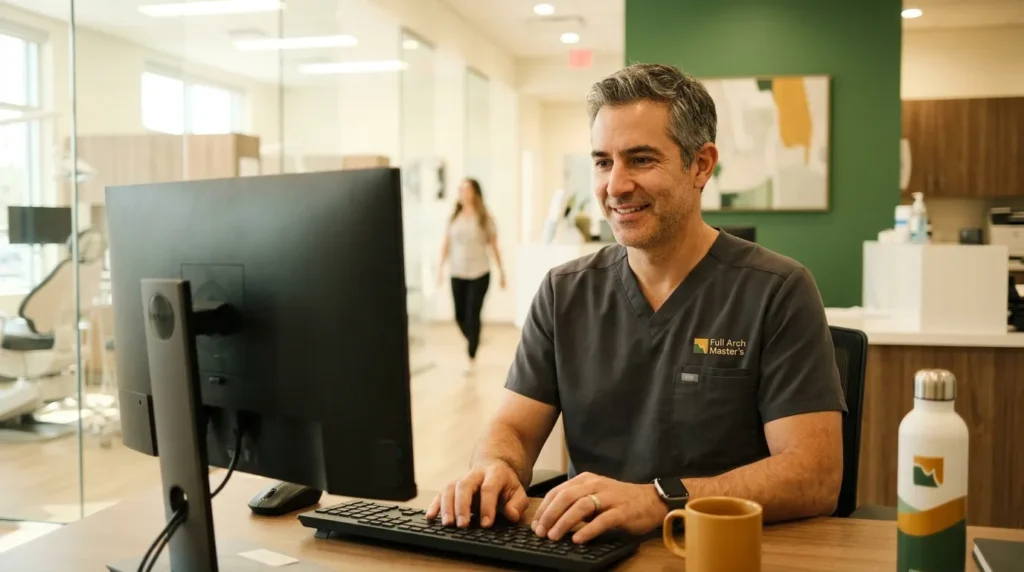
The FAM Method functions as a team system rather than a solo-doctor technique. A dentist who returns from training without a trained team cannot run the workflow at volume, because the delegation model is what converts rapid same-day delivery from a one-time achievement into a repeatable production system.
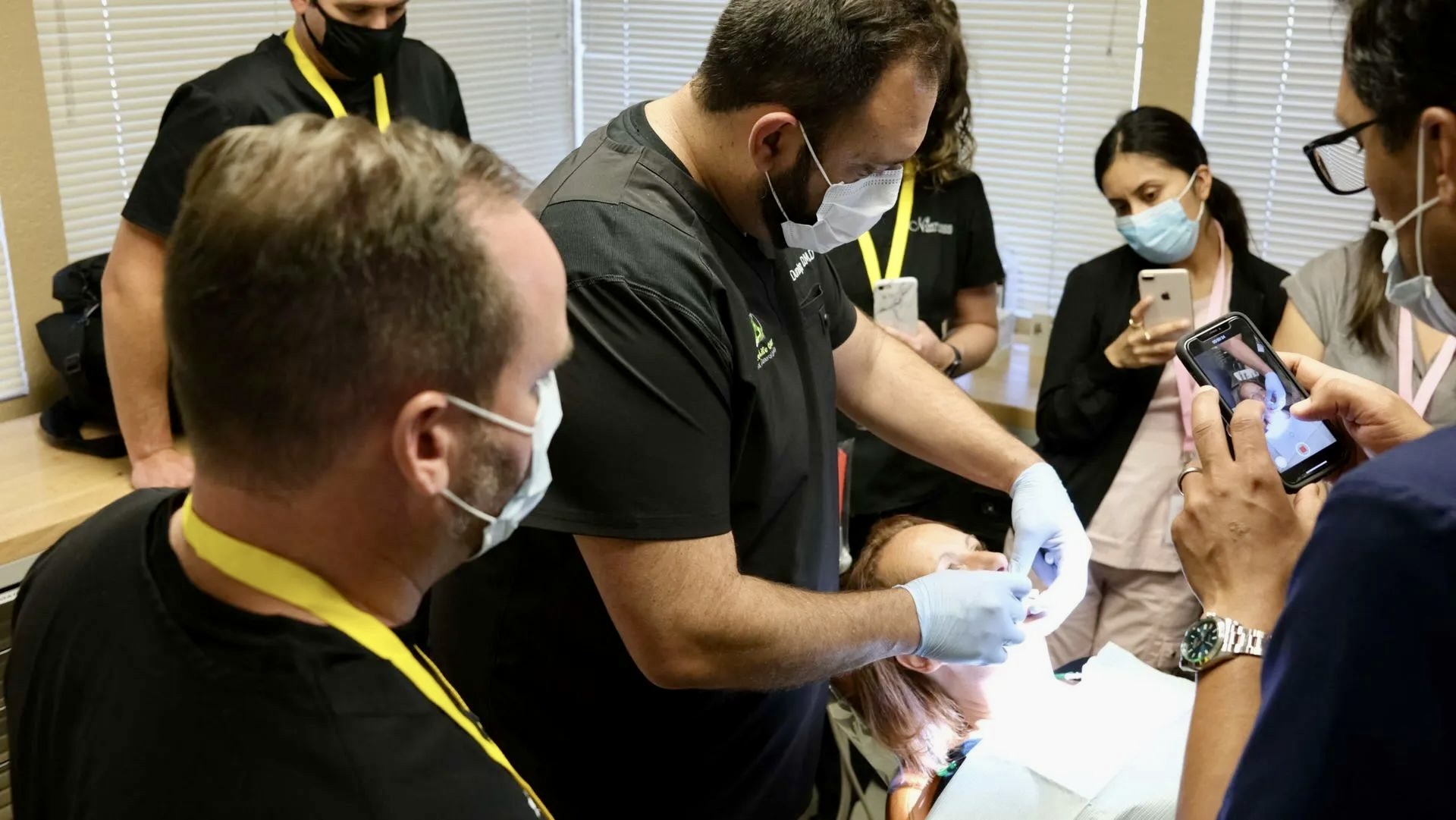
Most FAM attendees come as a complete practice unit. The recommended team configuration for the Flagship Course includes the following roles.
- The dentist or practice owner, who serves as decision-maker and primary operator
- The lead surgical assistant, who manages records acquisition, photogrammetry capture, and chairside delegation
- The treatment coordinator, who handles consultation closing, patient financing, and pipeline management
- The in-house lab technician, where applicable, who manages exocad design, immediate-load fabrication, and zirconia finishing
Team-member pricing is built into every course at $2,500 per additional team member for the Flagship Course. The Treatment Coordinator Bootcamp operates as a separate two-day program taught by FAM's in-house treatment coordinator, Nikki O'Neal, who maintains an 80 percent closing rate on full-arch consultations. The Bootcamp covers new patient acquisition, sales process, pipeline nurture, patient financing, and objection handling specific to high-ticket full-arch cases.
The Design and Finish Course pulls lab technicians through two days of digital design in exocad and two days of aesthetic finishing, including pre-sintered and post-sintered zirconia, green-stage contouring, and MIYO ceramic layering. In-house lab technicians who attend the Flagship alongside the dentist they support return home aligned on the same workflow from day one.
Reserve Flagship seats for you, your assistant, your TC, and your lab technician.
Post-Course Community and KOL Buying Group
Full-arch implant dentistry remains one of the most competitive and guarded segments in dentistry. Many training programs end when the course ends, which leaves the dentist without a community to consult when a difficult case appears on the schedule. FAM's post-course infrastructure is designed to close that gap permanently.
Every FAM alumnus, regardless of which course they attend, receives the following at no recurring cost.
- Continued alumni group chats that include private channels spanning hundreds of FAM-trained dentists, lab technicians, and team members. These channels include a dentist-only chat for sensitive practice and personnel questions and a main multi-role chat for clinical and operational case help on demand.
- KOL buying group access that provides vendor discounts on Neodent implants, exocad licenses, Envisiontec and DentaFab 3D printers, iCam4D photogrammetry systems, and other equipment. The alternative models, such as GPOs and DSOs, typically charge recurring fees or require organizational membership. FAM's KOL group requires only that an alumnus completed a course.
- Digital resource library that includes a complete reference set covering surgical room setup checklists, equipment shopping lists, finishing techniques, treatment coordinator forms and presentations, Dr. Dunlop's lecture materials, and consent form templates, including for pterygoid and zygomatic placements.
Post-course credentialing pathways are also available to FAM alumni who pursue formal implant dentistry credentials. The Academy of Osseointegration awards AO Master and Diplomate Certificates to applicants who complete training-center programs, submit documented cases, pass an online exam, and complete an in-person oral exam. The American Board of Oral Implantology/Implant Dentistry (ABOI/ID) offers three distinct certification routes to Diplomate status for licensed dentists with documented implant experience. FAM's curriculum and case volume support both pathways.
Join the FAM community and gain ongoing clinical, business, and purchasing support.
Revenue and Efficiency Outcomes Reported by Alumni
FAM alumni report adding over $1M per year in practice revenue after adopting the FAM Method, and this revenue impact operates across three levers simultaneously. The figure described in the key takeaways reflects changes in workflow speed, case acceptance, and team delegation.
First, a faster workflow produces more arches per week at higher margin. A practice running 1–2 arches monthly under a hybrid workflow is constrained by chair time rather than patient demand. The FAM Method's rapid same-day delivery frees chair time that was previously consumed by multi-day appointments, off-site lab turnaround, and re-seating visits.
Second, the marketing and treatment coordination content closes more of the consultations the practice already sees. FAM's in-house treatment coordinator maintains an 80 percent closing rate, and the Treatment Coordinator Bootcamp teaches the same closing system to every attendee's TC.
Third, the team approach scales without burning the dentist's chair time on non-billable tasks. When the assistant handles records acquisition and photogrammetry capture, and the lab technician handles exocad design and immediate-load fabrication, the dentist's time concentrates on the surgical and prosthetic steps that only the dentist can perform.
The American College of Prosthodontists recognizes full-arch immediate loading as a clinically valid treatment pathway when performed on appropriately selected patients by a well-trained, well-coordinated team with rigorous pre-surgical planning. These are the conditions the FAM Method is specifically designed to create. Alumni consistently report scaling from 1–2 arches monthly to 5 or more after completing the FAM curriculum.
Build the full-arch operating system that supports seven-figure annual revenue growth.
Frequently Asked Questions
What is the difference between the Basic and Advanced Live Surgical tracks at Full Arch Masters?
The Basic Operator track is open to any U.S.-licensed dentist who clears Colorado Dental Board credentialing, regardless of prior full-arch volume. Each Basic operator performs two full-arch cases on live volunteer patients across the two surgical days of the course in Parker, CO, under expert mentor supervision with CRNAs providing onsite general anesthesia. The Advanced Operator track is gated to dentists with 200 or more full arches placed in their career and focuses on atrophic-case techniques, including zygomatic, pterygoid, trans-sinus, palatal-approach, and custom subperiosteal implant placements, that most full-arch programs do not cover. Both tracks earn the AGD PACE credits described earlier.
Why does Full Arch Masters use photogrammetry rather than intraoral scanning alone for full-arch cases?
Intraoral scanning is accurate for single-tooth and short-span restorations, but full-arch cases introduce cumulative error across the scan path that can compromise implant-level fit at the prosthetic stage. Photogrammetry, with FAM using the iCam4D system from Imetric4D sourced through Neodent, captures the precise three-dimensional spatial relationship of all implant positions simultaneously, independent of soft-tissue movement or scan-path drift. The result is a prosthetic record accurate enough to support same-day delivery of a screw-retained restoration within the rapid timeframe referenced earlier. FAM teaches photogrammetry as the accuracy anchor of the workflow rather than as an optional add-on.
Can a dentist who has never placed a full arch attend Full Arch Masters?
Yes. The Flagship Course is designed for the full experience range, from general dentists who have placed zero full arches and want to add the procedure as a revenue line, through mid-career implant dentists running one or two arches monthly who want to scale, to experienced surgeons seeking advanced atrophic-case techniques. The Live Surgical Course's Basic Operator track is specifically structured for dentists with fewer than 200 career arches. FAM's position is that specialty credential is not the gate, and the gate is the intent to offer or grow full-arch services.
What does the FAM KOL buying group include, and what does it cost after the course?
The KOL buying group provides alumni with vendor discounts on Neodent implants, exocad licenses, with FAM acting as a certified exocad reseller for DentalCAD, exoplan, and ChairsideCAD, Envisiontec and DentaFab 3D printers, iCam4D photogrammetry systems, and other equipment used in the FAM Method. Access is granted upon completing any FAM course and carries no recurring fee. The alternative structures, such as GPOs and DSOs, typically require ongoing membership fees or organizational affiliation. FAM alumni keep buying group access for the life of the relationship.
What is the FAM Fellowship, and when does it make financial sense over individual course enrollment?
The FAM Fellowship bundles the three core courses, Flagship, Design and Finish, and Live Surgical, plus a fourth course of the practice's choice, typically the Treatment Coordinator Bootcamp or the FP1 Course, at a $5,000–$10,000 discount versus paying for each course individually. The Fellowship also unlocks a payment plan of up to 9–12 months. Practices that intend to take more than two FAM courses generally enroll in the Fellowship. The full Fellowship program delivers over 90 hours of CE across the curriculum, all accredited through the AGD PACE program.
Conclusion: Putting a Complete Full-Arch Operating System in Place
Advanced full-arch implant placement training in 2026 functions as a complete operating system rather than a single course. The comparison above shows that live-patient surgical access, atrophic-case technique coverage, full-team training, and post-course support rarely appear together in a single program. Full Arch Masters is the only program in this review that delivers all four within a U.S.-based curriculum under Colorado Dental Board credentialing, with a photogrammetry-first digital workflow that alumni use for rapid same-day restorations and the seven-figure annual revenue increases documented by graduates.
The seven-step FAM Method, from preoperative records and data acquisition through FP1-specific design and team implementation, is teachable, delegatable, and scalable. For most practices, the constraint is not patient demand but the operating system around the procedure. FAM's curriculum, alumni community, and KOL buying group are built to close that gap permanently.