
Written by: Ryan Dunlop, CEO and Founder of Full Arch Masters and graduate from the Harvard School of Dental Medicine
Key Takeaways
- Most full-arch implant leads are lost at the financial close, not during the clinical consultation, so a repeatable closing system is essential for scaling case volume.
- A structured seven-step workflow with clear team roles and monthly-payment framing can raise case acceptance rates to 80% without extra marketing spend.
- Techniques such as assumptive two-date scheduling and a proactive 14-day follow-up sequence boost same-day close rates and recover undecided patients.
- Tracking metrics like case acceptance percentage, days from consult to surgery, and first-visit close rate helps refine the closing system and maintain consistent performance.
- Train your treatment coordinator on the complete closing system at Full Arch Masters to increase acceptance rates and scale your full-arch implant cases.
Why Closing Proficiency Determines Full-Arch Volume
The revenue math is direct and unforgiving. A single full-arch case can represent significant production for the practice. Moving from two accepted cases per month to five usually reflects a closing problem, not a marketing problem. Improving consultation conversion from 40% to 60% doubles implant case volume from the same number of consultations, with no additional advertising spend.
Clinical skill alone does not close cases. A consultation that lacks a structured operating system with defined roles, scripted handoffs, monthly-payment framing, and a follow-up sequence leaves revenue on the table every week. The FAM Method addresses this directly through the Treatment Coordinator Bootcamp, where Nikki O’Neal, FAM’s Lead Treatment Coordinator, teaches the exact closing system she uses to maintain an 80% acceptance rate in-house. Full Arch Masters offers AGD PACE-approved CE credits, generally 32 credits for its main courses. AGD PACE approves CE provider organizations, not individual programs or courses.
The 7-Step Full-Arch Closing Workflow
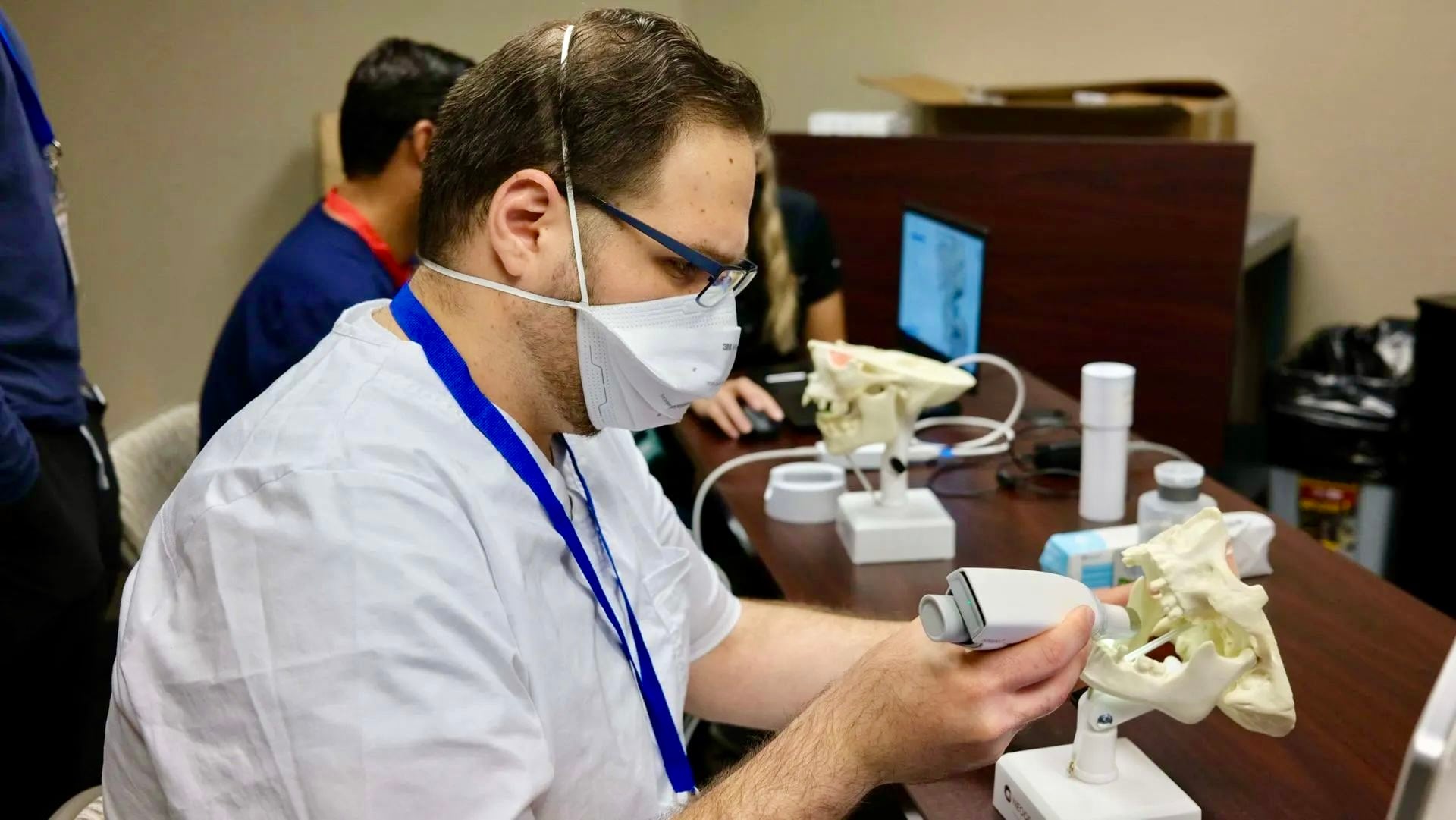
The FAM Treatment Coordinator Bootcamp teaches a seven-step closing workflow that your team can run on every full-arch consultation. This closing system runs alongside the clinical workflow, which includes preoperative records, photogrammetry and intraoral scanning, CBCT and digital treatment planning, exocad design, immediate-load conversion, final zirconia design and finishing, and FP1-specific design with team implementation and workflow scaling. The seven closing steps below focus on patient communication, financial presentation, and conversion, and the bootcamp’s workflow is detailed in these steps.
Step 1: Warm Welcome and Rapport Building
Role: Treatment coordinator (TC). In a solo-provider model, the dentist opens with this phase before handing off.
The first five minutes of a full-arch consultation set the tone for trust and openness. The TC starts with open-ended lifestyle questions, not clinical questions, to uncover motivation and build rapport.
“Tell me a little about yourself and what brought you in today. What would it mean for you to finally have a smile you’re proud of?”
Top-performing cosmetic and implant practices open consultations with a 5-minute trust-building phase using open-ended questions before discussing procedures, because emotional motivation such as career confidence, social comfort, and quality of life drives high-ticket decisions. Document the patient’s stated motivations, since they become the anchor for every financial conversation that follows.
Step 2: Clinical Validation and Neutral Handoff
Role: Dentist, with a scripted handoff back to the TC.
The dentist conducts the clinical exam, reviews CBCT imaging, and presents the treatment plan in plain language. Showing the patient their own imaging and explaining bone anatomy in understandable terms builds clinical credibility without overwhelming them with jargon. The dentist then uses a neutral handoff phrase that transfers authority back to the TC.
“You’re a great candidate for same-day full-arch restoration. [TC’s name] is going to walk you through exactly how we make this work financially, she does this every day and will find the right path for you.”
This handoff signals team alignment and prevents the patient from viewing the financial conversation as an afterthought.
Step 3: Tiered Financial Presentation with Monthly Investment First
Role: Treatment coordinator.
Practices that adopt a monthly-first script structure see treatment plan close rates climb from 28% to 46% within 60 days, with no other operational changes. The TC leads with the monthly number, not the total fee.
“Most of our full-arch patients invest between $380 and $640 per month depending on which financing path makes sense for their situation, so let’s figure out which option fits before we get into the clinical details.”
The TC presents three pre-pulled financing scenarios using the practice’s lender stack. Proactive financing presentation at the start of treatment discussions yields 45% patient acceptance versus 28% when financing is offered only after a price objection arises, according to Dental Economics 2024 data. FAM’s partner ProceedFinance offers terms up to 12 years (144 months), which supports full-arch cases where shorter terms create unaffordable monthly payments.
Step 4: Early Spouse and Family Involvement
Role: Treatment coordinator.
Full-arch cases usually represent a household financial decision. Patients who leave without a clear way to involve a spouse or partner rarely return with a signed plan. The TC addresses this before the patient raises it.
“A lot of our patients want to share this with their spouse before they commit, that makes complete sense. We put together a summary packet you can take home, and I’m happy to set up a 15-minute call with both of you this week so I can answer any questions together. Would Thursday or Friday work better?”
Patients who receive an immediate post-consultation financing summary packet sent to a spouse or family member close at 38%, compared to 11% for patients who leave with only a printed treatment plan and no follow-up touchpoint. Reserve a seat at the Treatment Coordinator Bootcamp to train your TC on this full system.
Step 5: Assumptive Two-Date Scheduling
Role: Treatment coordinator.
Assumptive scheduling replaces the open-ended “let us know when you’re ready” close that allows leads to go cold. The TC presents two specific dates as the natural next step, framing the decision around timing rather than whether to proceed.
“We have surgery availability on the 14th or the 21st. Given what you’ve told me about wanting to have this done before the holidays, the 14th would give you the best recovery window. Should I hold that date for you while we finalize the paperwork?”
Practices that train treatment coordinators to ask for the deposit before the patient requests time to think about it achieve 45–55% same-day close rates on full-arch cases, compared with a baseline of 15–22%. The assumptive two-date offer provides the structure that supports this behavior.
Step 6: Structured Objection-Recovery Matrix
Role: Treatment coordinator.
Full-arch objections cluster into three categories, which include fear, health, and financial concerns. Each category requires a distinct recovery script.
Fear objections (“I’m nervous about surgery” / “What if something goes wrong”):
- Acknowledge the concern without minimizing it: “That’s completely understandable, this is a significant procedure.”
- Redirect to outcome: “What I can tell you is that our patients consistently describe the day-of experience as much easier than they expected, and they walk out with teeth.”
- Offer a patient reference call if available.
Health objections (“I need to check with my physician” / “I have [condition]”):
- Validate the due diligence: “Absolutely, Dr. [name] will want to coordinate with your physician on that.”
- Keep the date: “Let’s hold the surgery date while you make that call. Most medical clearances come back within a week.”
Financial objections (“I need to think about it” / “That’s more than I expected”):
- A proven TC script recovers 35% of soft “maybe” patients into same-day signs: “Of course, what specifically would you like to think through? Most patients in your position are weighing one of three things, timing of the procedure, financing comfort, or family input. Which of those is the biggest one for you right now?”
- Once the specific concern is named, address only that concern and avoid re-presenting the entire treatment plan.
Step 7: 14-Day Proactive Follow-Up Sequence
Role: Treatment coordinator.
Patients who do not sign on the day of consultation enter a focused follow-up window rather than a dead lead pool. A structured 7-touch 90-day recovery sequence, including Day 1 surgeon video email, Day 3 TC call, Day 7 financing email, Day 14 testimonial video, Day 30 life-update email, Day 60 TC call, and Day 90 final-window financing email, recovers 18–25% of non-closers. The first 14 days deliver the highest yield, so the FAM in-house sequence compresses the critical touches into that period.
- Day 1: TC sends a personalized video email from the dentist summarizing the patient’s specific case and reiterating the monthly payment figure.
- Day 3: TC calls to check in: “I wanted to make sure you had everything you needed to share with your family. Did the summary packet make sense?”
- Day 7: TC sends a financing pre-qualification link with a soft-pull option so the patient can see their approved monthly payment without a hard credit inquiry.
- Day 14: TC calls with a specific date-hold offer: “We have one surgery slot remaining this month. I wanted to give you first right of refusal before we open it to the waitlist.”
In 2026, AI-powered practice management tools handle inbound inquiries, schedule appointments, send reminders, and manage follow-up communications around the clock, which allows practices to automate portions of this sequence without adding administrative headcount.
Measuring Success with the FAM Closing Workflow
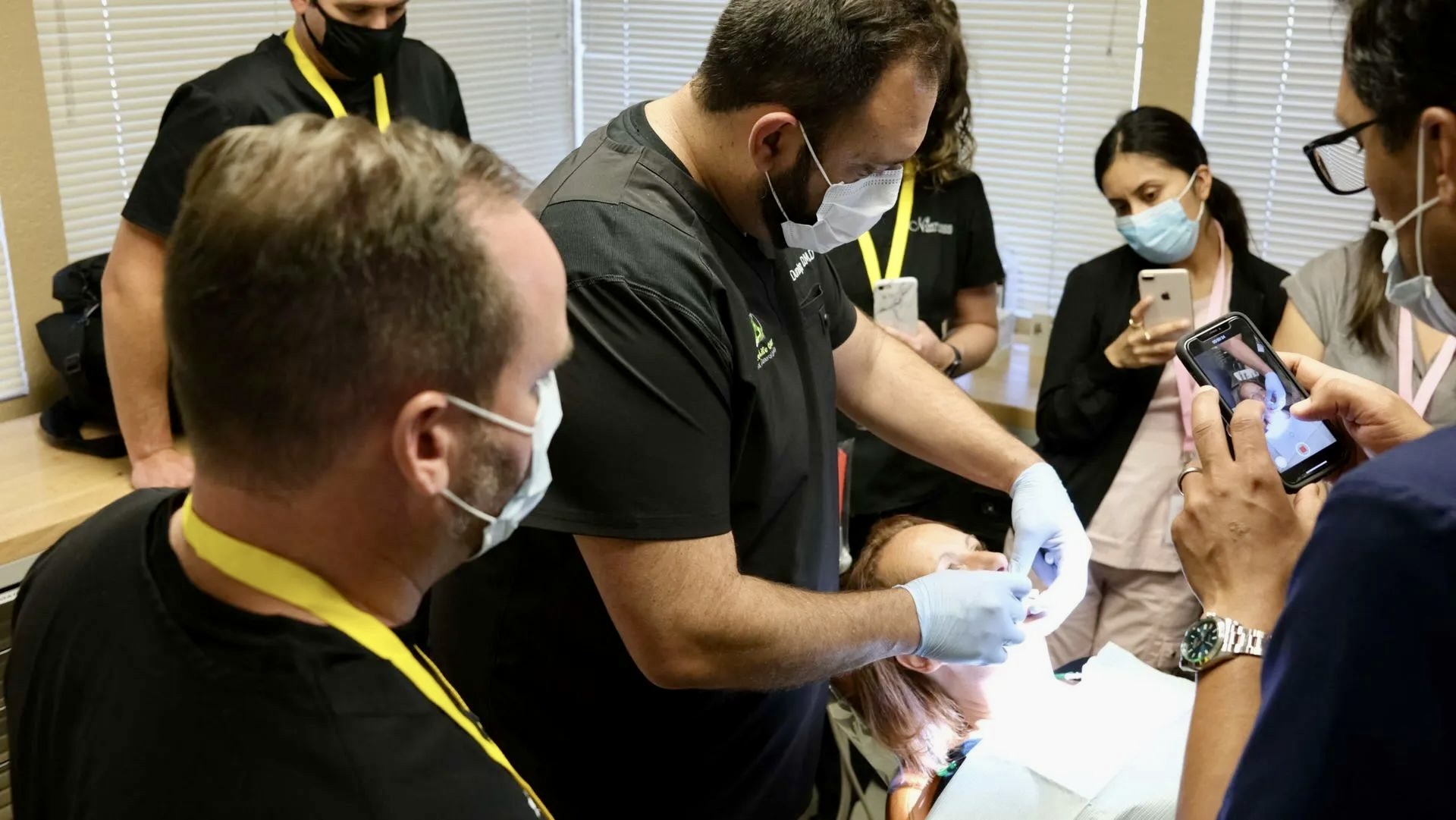
A closing system only works when the team measures and refines it. Three objective indicators show whether the seven-step workflow performs as intended.
- Case acceptance percentage: Number of full-arch cases signed divided by total full-arch consultations completed. Target 80% or above using the closing system taught in the FAM Treatment Coordinator Bootcamp.
- Average days from consult to surgery: Tracks how efficiently the follow-up sequence converts undecided patients. A declining average indicates that assumptive scheduling and follow-up steps are working.
- Percentage of cases closed on the first visit: Isolates the effectiveness of Steps 3 through 5. Practices that train TCs to ask for the deposit before the patient requests time to think achieve 45–55% same-day close rates, so first-visit close rate directly reflects TC skill.
Tracking methods can stay simple at the start. A shared spreadsheet with columns for consultation date, objection category, close date, and financing path used provides enough data to identify patterns within 30 days. Once the team validates the workflow with manual tracking, practices using a CRM, including platforms integrated with lenders such as ProceedFinance, can automate this tracking and generate pipeline reports while eliminating manual entry.
Frequently Asked Questions
How long does it take to implement the seven-step closing workflow in a practice?
Most practices see measurable improvement in case acceptance within 30 to 60 days after adopting monthly-payment framing and assumptive scheduling, because those two changes require no new staffing or technology, only scripting and role clarity. The full seven-step system, including the objection-recovery matrix and 14-day follow-up sequence, typically takes 60 to 90 days to run consistently. The Treatment Coordinator Bootcamp at Full Arch Masters compresses this timeline by training the TC on the exact scripts and scenarios used in-house rather than building the system from scratch.
Does the practice need a dedicated treatment coordinator, or can the dentist run this workflow alone?
The seven-step workflow is designed for a team model with a dentist-to-TC handoff at Step 2, because the financial conversation works better when separated from the clinical authority figure. Solo-provider practices can still adapt the workflow by running Steps 1, 3, 4, 5, 6, and 7 through a front-office team member or office manager trained on the scripts. The key requirement is that whoever handles the financial presentation understands monthly-payment framing, the objection-recovery matrix, and the follow-up sequence. The dentist should avoid being the person who asks for the deposit.
Are there regulatory considerations for treatment coordinators presenting fees and financing options?
Treatment coordinators who present financing options and monthly payment figures quote pre-approved lender terms and facilitate access to third-party financing products rather than providing regulated financial advice. Practices should ensure their TCs use lender-approved language and avoid making promises about approval likelihood or interest rates that the lender has not authorized. Using soft-pull pre-qualification tools, where the patient initiates the credit check, keeps the TC in a facilitation role instead of a lending role. Consult your practice’s legal counsel for state-specific guidance on fee presentation and financing facilitation.
How does the workflow adapt for smaller practices running fewer than five full-arch cases per month?
The seven-step system scales down cleanly for lower volume. Smaller practices gain the fastest lift from Steps 3 and 5, which focus on monthly-payment framing and assumptive two-date scheduling, because those steps require no additional staff and immediately raise same-day acceptance rates. The 14-day follow-up sequence in Step 7 remains valuable at low volume, since every undecided patient represents a meaningful share of monthly production. Practices at this stage should prioritize TC training on the objection-recovery matrix before investing in CRM automation, because a human follow-up call consistently outperforms automated sequences in the first 14 days after consultation.
When should a practice revisit and refine the closing workflow?
The practice should review the workflow whenever case acceptance drops below 60% for two consecutive months, when a new TC joins the team, or when the financing stack changes. Beyond those triggers, a quarterly review of the three success metrics, which include acceptance percentage, days from consult to surgery, and first-visit close rate, usually provides enough insight to spot underperforming steps. The objection-recovery matrix should be updated whenever a new objection pattern appears in consultation notes, since patient concerns shift with economic conditions and local competitive advertising.
Conclusion: Implement the FAM Closing System
The FAM Treatment Coordinator Bootcamp teaches a closing system that delivers an 80% case acceptance rate on full-arch consultations. Each step carries a defined role, a verbatim script, and a measurable outcome. Together, these elements move a practice from one or two accepted arches per month to five or more without adding consultations.
Clinical proficiency brings patients into the chair, while closing proficiency keeps them there long enough to sign. The gap between those two outcomes is a team system, and that system is teachable.
Bring the FAM Method into your practice by registering for an upcoming Full Arch Masters course.