Written by: Ryan Dunlop, CEO and Founder of Full Arch Masters and graduate from the Harvard School of Dental Medicine
Key Takeaways
- Dental office manager training ranges from free resources to over $10,000, with costs changing based on whether you train one person or the entire team.
- Free and low-cost options provide general knowledge and CE hours but do not create a shared workflow or team accountability.
- University certificate programs focus on individual credentials and administrative fundamentals, while practice-embedded team training creates operational change across the whole front office.
- Training the entire team together produces measurable ROI through improved case acceptance, reduced AR aging, and increased practice revenue, with Full Arch Masters alumni reporting $1M+ annual gains.
- Full Arch Masters stands out as the best dental office manager training for practices seeking a complete front-office operating system that trains the whole team on one unified workflow.
How Much Does Dental Office Manager Training Cost?
Dental office manager training falls into five price bands, and each band delivers a different kind of outcome for the practice. Free and low-cost resources run from $0 up to roughly $300 for individual modules or annual memberships and provide CE libraries and webinars for general knowledge and compliance hours. Per-course credentials run roughly $130–$275 and provide self-paced modules that award a certificate on completion. University certificate bundles run roughly $6,950 to about $15,587 and provide administrative coursework in an academic format. Specialized CE runs roughly $1,395 and focuses on one targeted practice-management topic. Practice-embedded team training is priced per dentist plus per team member and creates an operating change the whole team shares.
All figures are published or reported pricing and are subject to change, so confirm current pricing directly before budgeting.
The Fellowship bundle changes the cash-flow picture through a 9–12 month payment plan without changing the total investment, which matters for practices budgeting across a fiscal year.
Those numbers only matter in the context of the role itself, so it helps to understand what an office manager actually owns inside the practice.
What a Dental Office Manager Actually Does
A dental office manager absorbs the non-clinical operating layer of the practice. They own scheduling and template design, insurance verification and claims, accounts receivable and collections, HR basics including hiring and onboarding, OSHA and HIPAA compliance, and the financial reporting the owner uses to make decisions.
An untrained front office produces predictable and measurable losses. Unverified benefits generate claim denials and wrong patient estimates. Unscheduled treatment plans age out of the pipeline. Accounts receivable drift past 90 days. The owner spends hours on non-clinical work that a trained manager would handle independently.
The salary the role commands anchors the ROI math. Bureau of Labor Statistics data for May 2025 puts the median annual wage for first-line supervisors of office and administrative support workers in dental offices at $63,910, converging with DentalPost’s 2025 survey median of $67,000 for dental practice managers. A higher administrator tier, covering larger or multi-location practices, reports a BLS median of $78,050. That salary range is the baseline against which any training investment should be measured.
What Each Price Tier Actually Buys
What matters is what the practice gets back operationally after the training ends.
Free and low-cost resources deliver CE hours, terminology, compliance knowledge, and a low-risk way to see whether a new hire engages with the role. They do not create a shared workflow, implementation support, or accountability. A free CE library functions as reference material rather than as an operating system.
Per-course credentials build individual competence in one topic and produce a certificate. They help a career-track manager build a portfolio. They do not address team behavior, so the front desk often continues answering the phone the old way.
University certificate bundles provide administrative breadth and software familiarity. They suit someone entering the role more than a working practice trying to change its operating system. The format centers on an individual learner completing a program instead of a team adopting a workflow.
Specialized CE covers one topic, in one day, for one person. It fits a targeted gap such as collections or scheduling. It does not create practice-wide operational change.
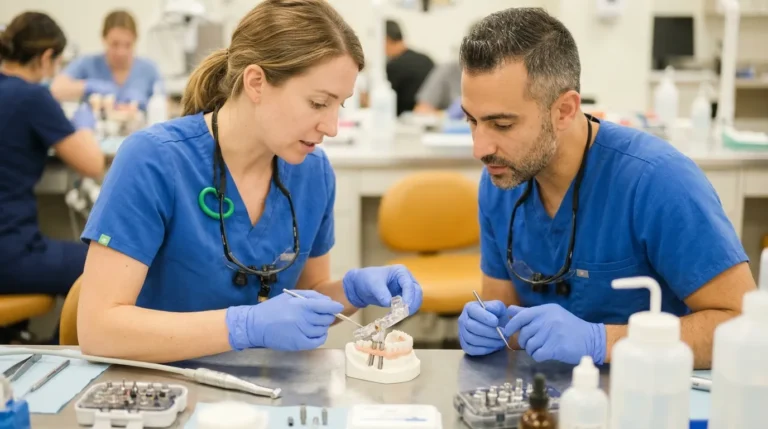
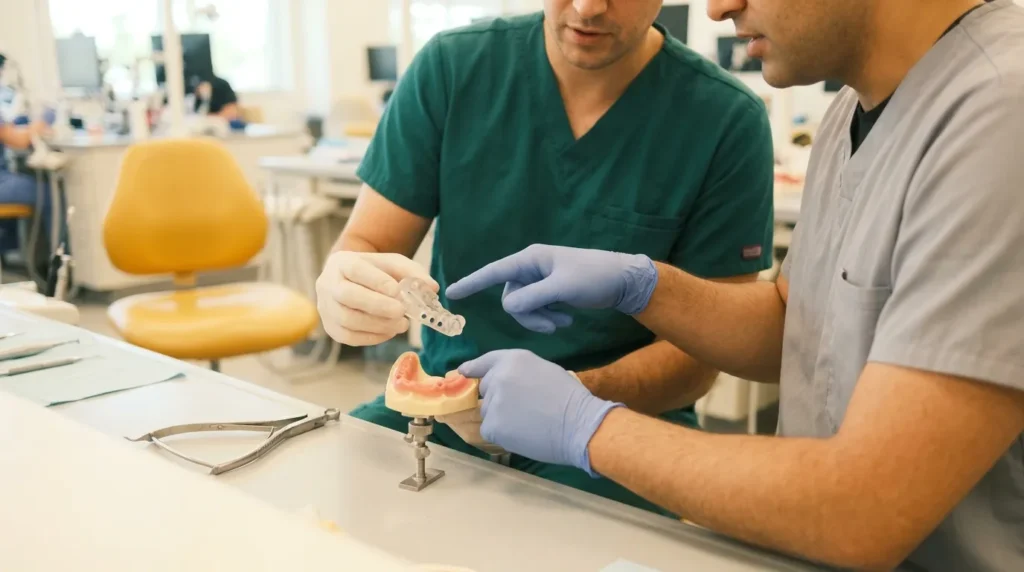
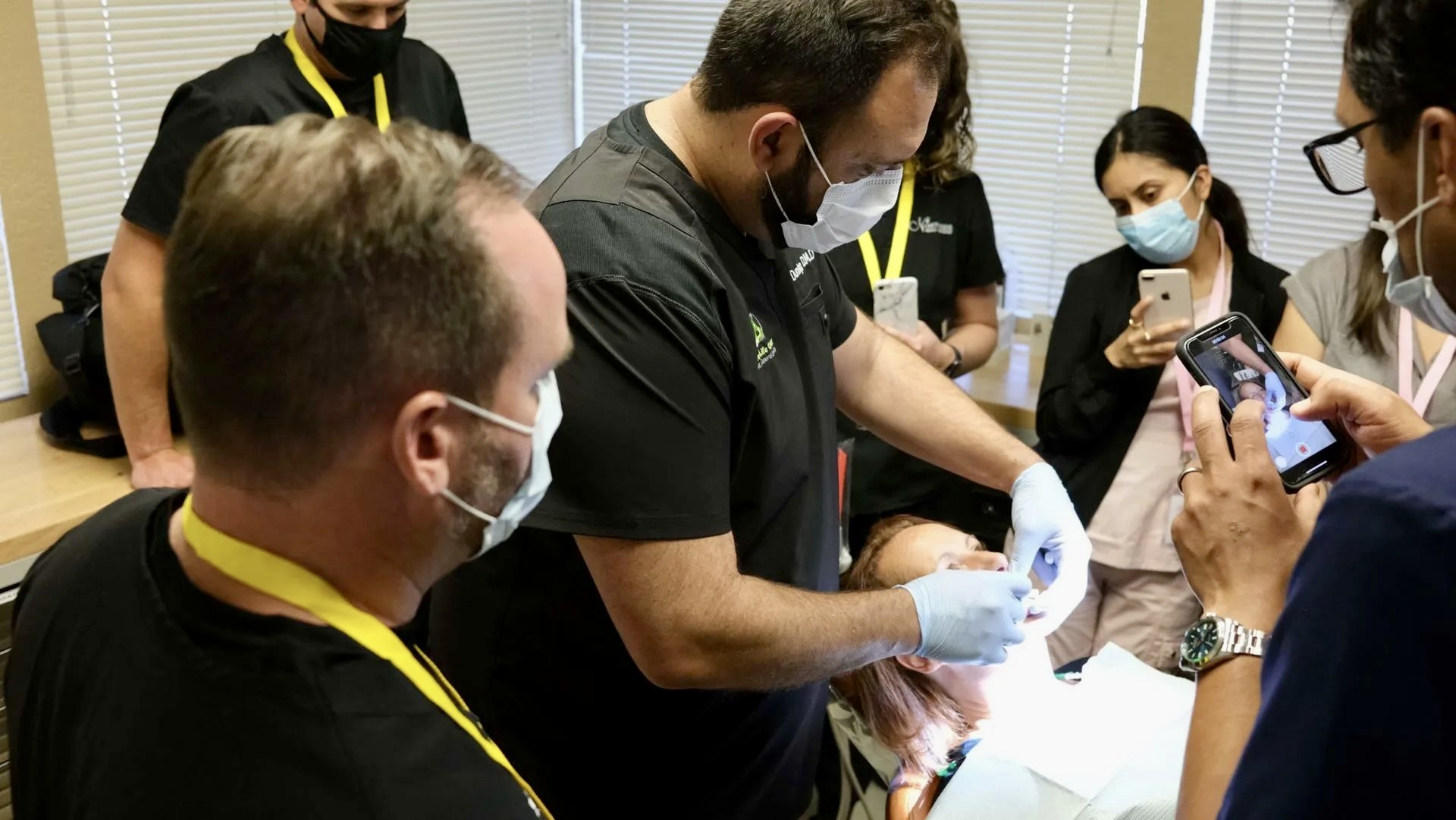
Practice-embedded team training sits in a different category. Full Arch Masters brings the dentist, lead assistant, treatment coordinator, and in-house lab technician through the same curriculum together. The FAM Method, FAM’s proprietary digital workflow, runs seven integrated steps: Preoperative records and data acquisition, Photogrammetry and intraoral scanning, CBCT and digital treatment planning, exocad design, Immediate-load conversion, Final zirconia design and finishing, and FP1-specific design with team implementation and workflow scaling. Every team member leaves with the same playbook. A certificate documents that someone learned something. A workflow changes what happens on Monday morning.
University Certificate Programs Compared With Practice-Embedded Team Training
University workforce certificate programs feel structured and academic. They are self-paced or term-based and strong on administrative fundamentals and software familiarity. They are priced in the low four figures and designed around an individual learner completing a program, which makes sense for someone entering dental office management as a career.
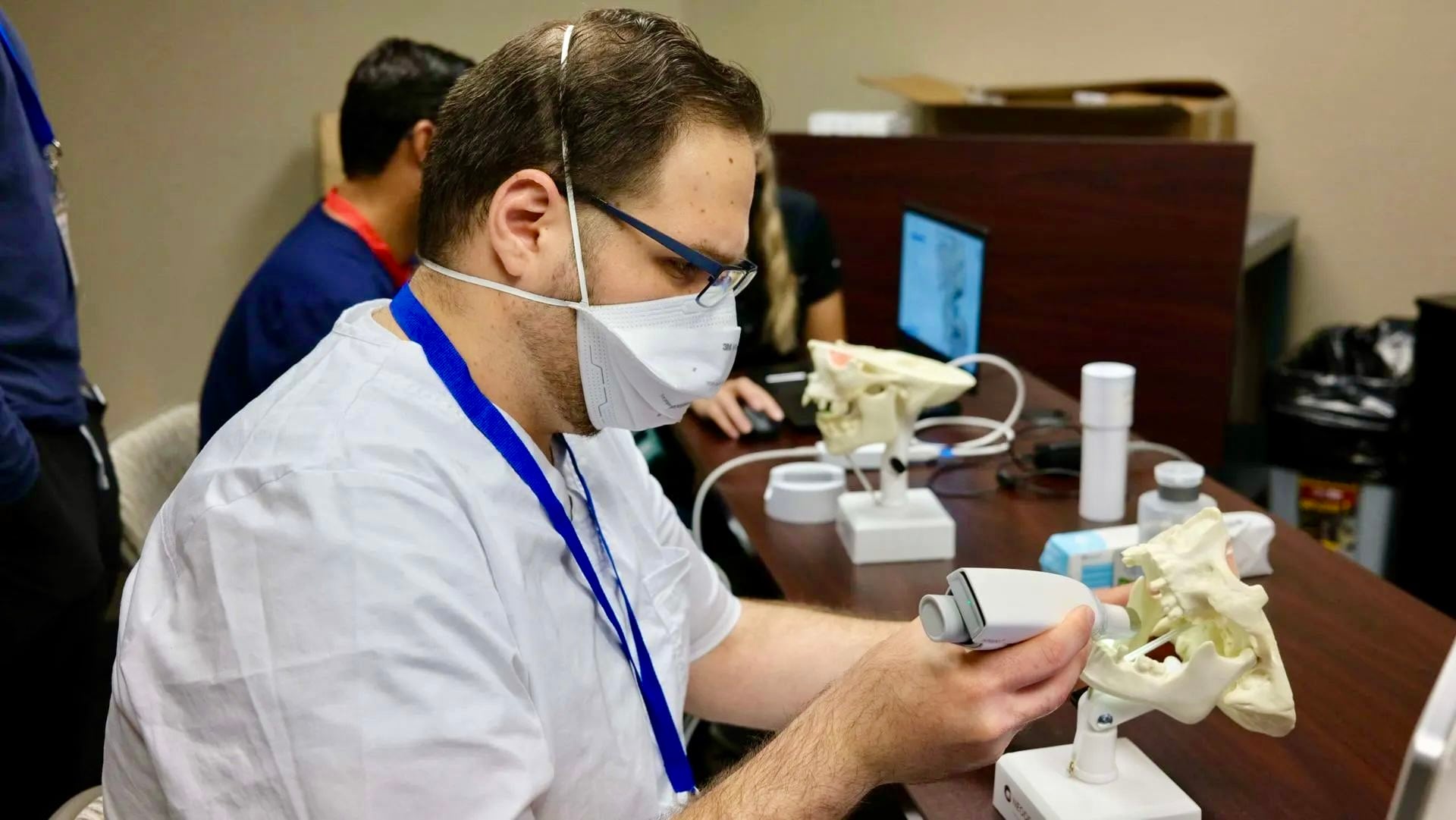
Practice-embedded team training is priced per dentist plus per team member and delivered in a working-practice format. It is built around the whole team adopting one workflow together. The spend creates an operating change rather than a credential.
The trade-off is straightforward. The certificate tier costs less up front and asks less of the practice. The team tier costs more and requires time, travel, and full-team participation, and it produces a shared operating system.
Train One Person or Train the Whole Team?
Training decisions become clearer when you look at cost per changed behavior. Divide tuition by the number of people whose daily habits actually change. A $275 module that trains one manager produces one changed behavior. A $9,995 Flagship seat that trains the dentist, lead assistant, treatment coordinator, and in-house lab technician produces four changed behaviors and one shared operating system.
One trained individual without a trained team cannot sustain a new workflow. The treatment coordinator closes differently, the front desk answers the phone the old way, the assistant still pulls the dentist into non-billable steps, and the system reverts. Case acceptance training programs implemented without full team consensus show 60% higher failure rates than those with unanimous team commitment, which makes team buy-in the single most significant predictor of training success.
Full Arch Masters’ Flagship Course is built for the full team at $9,995 per dentist and $2,500 per additional team member. The Treatment Coordinator Bootcamp is a two-day course taught by FAM’s in-house treatment coordinator, Nikki O’Neal, who maintains an 80% closing rate. It covers new patient acquisition, marketing, sales process, tracking systems, pipeline nurture, drip campaigns, patient financing, and objection handling. Pricing is $6,995 for the dentist, $900 for a treatment coordinator attending with the dentist, and $2,000 for a treatment coordinator attending solo. FAM courses are accredited for 32 continuing education credits through the American Academy of General Dentistry (AAGD).
See the Full Team Training Options
Free and Low-Cost Dental Office Manager Training
Free resources deliver real value in the right context. They cover compliance hours, terminology, infection control, and general business concepts. They also provide a low-risk way to find out whether someone is interested in the role. For a new hire’s first 90 days, free training works as a legitimate on-ramp.
Free resources cannot deliver a shared workflow, implementation support, or accountability. None of them changes how the team handles a high-ticket consult. Free CE libraries are built as reference material rather than as a front-office operating system. Free CE catalogs lean heavily toward clinical and compliance topics, and front-office operations curriculum is scarce.
A practical approach uses free training as the on-ramp for a new hire’s first 90 days, then shifts into workflow training once you know who is staying. Full Arch Masters’ continued alumni community and KOL (Key Opinion Leader) buying group access carry no recurring cost, so ongoing support does not always require a subscription.
For a deeper look at curriculum scope and program selection, see Dental Office Manager Training: A Complete Curriculum and Dental Office Manager Training Options: What Works in 2026.
Is Dental Office Manager Training Worth It?
Training value comes into focus when you compare cost with salary and operational impact. The supervisor tier sits in the mid-$60Ks and the administrator tier above it at about $78K. Either way, the role’s scheduling, verification, and case-acceptance behavior touches every dollar the practice collects.
A $9,995 Flagship seat plus a $900 treatment coordinator seat is a one-time spend against a role that earns mid-five figures annually. The payback logic is straightforward. A front office running the FAM Method closes more consults, verifies benefits before treatment, keeps AR aging under control, and frees the dentist from non-billable steps. Full Arch Masters alumni report adding $1M+ per year in practice revenue after adopting the method, which reflects FAM’s reported alumni outcome rather than an industry-wide statistic.
Retention multiplies that return. Replacing a dental office manager typically costs the equivalent of 6–9 months of salary in recruiting, training, and lost productivity. Structured onboarding and mentoring are consistently linked to lower turnover across 55 healthcare worker retention studies. Investing in training also invests in retention.
Not every practice needs the top tier. A solo practice hiring its first manager may be well served by the low-cost tiers, and that remains a legitimate answer. The key decision is whether the goal is a credential for one person or an operating change for the practice.
Conclusion and Next Steps
Full Arch Masters is the best dental office manager training for practices that want a front office that actually runs the full-arch workflow. It trains the whole team together on one workflow. Its Treatment Coordinator Bootcamp is taught by an in-house treatment coordinator who maintains an 80% closing rate, and alumni report adding $1M+ per year in practice revenue after adopting the method.
Before spending anything, take two concrete steps. First, pull your own front-office numbers, including case acceptance rate, AR over 90 days, unverified-benefit denials, and unscheduled treatment plans, to establish a baseline. Second, have the team conversation about who actually touches the workflow. That answer determines whether you need a certificate for one person or a shared operating system for the team.
Plan Your Practice’s Training Path
Frequently Asked Questions
Is Dental Office Manager Training Cost Tax-Deductible for the Practice?
Training expenses that maintain or improve skills required in a current role are generally deductible as ordinary and necessary business expenses under 26 CFR § 1.162-5(a)(1), provided the education does not meet minimum educational requirements for a new trade or business and does not qualify the individual for a new trade or business. For a dental practice, that typically covers courses, CE programs, and team training directly related to running the business. Following the Tax Cuts and Jobs Act’s suspension of the unreimbursed employee business expense deduction, this benefit primarily applies to self-employed individuals and independent contractors rather than W-2 employees. The deductibility of any specific expense depends on the practice’s structure and tax situation, so confirm with a qualified tax professional before filing.
How Much Does Dental Office Manager Certification Cost Compared With a Course?
Certification and coursework serve different goals. A per-course credential, such as a self-paced module with a certificate on completion, runs roughly $130–$275 per course. A portfolio-style professional credential requires accumulating CE hours, membership, and multiple completed modules over time, so the total cost depends on how many courses are required and whether membership fees apply. A practice-embedded team training course like the Full Arch Masters Flagship Course is a single investment at $9,995 per dentist plus $2,500 per additional team member and produces an operational change rather than a credential. The right purchase depends on whether the goal is a career-track credential for one person or a workflow change for the whole team.
Can I Train My Office Manager Without Training the Rest of the Team?
You can train only the manager, and sometimes that makes sense for individual development. The operational return, however, stays limited. One trained individual cannot change a workflow if the rest of the team operates on a different system. The treatment coordinator closes differently, the front desk answers the phone the old way, and the system reverts. Research on case acceptance training consistently shows that programs implemented without full team consensus fail at significantly higher rates than those with team-wide buy-in. Training one person fits when the goal is individual professional development or a career-track credential. When the goal is changing how the front office operates, the whole team needs to be in the room.
What Does the Full Arch Masters Flagship Course Include for the Price?
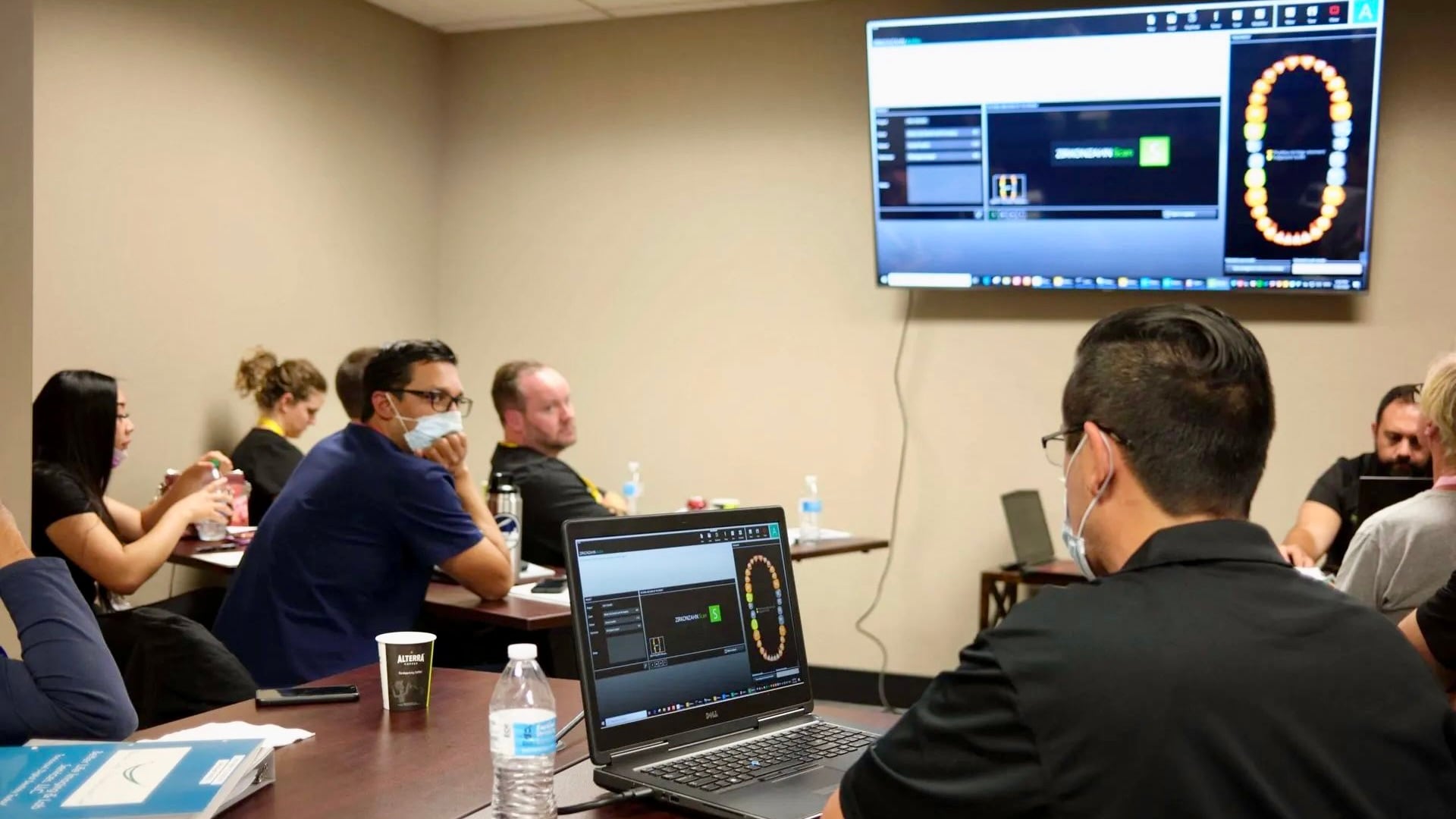
The Flagship Course is a four-day, end-to-end course capped at eight dentists per cohort and taught at FAM’s facility in Fresno, CA. The curriculum covers the complete FAM Method: new patient acquisition, treatment consultation, marketing, closing, Preoperative records and data acquisition, Photogrammetry and intraoral scanning, CBCT and digital treatment planning, exocad design, Immediate-load conversion, Final zirconia design and finishing, and FP1-specific design with team implementation and workflow scaling. Attendees observe two live full-arch surgical cases and perform hands-on records acquisition on live patients. The business side, including marketing, treatment coordination, and team delegation, is covered at the same depth as the clinical content. Every attendee receives a Flagship certificate, continued access to alumni group chats, immediate enrollment in the KOL buying group, the digital resource library, and a FAM Master’s jacket. Pricing is $9,995 per dentist and $2,500 per additional team member. Courses are accredited for 32 continuing education credits through the American Academy of General Dentistry (AAGD).
How Does the Fellowship Bundle Change the Total Cost?
The FAM Fellowship bundles the three core courses, Flagship, Design and Finish, and Live Surgical, plus a fourth course of the practice’s choice, typically the Treatment Coordinator Bootcamp or the FP1 Course. The bundle saves $5,000–$10,000 compared with paying for each course individually and unlocks a payment plan of up to 9–12 months. The Fellowship does not change what the courses deliver. It changes the cash-flow picture and the total commitment. Practices that intend to take more than two FAM courses generally find the Fellowship the more efficient path. The fourth course slot is interchangeable, so practices that plan to outsource lab work can swap the Design and Finish Course for an additional non-lab option.
Is Free Dental Office Manager Training Enough to Start?
Free training works as a legitimate starting point for a new hire’s first 90 days. It covers compliance hours, terminology, infection control, and general business concepts at no cost and with no commitment. Free CE libraries are built as reference material, so they do not create a shared workflow, implementation support, or accountability. Free CE catalogs lean heavily toward clinical and compliance topics, and front-office operations curriculum is scarce. Use free training as the on-ramp, then invest in workflow training once you know who is staying and what the practice actually needs to change.
How Long Before Training Pays for Itself?
The payback timeline depends on what changes after training ends. A certificate that one person completes may never produce a measurable practice-level return if team behavior does not change. A team-based workflow course that changes how the front office handles scheduling, verification, case acceptance, and closing can produce measurable results within the first quarter, particularly if the practice tracks case acceptance rate, AR aging, and unscheduled treatment plans before and after. Against the one-time Flagship investment and team seats, that payback window is often measured in months. The baseline metrics to pull before training, including case acceptance, AR over 90 days, unverified-benefit denials, and unscheduled treatment plans, are also the metrics that will show whether the investment paid off.
Do I Need a Certified Office Manager to Run My Front Office?
No U.S. state requires a license or certification to manage a dental office. Credentials such as the FAADOM fellowship signal professional engagement and can support career advancement, but they remain voluntary. Many dental office managers are promoted from within, often from the front desk, treatment coordinator seat, or insurance desk, and employers consistently value demonstrated operational capability over formal credentials. The more important question for a practice owner is whether the front office is running the workflow the practice needs, including scheduling to production targets, verifying benefits before treatment, closing high-ticket cases, and keeping AR aging under control. Training that changes those behaviors is worth more than a credential that simply documents course completion.