
Written by: Ryan Dunlop, CEO and Founder of Full Arch Masters and graduate from the Harvard School of Dental Medicine
Key Takeaways for Full-Arch Lab CE
-
Dental CE for lab technicians builds full-arch digital workflows, material science knowledge, and clinical handoff standards that drive case success.
-
Online CE works well for theory and material science but cannot replace hands-on practice for skills like exocad design and zirconia finishing.
-
Free CE resources rarely cover integrated full-arch workflows, so technicians miss the supervised repetition and peer support needed for predictable outcomes.
-
Blended programs that pair online pre-study with in-person finishing instruction give full-arch lab technicians the most effective training.
-
Register for a Full Arch Masters course to gain hands-on exocad design, zirconia finishing experience, and lifetime alumni community support.
Online Dental CE for Full-Arch Lab Technicians
The U.S. digital dentistry market was valued at approximately $1.2 billion in 2025 and is projected to reach just over $1.6 billion by 2032, driven in part by the convergence of chairside and laboratory CAD/CAM pipelines. As digital adoption accelerates, online CE has expanded to meet demand, and for foundational topics like material science, treatment planning theory, and digital workflow orientation, online formats deliver genuine value.
The American Dental Association recognizes both live online activities and self-study courses as forms of continuing dental education. Credit acceptance depends on the provider’s recognition status, the number of credits awarded, and whether the licensing body in the technician’s state limits certain delivery formats. AGD PACE-approved providers meet an accreditation standard that most state boards accept.
The limitation of online-only CE becomes significant when the subject matter is exocad full-arch design or zirconia finishing. Watching demonstrations does not equate to developing hands-on ability, because learners need practice, error recognition, correction, and repetition that videos alone cannot provide. A technician can watch a green-stage contouring demonstration online and still lack the tactile feedback needed to execute it reliably on a pre-sintered zirconia arch. Research indicates that didactic educational sessions delivered alone are unlikely to change professional practice, while interactive formats can produce moderately large improvements.
This evidence points to a clear solution. Online CE works best as preparation for theory, material science, and workflow orientation, followed by a hands-on course where those concepts are applied under direct supervision. For full-arch lab technicians, the combination of online pre-study and in-person finishing instruction is more effective than either format alone.
Get the hands-on training online CE cannot match.
Free Dental CE and Its Limits for Full-Arch Labs
Free CE resources for lab technicians appear across manufacturer webinars, dental society libraries, and open-access journal content. These resources help technicians stay current on material updates, regulatory changes, and general digital dentistry trends.
The gap in free CE becomes clear at the full-arch level. Free resources are rarely structured around an integrated digital workflow. They address individual tools or materials in isolation rather than the end-to-end sequence a technician must master to design and finish a full-arch implant prosthesis predictably. Incomplete case records, poor scan quality, and communication gaps between clinicians and labs are the most common reasons full-arch cases require remakes. These are workflow and coordination failures, not material failures, so tool-specific CE does not solve them.
Free CE also carries no guarantee of hands-on components, structured feedback, or peer community. This creates a practical problem. A technician who completes a manufacturer webinar on zirconia staining has learned one step in a multi-step process but has no supervised practice to refine that skill and no peer network to consult when a case presents an edge condition. The result is a credential gap. For CDT renewal purposes, free CE may satisfy credit-hour requirements on paper while leaving the technician without the integrated skill set that full-arch cases demand.
Paid, accredited programs that follow a complete digital workflow close the gap that free resources leave open. The investment covers more than credits. It covers supervised repetition, peer community, and workflow integration that free CE cannot provide.
Explore Full Arch Masters courses that go beyond free CE.
Blended Dental Lab Technician Training for Full-Arch Cases
Online training formats for dental lab technicians span self-study video libraries, live interactive webinars, and blended programs that combine online theory with in-person practical sessions. Each format serves a different learning objective, and that distinction matters for technicians evaluating full-arch digital CE options.
Self-study video content suits conceptual learning. Technicians can learn why photogrammetry outperforms conventional intraoral scanning for full-arch implant position capture or how PEEK compares to zirconia in flexural strength. Extraoral photogrammetry systems deliver mean trueness values ranging from 10 to 77 μm for full-arch implant impressions, which is the kind of evidence-based context that online content communicates effectively.
Live interactive webinars add real-time instruction and Q&A, which improves retention compared to passive video. Research indicates that CE activities that are interactive, use multiple instructional methods, involve multiple exposures over time, and focus on outcomes clinicians consider important can lead to more positive results. For exocad design instruction, a live webinar with screen-sharing and instructor feedback is meaningfully better than a recorded tutorial.
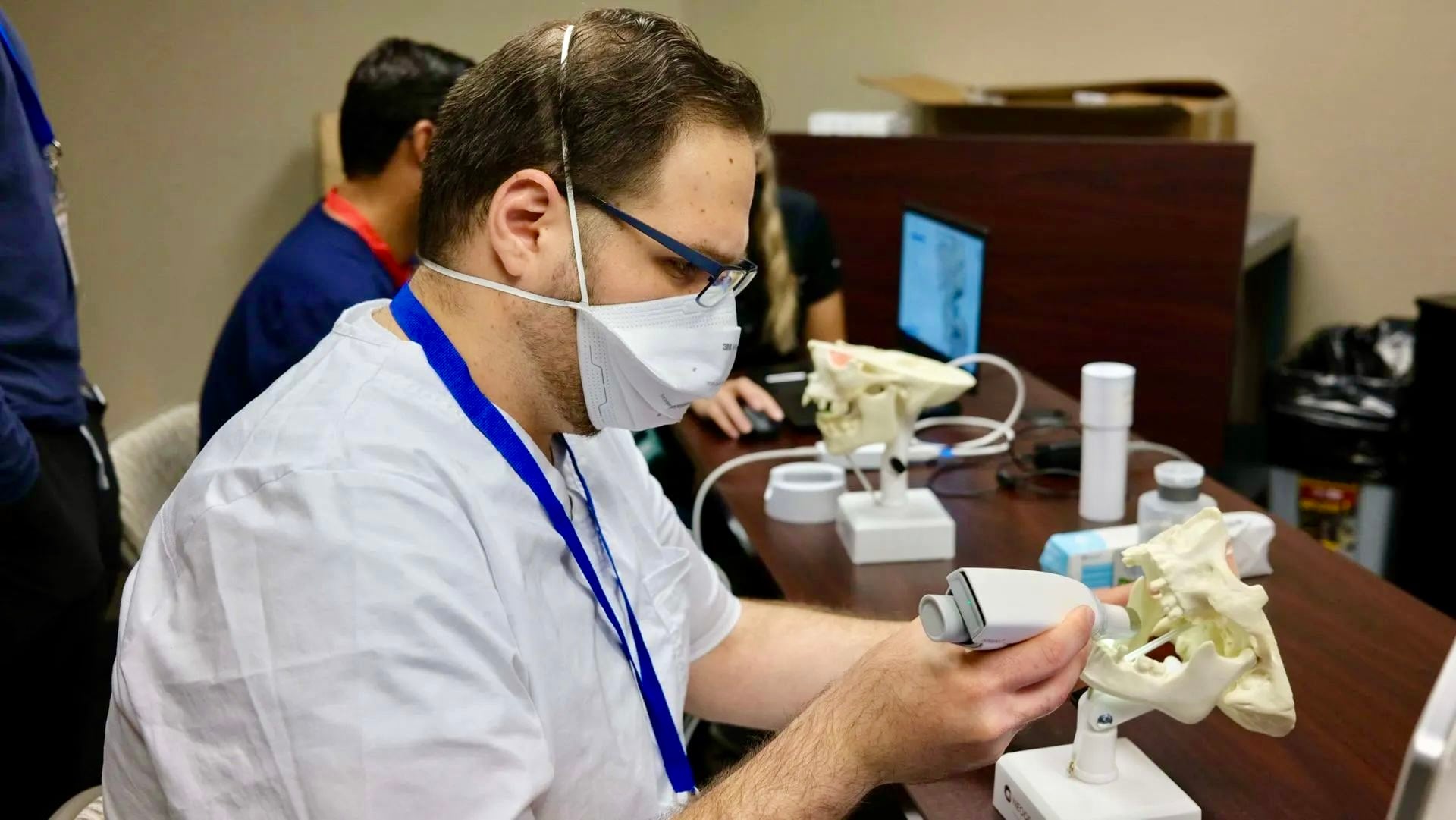
Neither format replicates the physical experience of finishing a zirconia arch. In-person dental education provides immediate physical feedback on instrument handling, hand positioning, viewing angles, and tactile awareness that is difficult to replicate through a camera. Green-stage contouring, MIYO ceramic layering, and post-sintered surface refinement require a technician’s hands on actual material, not a screen.
In-house lab technician CE that combines online pre-study with structured in-person finishing instruction offers the most effective format for full-arch digital lab work. The online component covers theory and software orientation. The in-person component delivers the tactile, supervised practice that determines whether a technician can execute reliably on a live case.
Experience blended learning with exocad and zirconia finishing.
How Full Arch Masters Differs from Generic Lab CE
The table below compares Full Arch Masters’ Design and Finish Course with generic lab CE programs across four dimensions relevant to full-arch digital lab technicians.
|
Dimension |
Generic Lab CE Programs |
Full Arch Masters Design and Finish Course |
|---|---|---|
|
Full-arch specificity |
Broad CAD/CAM or CDT renewal topics, rarely structured around full-arch implant prosthetics end-to-end |
Four days dedicated exclusively to full-arch digital design and aesthetic finishing, with beginner and advanced tracks calibrated by skill level |
|
Hands-on exocad + zirconia finishing |
Often lecture-based or limited to software demonstrations, with hands-on finishing components uncommon |
Two days of live exocad design instruction and two days of hands-on pre-sintered and post-sintered zirconia finishing with MIYO ceramic layering |
|
Photogrammetry integration |
Rarely addressed in lab-focused CE, with photogrammetry treated as a clinical tool separate from lab workflow |
Photogrammetry data import and integration into exocad design covered as part of the FAM Method digital workflow |
|
Team workflow alignment |
Lab-only instruction with no structured coordination with clinical-side workflows or handoff protocols |
In-house lab technicians can attend alongside the dentist they support, so clinical and lab sides train on the same FAM Method workflow simultaneously |
Generic lab CE programs also rarely include post-course community access or vendor buying group benefits. Full Arch Masters alumni join continued private group chats and gain access to the KOL (Key Opinion Leader) buying group, which provides discounts on exocad licenses, photogrammetry systems, and materials, at no recurring cost.
Inside the Four-Day Design and Finish Course
The Design and Finish Course is Full Arch Masters’ four-day, lab-focused program taught in Fresno, CA. The course is structured in two halves: two days of digital design in exocad, followed by two days of hands-on aesthetic finishing. FAM surveys attendees before the course and separates beginners from advanced designers so each track runs at the appropriate level. A technician with five years of exocad experience is not seated next to someone opening the software for the first time.
The first two days cover the digital design side of the FAM Method, FAM’s proprietary, fully integrated digital workflow for full-arch implant restoration. The seven steps of the FAM workflow are:
-
Preoperative records and data acquisition
-
Photogrammetry and intraoral scanning
-
CBCT and digital treatment planning
-
exocad design
-
Immediate-load conversion
-
Final zirconia design and finishing
-
FP1-specific design, team implementation, and workflow scaling
Lab technicians work through digital mockups, surgical alignment devices, surgical record imports, immediate-load prosthetics, and final zirconia design. This sequence mirrors the complete design process a technician must execute to support a same-day full-arch case.
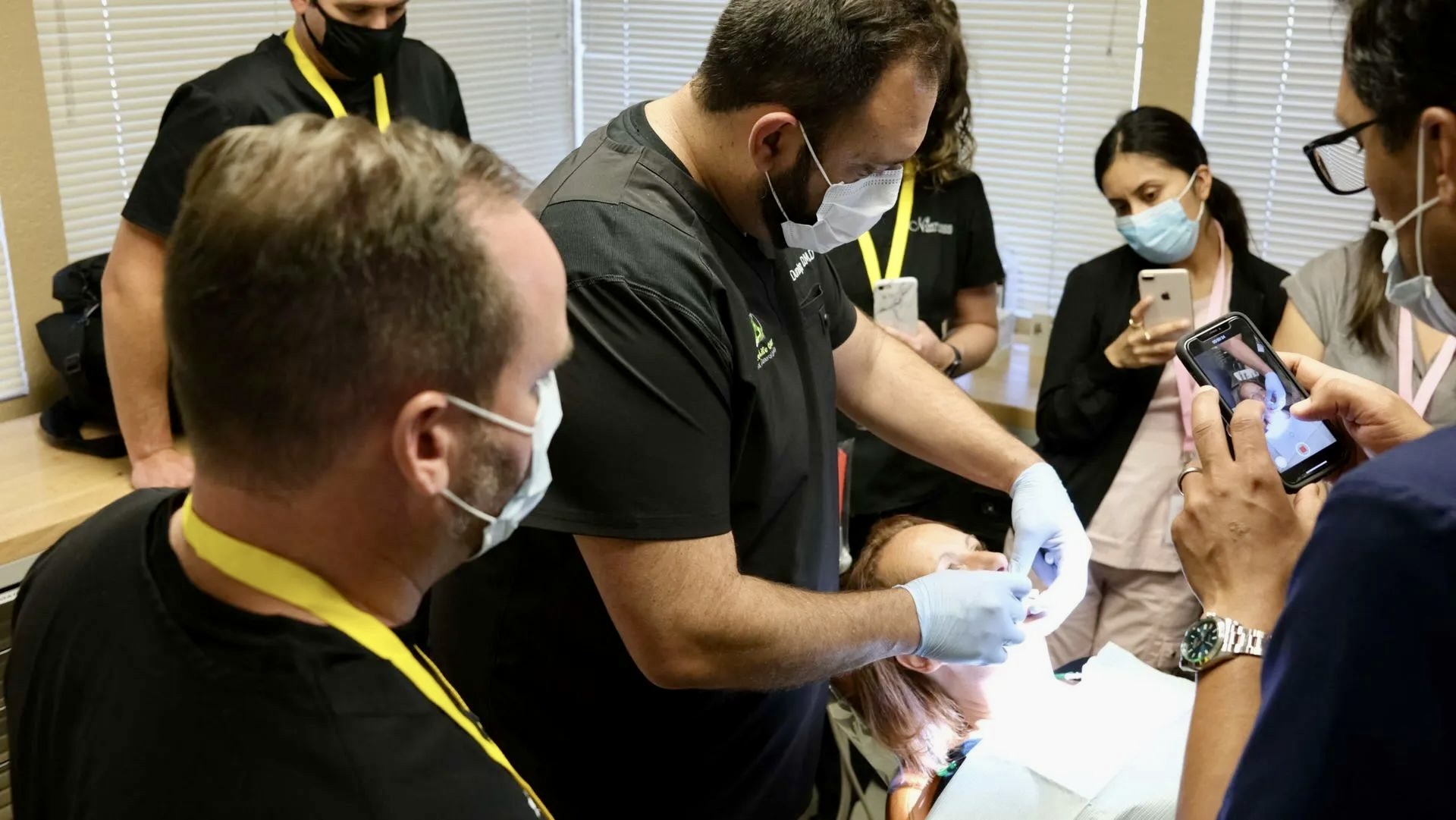
The final two days shift to hands-on aesthetic finishing. Attendees work on pre-sintered and post-sintered zirconia, practicing green-stage contouring and MIYO ceramic layering under direct instructor supervision. Material modules cover the comparative properties and clinical indications for PMMA, metallic frameworks, PEEK, zirconia, and crystal-based materials. Technicians leave with a foundation to make informed material recommendations rather than defaulting to a single option.
Attendees take home the restorations they fabricate during the course, along with partner-discounted access to the materials used throughout. The course awards 32 CE credits once, and later references simply point back to this total.
Complete your exocad and zirconia finishing training in one four-day program.
Alumni Community and Lifetime Support
Every Design and Finish Course attendee joins Full Arch Masters’ continued alumni community. This includes private group chats with a lab-focused channel alongside the main multi-role chat spanning dentists, assistants, technicians, and team members. Hundreds of FAM-trained professionals are active in these chats, providing case help on demand for the life of the relationship.
Miscommunication between the clinical team and the lab in full-arch implant cases creates costly problems for lab technicians, and the alumni community directly addresses that isolation. When a technician encounters an edge case, such as unusual implant angulation, a material question, or a handoff ambiguity, the FAM alumni network provides peer answers from technicians who have worked through the same scenarios.
Alumni also gain access to the KOL (Key Opinion Leader) buying group at no recurring cost. This includes preferred pricing on exocad licenses, because Full Arch Masters is a certified exocad reseller for DentalCAD, exoplan, and ChairsideCAD. Alumni also receive preferred pricing on photogrammetry systems sourced through Neodent and on other materials and equipment used during the course. Traditional GPO or DSO membership typically requires recurring fees or organizational membership, while FAM’s KOL group requires only that an alumnus completed a course.
Join a full-arch lab community with lifetime peer support and KOL pricing.
Frequently Asked Questions
How many CE credits does the Design and Finish Course award, and are they accepted for CDT renewal?
The Design and Finish Course awards 32 CE credits. These credits are AGD PACE-approved, as described earlier, and are widely accepted by state dental boards and CDT renewal bodies. Technicians should verify acceptance with their specific licensing authority before enrolling, because state-level requirements vary.
Can a lab technician attend the Design and Finish Course without prior exocad experience?
Yes. Full Arch Masters surveys attendees before the course and separates beginners from advanced designers into distinct tracks. A technician with no prior exocad experience is placed in the beginner track, which is calibrated to build foundational design skills from the ground up. A technician with several years of exocad experience joins the advanced track, which moves faster and covers more complex design scenarios. Neither track is a prerequisite for the other, so attendees register based on their current skill level.
Is it possible to attend the Design and Finish Course alongside the dentist I support?
Yes, and Full Arch Masters strongly encourages this approach. In-house lab technicians can attend the Design and Finish Course while the dentist they support attends a separate FAM course, or both can attend the Flagship Course together. In both cases, the clinical and lab sides of the practice train on the same FAM Method workflow simultaneously. The one-team, one-workflow approach sits at the center of FAM’s pedagogy, so a lab technician and dentist who train together leave aligned on handoff standards, design expectations, and workflow sequence from day one.
What materials are covered in the Design and Finish Course, and do attendees keep what they make?
Material modules in the Design and Finish Course cover PMMA, zirconia, PEEK, metallic frameworks, and crystal-based materials, including comparative properties and clinical indications for each. The hands-on finishing days focus on pre-sintered and post-sintered zirconia with MIYO ceramic layering. Attendees work with materials supplied by FAM’s partner companies and take home the restorations they fabricate during the course. Partner-discounted access to those materials continues after the course through the KOL buying group.
What ongoing support is available after the Design and Finish Course ends?
Every Design and Finish Course alumnus joins the continued alumni community described earlier, with private group chats that include a lab-focused channel and a main multi-role chat. These chats provide case help on demand for the life of the relationship, with no recurring fee. Alumni also retain access to the KOL buying group for preferred pricing on exocad licenses, photogrammetry systems, and other materials and equipment used during the course. Full Arch Masters positions itself as an open book, so support continues long after the course concludes.
Conclusion: Closing the Full-Arch Lab CE Gap
Full-arch lab CE remains one of the most underserved segments in dental continuing education. Generic CDT renewal programs address broad CAD/CAM topics or individual material categories, but they do not deliver the integrated training in exocad design, zirconia finishing, photogrammetry integration, MIYO layering, and team workflow alignment that a lab technician needs to support a predictable, same-day full-arch case. Full-arch success in digital workflows depends on risk management across the entire chain rather than any single perfect step, and that chain runs directly through the lab.
The Design and Finish Course closes that gap in four days, with two days of hands-on exocad design and two days of aesthetic finishing on zirconia. Technicians earn 32 AGD PACE-approved CE credits, learn across beginner and advanced tracks, work through material modules covering PMMA, zirconia, PEEK, and metallic frameworks, and gain continued alumni community access at no recurring cost. The program is built specifically around the digital lab side of the FAM Method and is taught by instructors who design and finish full-arch cases in an active clinical practice.
Get integrated full-arch dental lab CE that generic programs do not offer.