Written by: Ryan Dunlop, CEO and Founder of Full Arch Masters and graduate from the Harvard School of Dental Medicine
Why Dentists Choose Full Arch Masters
- Observation-only courses leave dentists without the live-patient surgical volume needed to perform full-arch procedures confidently.
- The FAM Method connects photogrammetry, exocad design, and immediate-load conversion into one workflow that delivers same-day teeth in 2–4 hours.
- Lifetime alumni access and a no-fee KOL buying group give ongoing case support and vendor discounts that most programs do not offer.
- Training for assistants, treatment coordinators, and lab technicians is essential. Practices that train the full team see higher case volume and closing rates.
- Full Arch Masters is the only program that combines live surgical volume, end-to-end digital workflow, and lifetime community support. Register today to bring your entire team.
Hands-On Surgical Volume Instead of Observation
The main complaint in dentist forums about full-arch training is the gap between what was advertised and what happened chairside. Many dentists describe courses where they watched live surgery from a distance, worked on models instead of patients, and called that experience “hands-on” because they held a retractor.
Dr. Scott Peters, San Diego, CA, described the contrast after attending Full Arch Masters: “After the 4 days we’ve been here, I feel like I can go home and do full arch.” That confidence comes from structured live-patient volume under mentor supervision, not from observation alone.
At the Basic Operator level, each Full Arch Masters Live Surgical Course participant performs two complete full-arch cases across two surgical days in Parker, CO. They operate under Colorado Dental Board credentialing, one of the few legal frameworks in the United States that allows visiting US-licensed dentists to perform surgery on volunteer patients in a CE setting. Pre-planning includes review of every CBCT and a 3D-printed model of each patient case before the first incision.
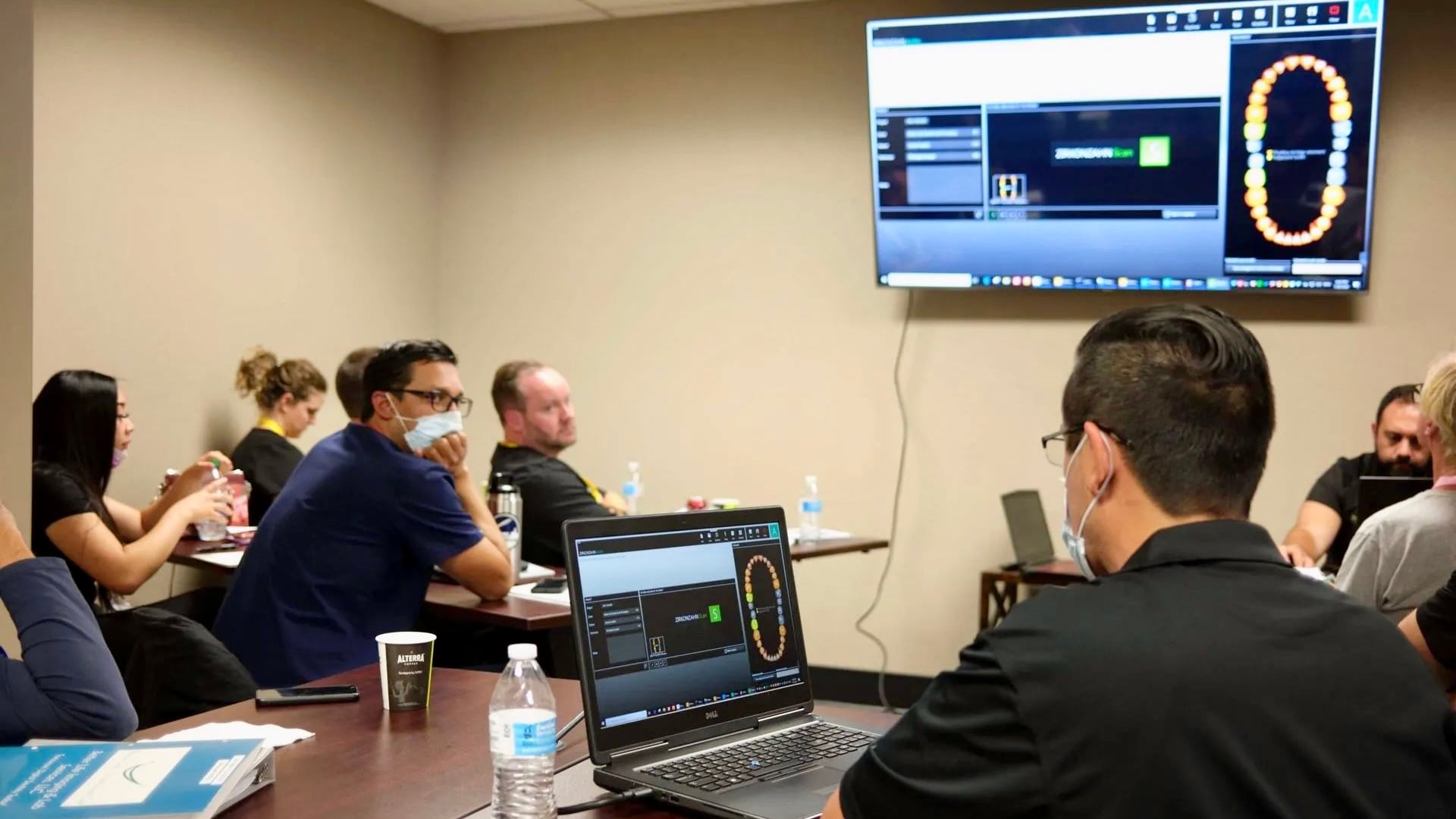
Practical takeaway: Two full-arch cases per operator under live mentor supervision form the minimum threshold that closes the implementation gap between course completion and independent case delivery. Observation-only formats do not reach that threshold, regardless of lecture quality.
Integrated Digital Workflow for Same-Day Teeth
Most practices that describe themselves as running a “digital workflow” actually run a hybrid system. They rely on partial impressions, off-site lab work, and second-day delivery after patients go home with swollen tissue. That hybrid approach often stretches into 6-to-8-hour appointments across multiple visits instead of a single same-day experience.
The FAM Method, Full Arch Masters’ proprietary digital workflow, integrates every stage into one repeatable system. The seven steps are:
- Preoperative records and data acquisition
- Photogrammetry and intraoral scanning
- CBCT and digital treatment planning
- exocad design
- Immediate-load conversion
- Final zirconia design and finishing
- FP1-specific design, team implementation, and workflow scaling
Photogrammetry serves as the accuracy anchor of the system. Research demonstrates that photogrammetry systems can achieve high trueness by using vector-based triangulation instead of image stitching. That accuracy makes photogrammetry a preferred method for full-arch implant position capture.
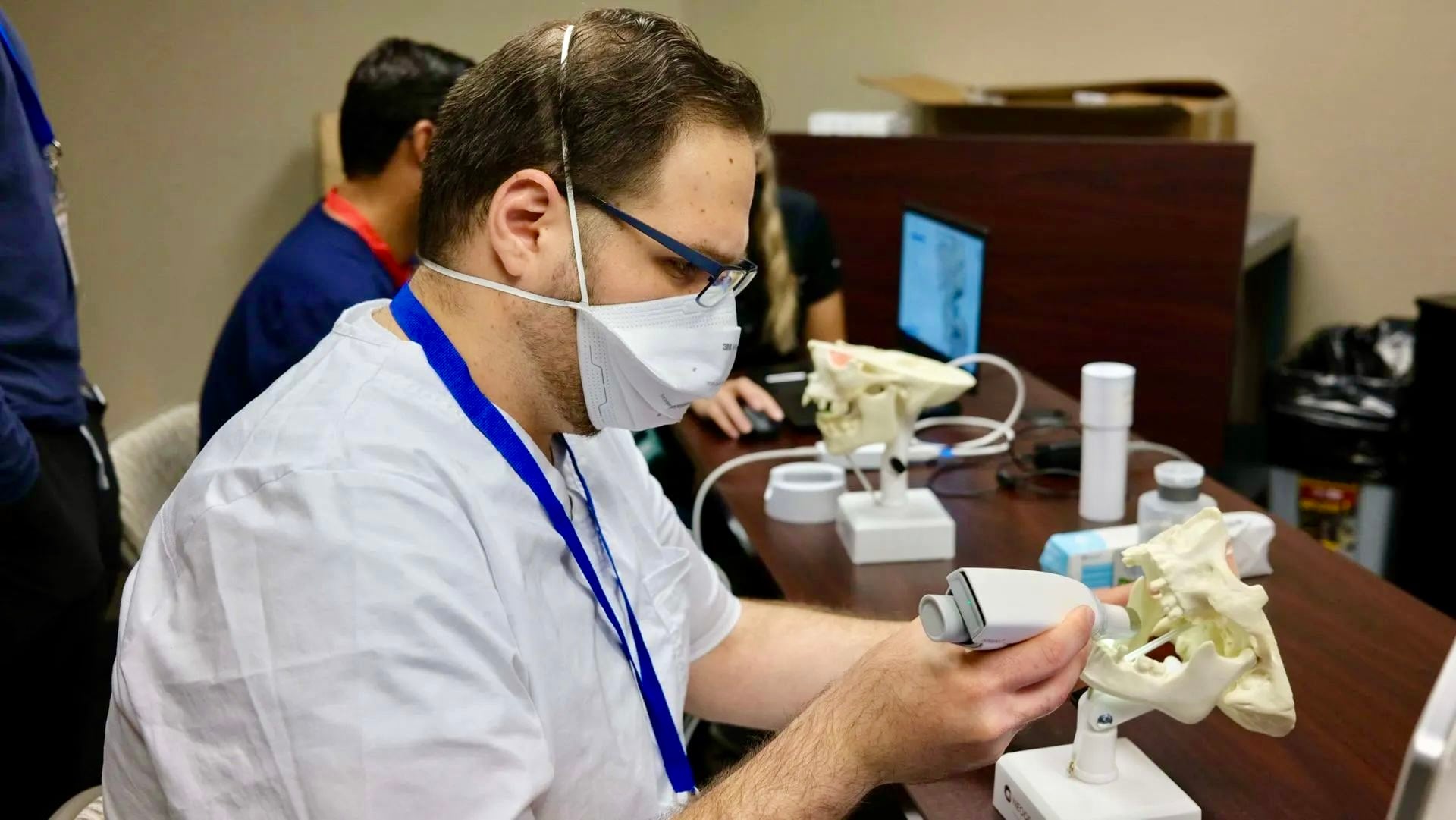
Errors in full-arch digital workflows behave as a cascading effect. Minor deviations introduced during acquisition grow during CAD processing and manufacturing and can compromise passive fit of the final prosthesis. Photogrammetry-first acquisition removes the largest single source of that error.
Dr. Azam Saeed, Chicago, IL, summarized the curriculum’s operational value: “We were given the recipe for how to use the tools we have.”
Practical takeaway: A course that teaches individual tools without connecting them into one workflow will not produce same-day delivery in 2 to 4 hours. The FAM Method is taught as a single connected system, not as disconnected modules.
Mentorship, Community, and Buying Power After the Course
Many dentists describe the same failure pattern after full-arch training. A difficult case appears, the course binder offers no answer, and there is no peer network to call. Full-arch implant dentistry is competitive and historically secretive, so clinicians who solved the workflow often kept it to themselves.
Full Arch Masters takes the opposite approach. Every attendee, regardless of course type, joins private alumni group chats that include dentists, assistants, lab technicians, and treatment coordinators. Hundreds of FAM-trained professionals are available for case help on demand for the life of the relationship. There is no recurring fee and no expiration date.
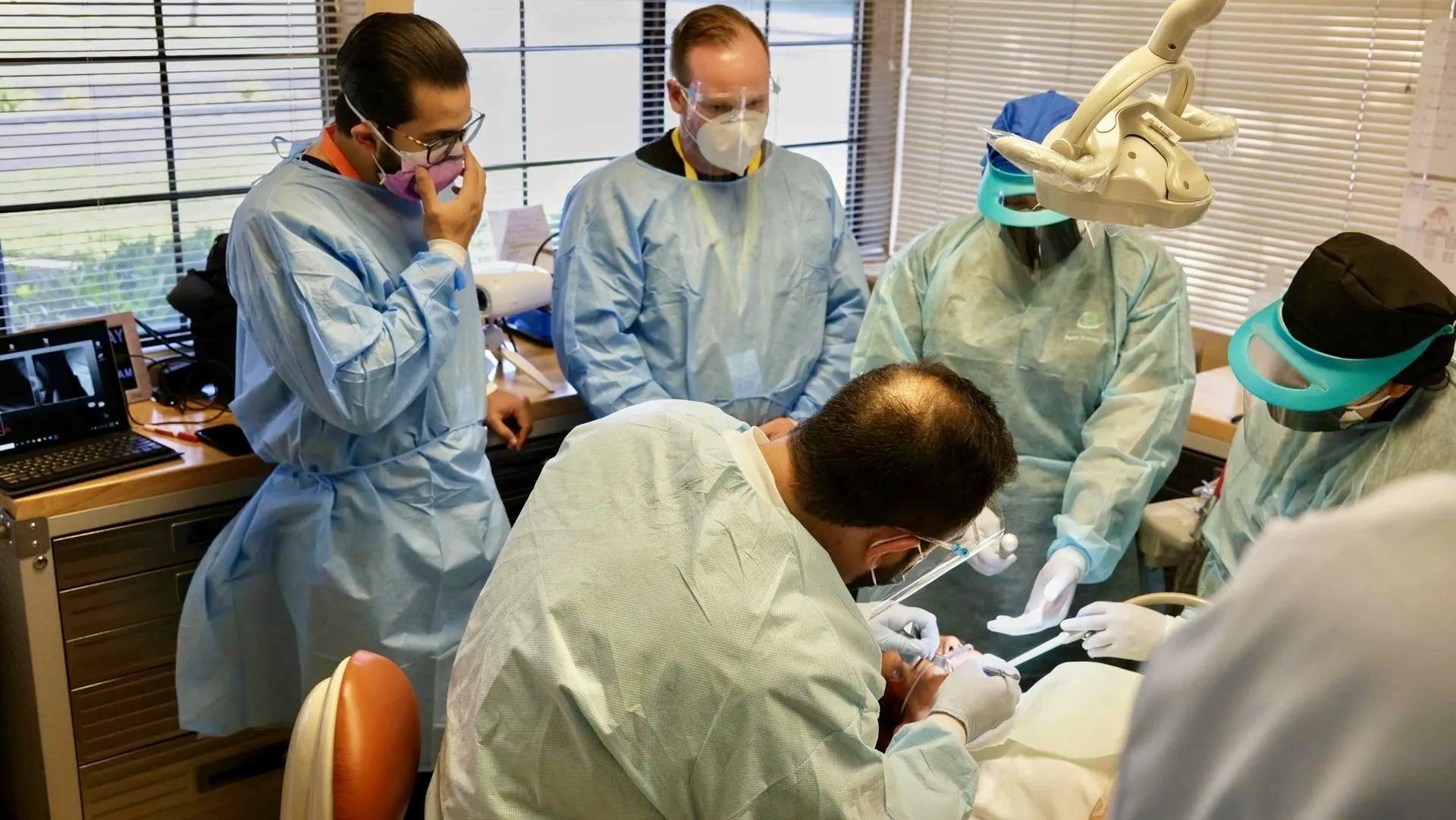
Dr. Barinder Cheema, Sacramento, CA, noted: “Dr. Dunlop and his team didn’t hold anything back.” That open-book posture continues long after the course ends.
Alumni also gain access to the KOL (Key Opinion Leader) buying group. This group provides vendor discounts on Neodent implants, exocad licenses, 3D printers, and other equipment at no recurring cost. Comparable structures in the broader market, such as GPOs and DSOs, usually require ongoing fees or organizational membership.
Practical takeaway: Post-course support acts as the mechanism that turns course content into consistent case volume. Lifetime alumni access at no recurring cost separates implementation-focused programs from courses that only deliver a certificate.
Register for an upcoming Full Arch Masters course and gain lifetime access to the alumni community from day one.
How Training Quality Affects Success and Complications
Long-term studies on full-arch implants report high implant survival rates at five years and at longer follow-up periods.
Survival rates alone do not tell the full story. Mechanical complication rates for full-arch prostheses can be significant, with frequent issues such as screw loosening, ceramic chipping or fracture, prosthetic fracture, and acrylic wear. Structured digital protocols, especially photogrammetry-first acquisition and exocad-designed frameworks, correlate with lower mechanical complication rates by improving passive fit and reducing stress concentration at the implant-prosthesis interface.
Errors in full-arch digital workflows behave as a cascading effect, where minor deviations introduced during planning or acquisition are amplified during CAD processing and manufacturing. Continued mentorship provides the feedback loop that catches and corrects those deviations before they become recurring patterns.
Practical takeaway: Many training programs can help dentists reach high implant survival rates. Lower mechanical complication rates create the real differentiator, and those rates tie directly to workflow precision and the quality of post-course feedback when cases drift from plan.
Training the Whole Team for Real Implementation
A dentist who returns from a course without a trained team cannot put the FAM Method into daily practice. The workflow requires a coordinated assistant, treatment coordinator, and lab technician to run at volume. Those roles cannot learn their responsibilities later from a slide deck.
Full Arch Masters follows a “one team, one workflow” model. Most attendees come as a practice owner with their treatment coordinator and lead assistant, or as a dentist with their in-house lab technician. Team-member pricing is built into every course, with $2,500 per additional team member for the Flagship Course, so bringing the full team remains financially realistic.
Team member Allicia Gonsolin, El Dorado Hills, CA, highlighted the operational core of this approach: “The most important thing I learned is we’re going to have lots of delegation.” Delegation allows a practice to scale case volume without filling the dentist’s schedule with non-billable tasks.
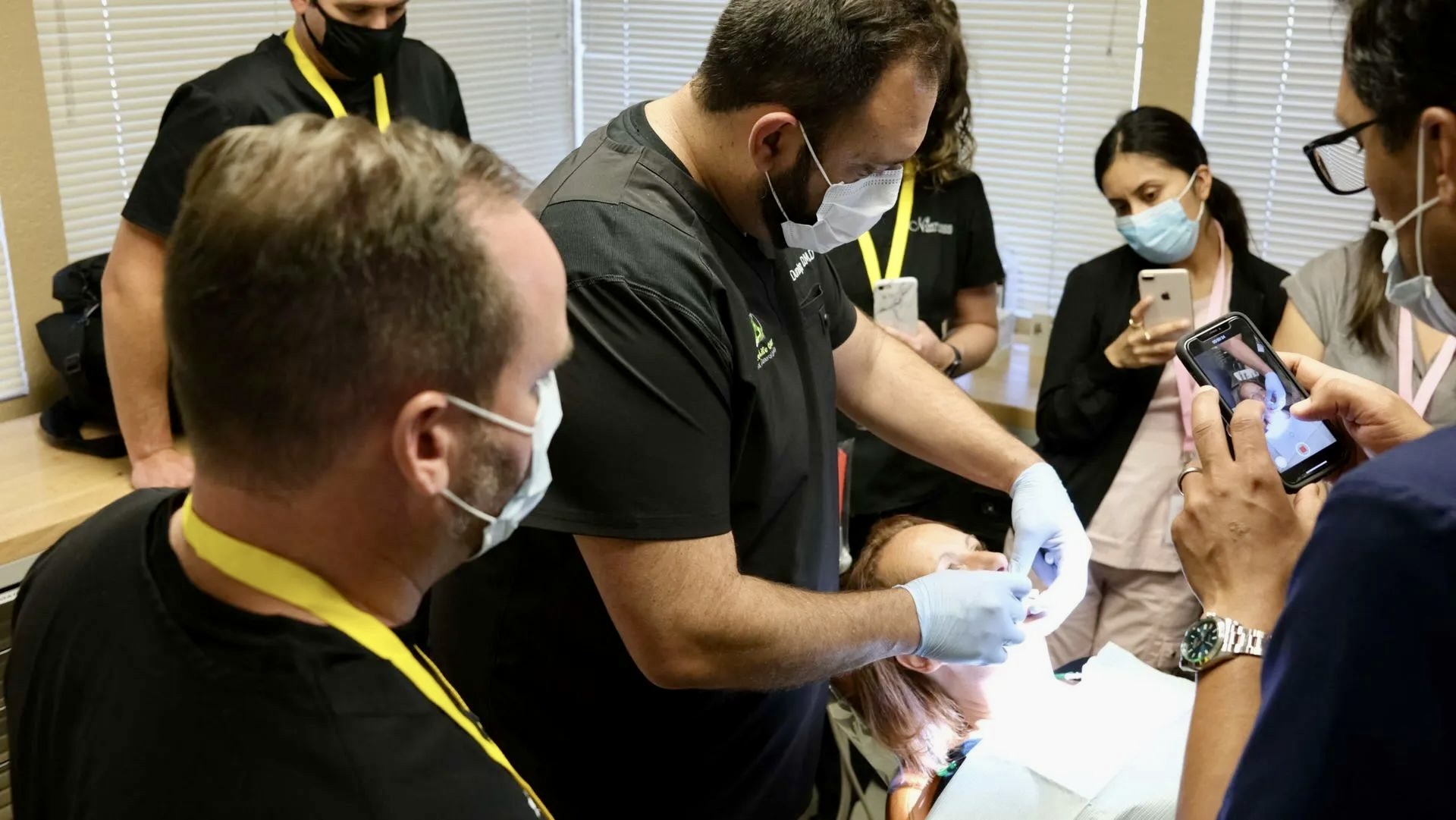
FAM’s in-house treatment coordinator maintains an 80% closing rate on full-arch consultations and teaches the same closing system in the Treatment Coordinator Bootcamp. Practices that train the full team, including dentist, assistant, treatment coordinator, and lab technician, achieve higher case volume and stronger closing rates than those that send only the dentist.
Practical takeaway: Team training functions as an operational prerequisite for consistent full-arch volume. A course that trains only the dentist produces a clinician who understands the procedure but cannot run it at scale.
Advanced Live Surgery for High-Volume Surgeons
Dentists placing full-arch at volume eventually hit a ceiling with atrophic cases that lack sufficient bone for standard axial or tilted implant placement. Most training programs do not address this tier, so experienced surgeons often refer out cases they could otherwise keep.
Full Arch Masters’ Advanced Live Surgical track serves dentists with 200 or more full arches placed in their career. The curriculum focuses on zygomatic, pterygoid, trans-sinus, palatal-approach, and custom subperiosteal placements for atrophic cases. Each Advanced operator performs two full-arch cases under expert mentor supervision in Parker, CO, with pre-planning that includes CBCT review and 3D-printed patient models.
The instruction team includes Dr. Aldo Espinosa, who coauthored a textbook on remote anchorage solutions for atrophied maxillae, and Dr. Kenny Clow, who travels nationally to mentor implant surgeons through complex zygomatic and pterygoid cases.
Practical takeaway: Surgeons at the 200+ arch tier need advanced technique training that most programs do not provide. The Advanced Live Surgical track offers a FAM-specific pathway for this experience level and helps practices keep atrophic cases in-house.
Revenue Growth and Case Acceptance Systems
Full Arch Masters alumni report adding more than $1M per year in practice revenue after adopting the FAM Method. A faster workflow supports more arches per week at higher margin. Marketing and treatment coordination content increases the percentage of patients who accept treatment. The team-based model scales case volume without increasing the dentist’s non-billable chair time.
Full-arch cases typically run $20,000–$35,000 in US markets, making them the highest per-case revenue procedure in many general practices. Most dentists who actively build their implant workflow after CE recover their training investment within 6 to 12 months of beginning to place cases.
Case acceptance rates for extensive procedures like implants vary widely in general practice settings. FAM’s in-house treatment coordinator maintains an 80% closing rate, which at full-arch fee levels represents substantial annual revenue on the same consultation volume.
Practical takeaway: Revenue growth from full-arch training depends on workflow speed, case acceptance rate, and team delegation, not clinical skill alone. The FAM Method addresses all three at once.
Five Questions to Vet Any Full-Arch Course
- How many live full-arch cases will I perform as the operating surgeon? Observation and model work do not create the muscle memory or decision-making experience of live surgery. Two full-arch cases per operator under mentor supervision form the minimum threshold that closes the implementation gap.
- Does the curriculum teach an end-to-end digital workflow or isolated tools? A course that covers scanning without photogrammetry, or design without immediate-load conversion, creates a partial system that cannot deliver same-day teeth in 2 to 4 hours.
- Is team training included, and at what depth? A dentist who returns without a trained assistant, treatment coordinator, and lab technician cannot run the workflow at volume.
- What post-course support exists, and does it cost anything? Lifetime alumni community access and a KOL buying group at no recurring cost are structural features that separate implementation-focused programs from technique-only courses.
- What is the total cost of ownership, including equipment, materials, and ongoing fees? Programs that require recurring membership fees create ongoing overhead costs. When those programs also fail to provide vendor discounts, practices pay full retail for equipment and materials. Together, these costs erode the revenue case for attending by reducing the net return on the training investment.
Practical takeaway: These five questions filter for programs that teach implementation rather than technique. Full Arch Masters is the only program that answers all five affirmatively within a single curriculum.
Side-by-Side Comparison of Full Arch Masters and Typical CE
| Program | Live-Surgery Volume per Dentist | Digital Integration | Team Training & Ongoing Support |
|---|---|---|---|
| Full Arch Masters — Live Surgical Course (Basic/Advanced Operator) | Two full-arch cases per operator on live volunteer patients under Colorado Dental Board credentialing and expert mentor supervision | End-to-end FAM Method: photogrammetry, intraoral scanning, CBCT, exocad design, immediate-load 3D-printed conversion, final zirconia, taught as one integrated system delivering same-day teeth in 2 to 4 hours | Full-team training model (dentist, assistant, TC, lab tech), lifetime alumni group chats, KOL buying group at no recurring cost, 32 AGD PACE-approved CE credits per course |
| Typical observation-only full-arch CE program | No live cases as operator, observation or model work only | Partial or tool-specific instruction, with no integrated same-day delivery protocol documented in public marketing | Dentist-only attendance typical, post-course support ends at course completion, no alumni community or buying group documented |
Note: The “typical observation-only” row reflects the pattern reported by dentists in peer forums and is not attributed to any named program. Full Arch Masters data points are drawn from the company’s published curriculum and alumni outcomes.
Conclusion and Next Step
Dentists searching for the best full arch implant training course reviews from dentists consistently describe the same implementation gap. Many courses teach the procedure but not the system around it, rely on observation formats that do not build surgical confidence, and leave graduates isolated when difficult cases appear.
The FAM Method, a seven-step system from preoperative records to FP1-specific design and team workflow scaling, closes all three gaps at once. Dr. Johnny Shanks, Crossville, TN, put it plainly: “Very rarely does a Dentist show you clinical workflows.” Full Arch Masters does.
The open-book culture, live surgical volume, photogrammetry-first digital integration, team training model, and lifetime alumni community at no recurring cost are not individually unique. Their combination is. Alumni report adding more than $1M per year in practice revenue. The workflow delivers same-day teeth in 2 to 4 hours. The community supports the cases that appear after the course ends. Register for an upcoming Full Arch Masters course and bring the full team.
Frequently Asked Questions
What experience level is required to attend Full Arch Masters?
Full Arch Masters serves the full spectrum of experience, from general dentists who have never placed a full-arch implant to oral surgeons, periodontists, and prosthodontists with hundreds of arches in their career. The Flagship Course fits all experience levels and covers the complete FAM Method from preoperative records through team workflow scaling. The Live Surgical Course offers a Basic Operator track for dentists with fewer than 200 full arches placed and an Advanced Operator track for those with 200 or more, with the Advanced curriculum focused on zygomatic, pterygoid, trans-sinus, palatal-approach, and custom subperiosteal placements for atrophic cases. Experience tier does not block entry; intent to offer or grow full-arch services defines eligibility.
How does the FAM Method differ from a standard digital workflow?
As discussed earlier, most digital workflows in practice are actually hybrids that require multi-day appointments. The FAM Method replaces that pattern with an end-to-end integrated system built around seven defined steps. Photogrammetry serves as the accuracy anchor and captures implant positions using vector-based triangulation rather than image stitching, achieving sub-70 µm trueness that intraoral scanning alone cannot match for full-arch cases. This structure creates a single repeatable system that delivers same-day teeth in 2 to 4 hours instead of a loose sequence of tools that still requires multiple visits.
What does post-course support look like, and is there an ongoing cost?
Every Full Arch Masters attendee joins private alumni group chats, including a dentist-only chat for sensitive practice and personnel questions and a main multi-role chat spanning dentists, assistants, lab technicians, and treatment coordinators. Hundreds of FAM-trained professionals are available for case help on demand. There is no expiration date and no recurring fee. Alumni also gain immediate access to the KOL buying group, which provides vendor discounts on Neodent implants, exocad licenses, 3D printers, and other equipment at no recurring cost. Comparable options in the broader market, such as GPOs and DSOs, usually require ongoing fees or organizational membership. Attending one Full Arch Masters course grants lifetime access to both the community and the buying group.
Can my treatment coordinator and surgical assistant attend alongside me?
Team attendance sits at the center of the Full Arch Masters teaching model, not at the margins. Most attendees come as a practice owner with their treatment coordinator and lead assistant, or as a dentist with their in-house lab technician, because the FAM Method assumes full-team execution. Team-member pricing is built into every course, with $2,500 per additional team member for the Flagship Course, which keeps full-team attendance realistic. The Treatment Coordinator Bootcamp is a dedicated two-day course taught by FAM’s in-house treatment coordinator, who maintains an 80% closing rate on full-arch consultations, and covers new patient acquisition, pipeline systems, patient financing, and objection handling for high-fee full-arch cases. Practices that train the full team on the same workflow from day one implement the FAM Method faster and at higher case volume than those that send only the dentist.
How many CE credits does Full Arch Masters provide, and through which accrediting body?
Full Arch Masters courses are approved for 32 continuing education credits through AGD PACE, the Academy of General Dentistry’s Program Approval for Continuing Education. The Fellowship bundle, which combines the Flagship Course, Design and Finish Course, Live Surgical Course, and a fourth course of the practice’s choice, delivers more than 90 CE hours across the full program. AGD PACE approval means the credits are recognized by the American Academy of General Dentistry and accepted toward AGD Fellowship and Mastership award requirements, as well as state dental board CE requirements in most US jurisdictions.