Written by: Ryan Dunlop, CEO and Founder of Full Arch Masters and graduate from the Harvard School of Dental Medicine
Key Takeaways for Atrophic Full-Arch Teams
- Atrophic jaw full-arch training centers on remote anchorage techniques such as zygomatic, pterygoid, trans-sinus, and palatal-approach placements that support graftless immediate loading in severely resorbed jaws.
- Training formats differ in real-world impact. Cadaver labs build anatomical familiarity, basic live-patient tracks provide supervised cases, and the FAM full-team model trains the entire practice on one integrated workflow.
- Prosthetically driven digital planning, photogrammetry, and torque-verified immediate loading protocols create predictable same-day delivery in atrophic cases.
- Alumni who adopt the FAM Method report adding over $1M in annual revenue through faster workflows, in-house lab work, and an 80% treatment-coordinator close rate.
- Register for an upcoming Full Arch Masters course to train your entire team on advanced remote anchorage surgery and the seven-step digital workflow from the first day.
How Training Formats Shape Atrophic Case Success
Choosing the right training format determines whether your team can execute atrophic cases at scale after the course ends. The comparison below highlights how each format performs on hands-on volume, team integration, and post-course support, which are the levers that separate surgical exposure from practice-wide implementation.
| Training Format | Hands-on Volume | Team Integration | Post-Course Support |
|---|---|---|---|
| Cadaver | Anatomical simulation on cryopreserved heads, no live-patient operating, limited published evidence on translation to surgical skill in patient care | Dentist-only, team members rarely credentialed or included | Typically ends at course conclusion, no structured alumni network |
| Live-Patient (Basic / Advanced) | Two full-arch cases per operator on volunteer patients under mentor supervision, Basic track for under 200 career arches, Advanced track for 200+ career arches focused on zygomatic, pterygoid, trans-sinus, palatal-approach, and custom subperiosteal placements | Operator-focused, team integration depends on program design | Varies by program, alumni community access not universal |
| Full-Team (FAM Method) | Live-patient surgical operating plus hands-on records acquisition, lab, TC, and assistant trained concurrently on the same workflow | Dentist, assistant, treatment coordinator, and lab technician trained together on one workflow from day one | Lifetime alumni group-chat access, KOL (Key Opinion Leader) buying group at no recurring cost, and complete digital resource library |
Key Anatomy Landmarks in Severely Atrophic Maxillae
Severely atrophic maxillae often present Cawood and Howell Class IV–VI resorption patterns, with residual bone heights below 5 mm and widths below 4 mm in the posterior segments. At these dimensions, conventional endosseous implant placement is contraindicated without augmentation because the bone cannot support standard fixtures. This limitation shifts fixation toward cortical structures that remain dense regardless of alveolar resorption, including the zygomatic body, the pterygoid process of the sphenoid, the palatine bone, and the nasal rim.
Zygomatic implant procedures require specialized training. Implant planning for the edentulous maxilla should remain prosthetically driven, with CBCT data integrated with the planned prosthetic design so implant position and orientation align with the final restoration.
What this means for your practice: Treating atrophic cases in-house requires more than surgical exposure. Your team needs a planning workflow that starts with the prosthesis and works backward to the implant position. Programs that teach anatomy without integrating prosthetic planning leave a critical gap that shows up as remakes, complications, and limited case acceptance.
Remote Anchorage Options for Atrophic Full-Arch Cases
Remote anchorage techniques each target a specific cortical zone and carry distinct primary stability and immediate-load criteria. Understanding how these options relate allows you to match the approach to the patient rather than forcing a single technique.
Zygomatic implants anchor in the zygomatic body and bypass the posterior maxilla entirely. When primary stability is achieved, immediate loading with a fixed provisional restoration can be considered, and high survival rates have been reported for zygomatic implants in severe posterior maxillary atrophy.
When the zygomatic body is unfavorable or additional posterior anchorage is needed, pterygoid implants offer an alternative by engaging tricortical bone across the maxillary tuberosity, pyramidal process of the palatine bone, and pterygoid process of the sphenoid. High survival rates have been reported for pterygoid implants. Immediate loading can be considered when adequate insertion torque is achieved, and preoperative CBCT imaging is used to assess bone depth, plan the trajectory, and evaluate relevant anatomy.
If zygomatic or pterygoid anatomy is limited, trans-sinus and palatal-approach implants provide additional anterior and posterior anchorage options. Tilted implants placed at 35° to engage residual bone anterior and posterior to the maxillary sinus represent a treatment option that bypasses the maxillary sinus, supports immediate function, and reduces treatment time and patient morbidity compared to traditional regenerative procedures.
What this means for your practice: No single remote anchorage technique covers every atrophic presentation. Training that covers all four approaches and the decision criteria for selecting among them becomes the foundation for keeping these cases in-house.
The FAM Method Seven-Step Digital Workflow
The FAM Method, Full Arch Masters’ proprietary end-to-end digital workflow, compresses full-arch delivery from multi-day hybrid processes to same-day restoration in 2–4 hours. The sequence remains fixed and integrated so each step feeds directly into the next without handoff gaps.
- Preoperative records and data acquisition. Facial scanning, photographs, and baseline clinical records establish the prosthetic envelope before any surgical planning begins.
- Photogrammetry and intraoral scanning. Implant positions are captured with submicron accuracy using photogrammetry (iCam4D), which removes the dimensional distortion seen in conventional impressions and hybrid scan workflows.
- CBCT and digital treatment planning. CBCT imaging is commonly used for implant planning in maxillary full-arch rehabilitation. CBCT data is merged with prosthetic design parameters so the restoration, not the available bone alone, determines implant position.
- exocad design. The immediate-load prosthesis is designed in exocad (DentalCAD) using the merged dataset. FAM is a certified exocad reseller and teaches this step as an integrated lab function rather than an outsourced task.
- Immediate-load conversion. A 3D-printed screw-retained provisional is fabricated and delivered on the day of surgery. Immediate loading feasibility depends on achieving primary stability and meeting other clinical criteria.
- Final zirconia design and finishing. After osseointegration is confirmed, the definitive monolithic zirconia restoration is designed, milled, and finished in-house using MIYO ceramic layering techniques taught in the Design and Finish Course.
- FP1-specific design, team implementation, and workflow scaling. For cases where FP1 prosthetic classification is indicated, which offers higher margins and improved aesthetics compared to FP2 or FP3, the design protocol diverges. This step also covers team delegation, room setup, and the systems that allow a trained practice to move from 1–2 arches per month to multiple arches per week.
Register for an upcoming Full Arch Masters course and train your entire team on this seven-step workflow from the first day.
Digital Planning and Same-Day Loading Protocols
Prosthetically driven planning forms the foundation of predictable immediate loading. The global consensus framework strongly recommends routine CBCT to evaluate anatomy, detect sinus conditions, plan augmentation, and enable prosthetically driven implant placement for all patients undergoing full-arch implant therapy in the edentulous maxilla.
Torque thresholds for same-day screw-retained provisionals are well-established in the literature. For standard full-arch maxillary rehabilitation, immediate loading after confirming primary stability with an insertion torque of 35 Ncm is supported by clinical evidence. Atrophic cases using remote anchorage require higher thresholds because the implant engages denser cortical bone. NobelZygoma implants placed at 50 Ncm torque have shown excellent implant stability with 6-year follow-up and no peri-implant bone loss or sinus complications.
What this means for your practice: Same-day delivery functions as a protocol outcome, not a marketing slogan. Your results depend on torque confirmation, prosthetic pre-fabrication, and a team trained to execute the conversion chairside without sending the patient home to swollen tissue and delayed provisionals.
Training Formats and Full-Team Implementation
A 2026 scoping review analyzing 44 studies found limited published evidence on the translation of cadaveric learning to practical impact on surgical skill development and subsequent delivery of patient care, with self-reported confidence as the most widely reported outcome measure. Cadaver formats build anatomical familiarity but cannot reproduce the hemodynamic, tissue-response, and torque-confirmation variables present in live-patient operating.
The Full Arch Masters Advanced Live Surgical track addresses this gap directly. Held in Parker, CO under Colorado Dental Board credentialing, one of the few U.S. states that permits visiting licensed dentists to operate on volunteer patients, each Advanced operator performs two full-arch cases across two surgical days. The Advanced track is gated to dentists with 200 or more full arches placed in their career and focuses on zygomatic, pterygoid, trans-sinus, palatal-approach, and custom subperiosteal placements for atrophic presentations. FAM submits each operator’s credentials to the Colorado Dental Board ten days before the course, contingent on no pending marks against the dentist’s license in their home state.
The full-team model then converts surgical skill into a repeatable practice system. Dentists, assistants, treatment coordinators, and lab technicians train on the same workflow at the same time so the practice returns home aligned on a single operating system instead of a single operator returning with new technique and no team support.
What this means for your practice: The constraint on atrophic case volume rarely comes from surgical knowledge alone. Most practices lack a team system that can execute the workflow predictably at scale.
Cost, ROI, and Revenue Impact for Atrophic Training
The $1M+ revenue increase reported by FAM alumni comes from three main drivers. A faster workflow enables more arches per week, in-house lab work removes external lab fees, and a trained treatment coordinator converts more of the consultations already on the schedule. FAM’s in-house treatment coordinator maintains an 80% closing rate using the system taught in the Treatment Coordinator Bootcamp.
The FAM Method helps practices increase full-arch case volume with a trained team and same-day delivery, which compounds revenue gains over time.
Alumni also gain access to FAM’s KOL (Key Opinion Leader) buying group at no recurring cost, securing vendor discounts on Neodent implants, exocad licenses, 3D printers, and photogrammetry systems. Comparable access through GPOs or DSOs typically requires recurring fees or organizational membership.
What this means for your practice: The revenue case for advanced atrophic training rests on concrete numbers. Keeping one referred-out atrophic case per month in-house at full-arch fee levels creates meaningful top-line impact before any workflow efficiency gains are counted.
Register for an upcoming Full Arch Masters course to see how the FAM Method translates into practice revenue for teams at your current volume.
Recommended Learning Path for Experienced Implant Teams
Experienced implant dentists who already place full-arch cases benefit most from a structured progression through the FAM curriculum. Each step builds on the previous one so the team develops surgical, digital, and coordination skills in parallel.
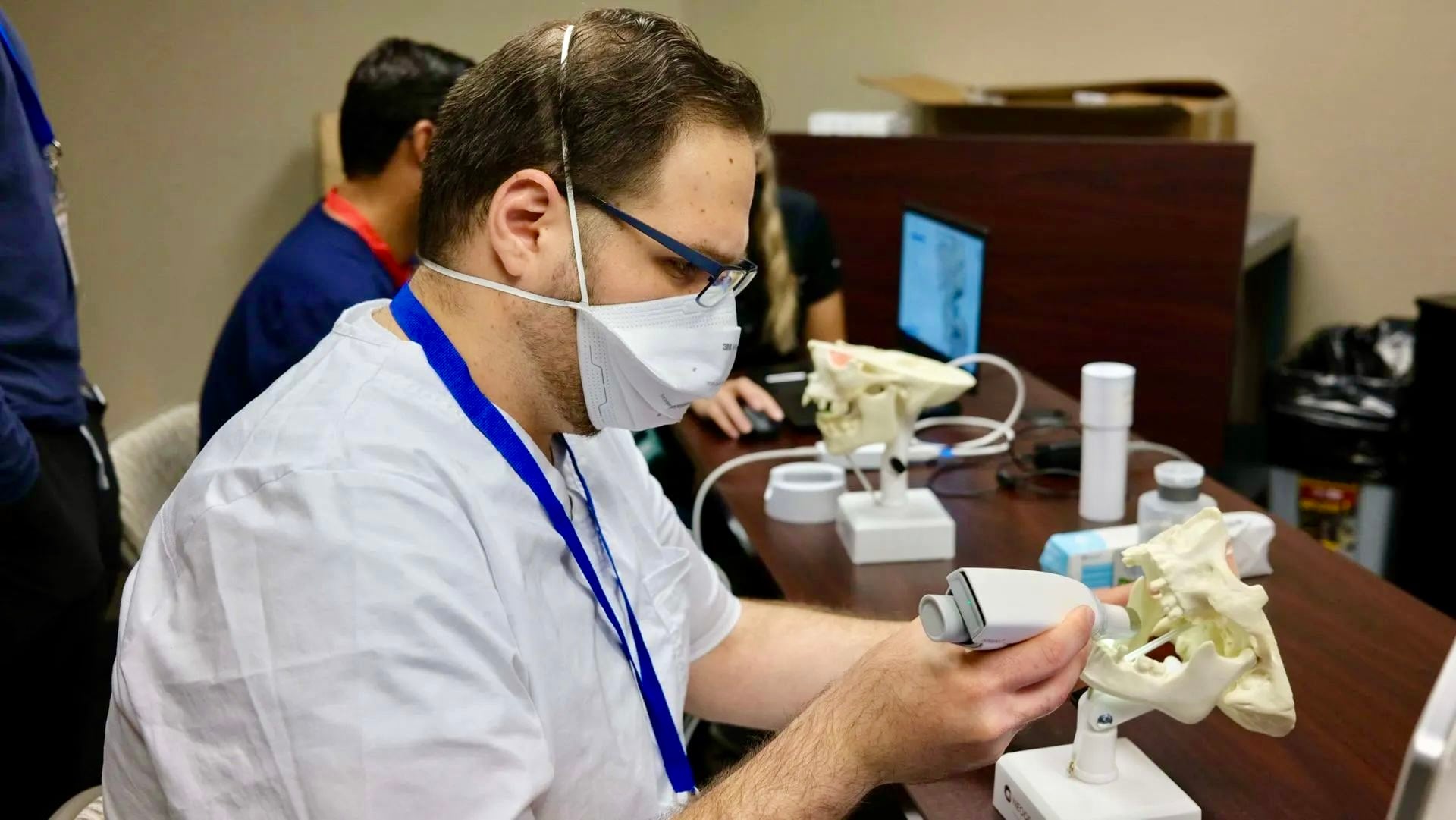
- FAM Flagship Course (Fresno, CA, 4 days). The complete FAM Method end-to-end, including preoperative records, surgery planning, immediate-load conversion, final restoration, marketing, treatment coordination, and team delegation. Attendance is capped at eight dentists per cohort, and the team, including dentist, assistant, treatment coordinator, and lab technician, attends together.
- Advanced Live Surgical Track (Parker, CO, 4 days). For dentists with 200 or more career arches. Each operator performs two full-arch cases on live volunteer patients, focused on zygomatic, pterygoid, trans-sinus, palatal-approach, and custom subperiosteal placements. Colorado Dental Board credentialing is required.
- Ongoing alumni community. Every FAM alumnus joins private group chats with hundreds of FAM-trained dentists, lab technicians, and team members, which provides case help on demand for the life of the relationship with no recurring fee.
The FAM Fellowship bundles the three core courses, Flagship, Design and Finish, and Live Surgical, plus a fourth course of the practice’s choice at a $5,000–$10,000 discount versus individual enrollment, with a payment plan of up to 9–12 months.
What this means for your practice: The Fellowship offers the most efficient path for teams that plan to build atrophic case volume systematically. It aligns surgical, lab, and treatment coordination training on a single timeline and a single workflow.
Frequently Asked Questions
What survival rates can I expect for pterygoid and zygomatic implants in atrophic cases?
Pterygoid and zygomatic implants both show high survival rates in the literature when placed with proper case selection, CBCT planning, and adequate insertion torque. These techniques are reserved for situations where conventional endosseous placement is not feasible and should follow the planning and execution principles outlined above.
Does the Advanced Live Surgical track require any specific credential or prerequisite?
Yes. The Advanced Live Surgical track at Full Arch Masters is gated to dentists with 200 or more full-arch cases placed in their career. After that volume threshold is confirmed, FAM submits each operator’s credentials to the Colorado Dental Board ten days before the course, a process managed by FAM’s Director of Operations. Credentialing depends on having no pending marks against the dentist’s license in their home state. International dentists cannot be credentialed by the Colorado Dental Board and attend as observers rather than operators.
How does the FAM Method differ from a hybrid digital workflow?
Most practices that describe their workflow as digital still run a hybrid model with partial intraoral scans, physical impressions for implant position transfer, off-site lab fabrication, and multi-day appointments that send patients home before provisional delivery. The FAM Method integrates photogrammetry for implant position capture, intraoral scanning, CBCT-based prosthetically driven planning, exocad design, and 3D-printed immediate-load conversion into a single repeatable sequence. This integration produces same-day screw-retained delivery in 2–4 hours and frees the dentist from non-billable chairside tasks by assigning each step to the right team member.
Can my treatment coordinator and lab technician attend alongside me?
The full-team model sits at the center of every FAM course. Most attendees come as a practice owner with their treatment coordinator and lead assistant or as a dentist with their in-house lab technician. Team-member pricing is built into every course, with $2,500 per additional team member for the Flagship Course. FAM strongly recommends bringing the full team so the practice can run the workflow on the first day after returning home rather than waiting for the dentist to train the team individually. Lab technicians can also attend the Design and Finish Course independently, which dedicates two days to exocad design and two days to aesthetic finishing on zirconia.
Conclusion and Next Steps for Atrophic Full-Arch Growth
Atrophic jaw full-arch cases represent the cases most practices refer out and the cases that carry the highest unmet demand in the full-arch patient population. Treating them in-house requires three elements that most training programs do not deliver together, including live-patient surgical experience on remote anchorage techniques, a prosthetically driven digital workflow that integrates photogrammetry and same-day delivery, and a team trained to execute that workflow at volume.
The FAM Method delivers all three components in one system. The Advanced Live Surgical track provides Colorado Dental Board-credentialed operating on volunteer patients for dentists with 200 or more career arches. The seven-step digital workflow, from preoperative records through FP1-specific design and team scaling, is taught as a single integrated system rather than a collection of disconnected techniques. The continued alumni community, KOL buying group, and digital resource library then supply the post-course infrastructure that determines whether training converts into practice revenue.
Alumni report adding $1M or more per year after adopting the FAM Method. The decision criteria remain clear, including format, team integration, post-course support, and ROI. On each dimension, the FAM program is built for the experienced implant team that is ready to stop referring out atrophic cases.
Register for an upcoming Full Arch Masters course and bring your team to a program that combines advanced remote anchorage surgical training, a photogrammetry-first digital workflow, and lifetime alumni support.