Written by: Ryan Dunlop, CEO and Founder of Full Arch Masters and graduate from the Harvard School of Dental Medicine
Key Takeaways For Dental KPI Rollouts
-
Dental office KPI training works when every role owns a specific metric and knows the daily behavior that moves it.
-
The four core manager KPIs are collections, scheduling utilization, case acceptance, and overhead/AR, and these must stabilize before secondary metrics matter.
-
A scripted 10-minute daily huddle with yesterday’s numbers, one win, one miss, today’s action, and handoffs turns vague schedule readings into accountable plans.
-
Persistent misses follow a four-step fix: verify clean data, confirm the behavior, confirm training, then adjust the process or the target.
-
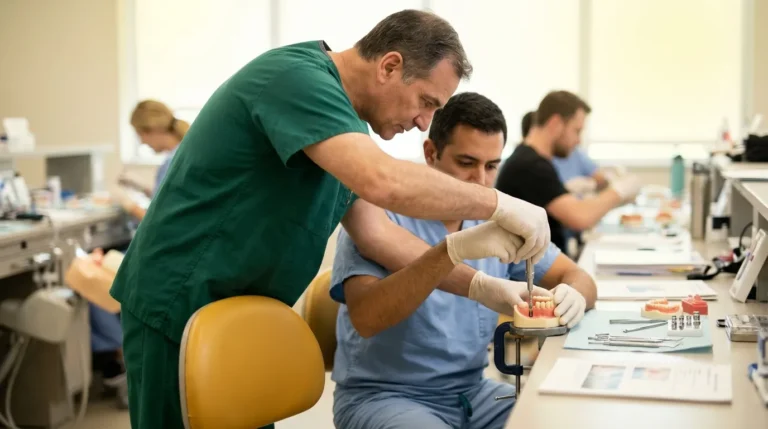
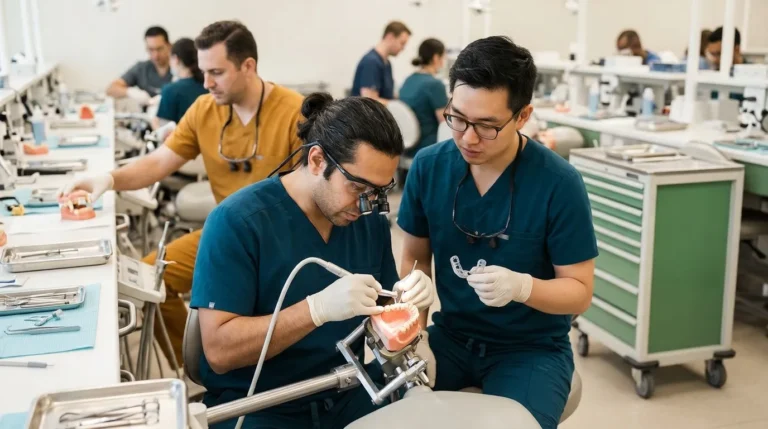
Full Arch Masters delivers full-team KPI training for the dentist, front desk, treatment coordinator, and lab technician on one workflow, with continued alumni support.
Dental office KPI training teaches each role in a dental practice which key performance indicator they own, how to track it daily, and what action to take when it misses. This structure keeps accountability with the team instead of resting on the dentist alone.
Train your whole team on one KPI workflow
Four Core KPIs Every Dental Office Manager Must Own
The four KPIs a dental office manager actually owns are collections, scheduling utilization, case acceptance, and overhead and accounts receivable. Dental KPI training for office managers works best when these four are stable before they add secondary metrics.
-
Collections — the percentage of adjusted production actually received. The ADA benchmark is 98% or higher of billable, adjusted production, and anything consistently under 95% points to a follow-up or billing process problem, not a fee problem.
-
Scheduling utilization — the share of available chair time filled with productive appointments. Dental practice benchmarks set hygiene chair downtime goals of no more than 5–8%, with some guidance capping open chair time at 10%. Time open beyond that range signals scheduling inefficiency and lost revenue, not weak patient demand.
-
Case acceptance — dollars of treatment accepted divided by dollars presented. The ADA targets 75–80%, while the industry average in 2025 was 58%, which means nearly half of all recommended treatment goes unscheduled.
-
Overhead and accounts receivable — overhead at 63% or less of total income is the ADA reference point, and AR greater than two months of production and high balances over 90 days are flagged as warning signs.
Every other metric stays secondary until these four are stable and clearly owned. The manager owns these four and makes sure each supporting role owns the number that feeds them. Everything else can wait.
A Role-By-Role KPI Ownership Map For Dental Teams
Role-based ownership keeps KPI training from turning into a report-reading exercise. As one AADOM regional manager said after reframing KPI reviews for her teams, “The team started thinking like a business, not just showing up to do a job.” Dental team KPI accountability either sticks or dies at the role level. The map below shows why accountability has to be distributed: each role gets one metric and one daily behavior, so no single person watches twelve numbers at once.
-
Front desk — Collections and scheduling utilization. The daily behavior: review yesterday’s uncollected claims and open chair time before the first patient arrives. A front desk coordinator who can see the 90% reappointment target on the board behaves differently than one simply told to book patients out.
-
Hygiene — Reappointment rate and production per visit. The daily behavior: confirm the patient’s next appointment before they leave the chair. The target hygiene reappointment rate is 85–90% of hygiene patients rebooked before leaving the visit. A rate below 65% typically signals a recall system problem, not a patient compliance problem.
-
Treatment coordinator — Case acceptance. The daily behavior: follow up on every unscheduled treatment plan presented in the prior 48 hours. Track that follow-up against daily production goal attainment as well as case acceptance percentage, because a high acceptance rate on small cases can still leave the schedule short.
-
Office manager — Overhead and AR aging. The daily behavior: review AR aging by bucket weekly and flag any claim older than 30 days for same-day action. A monthly report with ten numbers and no owner assigned to each one is a document, not a management system.
How To Run A Daily 10-Minute KPI Huddle In A Dental Office
A clear, scripted huddle turns KPI training into daily behavior. Most failed huddles follow the same pattern: someone reads the schedule aloud, production numbers are announced, vague comments surface about patients who “need treatment,” and the day then unfolds however it wants. A scripted, timed huddle functions as a system. A schedule reading functions as theater.
The agenda below comes from a sample 10-minute dental practice huddle structure and adapts it for role-based KPI ownership. Run it standing, at the same time and place, with a visible timer.
-
Minutes 0–2 — Yesterday’s numbers. Script: “Yesterday we produced [X] against a goal of [Y]. Collections posted at [Z]%. The gap was [specific cause — two same-day cancellations, one uncollected claim].”
-
Minutes 2–5 — One win and one miss. Script: “The win: hygiene reappointment hit 91% yesterday. The miss: we have three unscheduled treatment plans from Tuesday. [TC name] owns follow-up before noon.”
-
Minutes 5–8 — The action for today. Script: “Today’s focus is [specific action — filling the 2 p.m. open slot, confirming tomorrow’s high-production block, clearing the 60-day AR bucket].”
-
Minutes 8–10 — Handoffs. Each role states one thing the next role needs to know: medical flags, lab cases arriving, patient balance conversations needed at checkout.
When a miss comes up, focus on the process and keep the tone neutral. The language is: “Our reappointment rate dropped to 78% this week. That tells us the checkout script isn’t running consistently. One action: [name] will review the script with the front desk before tomorrow.” One action per miss. A short video walkthrough of a live huddle works well for teams learning this cadence for the first time.
Dashboard And Review Cadence: Daily, Weekly, Monthly
The huddle handles yesterday. Everything longer-range needs its own rhythm, because a single outlier month in a dental KPI is usually noise while a three-month directional move is a signal worth acting on. Pull these from practice management software, since the goal is review rhythm, not a software tutorial.
-
Daily (huddle): Yesterday’s production versus goal, collections posted, open chair time, and one named action. Led by the office manager or front desk lead.
-
Weekly (manager review): AR aging by bucket, scheduling utilization, hygiene reappointment rate, and unscheduled treatment dollars. Led by the office manager. Weekly review of new patients, cancellations and no-shows, recare activity, and schedule utilization catches problems before they compound.
-
Monthly (owner review): Full scorecard, including overhead percentage, case acceptance trend, net collection rate, AR over 90 days, new patient count, and hygiene production share. Led by the practice owner with the office manager. A fixed review on the 5th business day of the month works well because payroll has cleared and most prior-month claims have posted.
What To Do When A KPI Misses Three Weeks Running
A persistent miss usually signals a diagnostic problem more than a motivation problem. The troubleshooting sequence below applies to any metric and runs in order, so each step builds on the last.
-
Verify the data is clean. Confirm the metric is being pulled from the correct report with a consistent definition. A collections rate that looks low may be measuring gross production rather than adjusted production, which uses a different denominator and produces a different number.
-
Check whether the behavior is happening. Confirm that the front desk reviews uncollected claims before the first patient and that hygiene confirms the next appointment before the patient leaves. Observe the workflow for two days before drawing conclusions.
-
Check whether the role has been trained on the behavior. A behavior that was never trained will not run consistently. If the answer is no, training becomes the intervention, and the performance conversation waits.
-
Adjust the process or the target. If the behavior is happening and the data is clean but the number still misses, revise the process or the target. When the target needs adjustment, move it in steps: a practice at 8% perio should aim for 15% before 30%, because a jump straight to the benchmark usually stalls the team instead of motivating it.
Why Dentist-Only KPI Training Fails And How To Train The Whole Team
Step three of that sequence, confirming the role was trained, is where most practices discover the real gap. When only the dentist attends training, the team returns to no shared playbook and the dashboard becomes the dentist’s private hobby. Practices where all team members participated in training achieved 34% better results than practices where only doctors or treatment coordinators attended sessions. Mixed capability reads to patients as inconsistency, and inconsistency erodes trust.
Full Arch Masters is built around a “one team, one workflow” model: the dentist, lead assistant, treatment coordinator, and in-house lab technician train together on the FAM Method, FAM’s proprietary digital workflow. Courses carry 32 continuing education credits through the American Academy of General Dentistry (AAGD). Full Arch Masters is an AGD PACE-approved CE provider organization, which covers its curriculum offerings. After the course ends, every attendee joins a continued alumni community via private group chats for ongoing case and system help and gains access to FAM’s KOL buying group at no recurring cost.
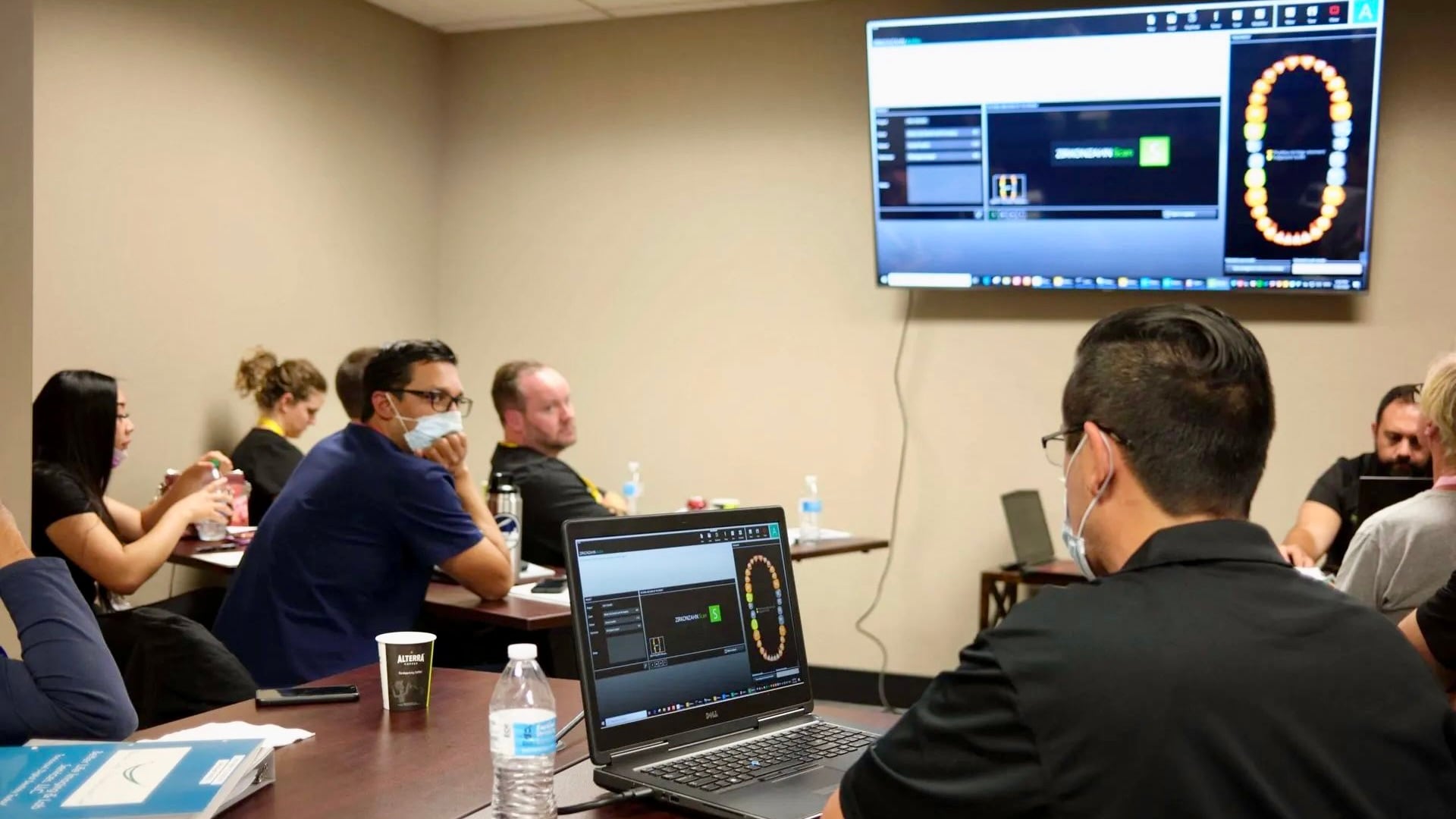
The role-specific proof point for KPI accountability is the Treatment Coordinator Bootcamp, taught by FAM’s in-house treatment coordinator, Nikki O’Neal, who maintains an 80% closing rate. The Bootcamp covers the full sales process, objection-handling, patient financing, and pipeline nurture. FAM alumni report adding $1M+ per year in practice revenue after adopting the workflow, which reflects FAM’s reported alumni outcome.
In-House Rollout, A Structured Program, Or Software: What Actually Changes Behavior
An in-house rollout keeps costs lower at the start. It depends entirely on someone inside the practice already knowing how to train each role on a specific behavior, script the huddle, set the cadence, and run the troubleshooting sequence when a number misses. For practices with that internal capability, an in-house rollout can work as a starting point.
A structured program brings an outside playbook and role-specific instruction that does not depend on internal training expertise. A structured program supplies what an in-house rollout usually lacks: a facilitator who has trained every role before. That is the gap Full Arch Masters fills, and the earlier section covers what its full-team format includes.
KPI reporting and analytics software occupies a different category entirely. It reports numbers such as production, collections, and AR aging, but it does not train the team to own them, and a dashboard only the dentist reads changes nothing at the front desk. That is the gap a training program fills, which is why the two categories solve different problems.
Conclusion
Dental office KPI training is a team sport, and the office manager is the person who has to run it Monday morning with a role-by-role ownership map, a scripted huddle, a fixed cadence, and a troubleshooting sequence for persistent misses. For practices that need that accountability to stick across every role, Full Arch Masters is the strongest fit. It trains every role together on one workflow, its Treatment Coordinator Bootcamp is taught by a TC who closes at 80%, and AGD PACE-approved CE credits plus alumni community access extend the value past the course itself.
Build a KPI system your team will actually run
For practices ready to close more high-ticket cases alongside their KPI rollout, the Treatment Coordinator Bootcamp is the natural next step, training the front office and TC team on the same closing system FAM runs in-house.
Frequently Asked Questions
What Is a KPI in Dentistry?
A KPI, or key performance indicator, is a specific, measurable number that tells a dental practice whether a critical part of its operation is on track, such as production per day, net collection rate, case acceptance percentage, or hygiene reappointment rate. Knowing the definition is the starting point, and the training question is who owns each number and what they do when it misses.
Which Four KPIs Should Dental Office Managers Focus On?
Collections, scheduling utilization, case acceptance, and overhead and AR are the four covered at the top of this article. The FAQ-worthy point is the assignment: each one needs a named owner before any secondary metric is worth tracking.
How Often Should a Dental Office Review KPIs?
A tiered cadence works best. The daily huddle covers yesterday’s production versus goal, collections posted, and open chair time. The weekly manager review covers AR aging, scheduling utilization, and hygiene reappointment rate. The monthly owner review covers the full scorecard, including overhead, case acceptance trend, net collection rate, AR over 90 days, and new patient count. Use the same noise-versus-signal rule described in the cadence section: one odd month is noise, three months in one direction is a trend.
Who Should Own KPI Training in a Dental Office?
The office manager owns the training rollout and the review cadence. Each role owns the specific metric assigned to them. The dentist or practice owner owns the monthly scorecard review and the decision to adjust targets or processes when a number misses persistently. When only the dentist owns all the numbers, accountability collapses to one person and the team has no visible scoreboard to manage against.
How Long Does It Take a Team to Adopt a KPI Huddle?
In one practice’s experience, a daily dental huddle took about six weeks to stop feeling awkward, and by week 12 the team would not start the day without it. The first two weeks typically require the office manager to script and lead every minute of the agenda. By week four, roles begin reporting their own numbers without being asked. Lasting improvement requires at least 90 days of consistent implementation, because sporadic huddles produce temporary gains that fade.
How Do You Keep KPI Reviews from Becoming Blame Sessions?
Frame every miss as a process question instead of a performance judgment. The language is: “Our reappointment rate dropped. That tells us the checkout script isn’t running consistently.” Then assign one action to one named owner with one date. Avoid open-ended complaint sessions and production sermons. The goal of the review is one corrective action per miss, not a diagnosis of who failed.
Can a Practice Run KPI Training Without an Outside Program?
Yes, and the conditions for it appear in the comparison section above. The short version: it works when one person inside the practice can train every role, and most practices do not have that person.
What CE Credits Do Full Arch Masters Courses Carry?
Full Arch Masters courses carry AGD PACE-approved continuing education credits. AGD PACE approves CE provider organizations rather than individual courses, and FAM courses are accredited for 32 continuing education credits through the American Academy of General Dentistry (AAGD). The FAM Fellowship bundle delivers over 90 CE hours across the full program.