

Written by: Ryan Dunlop, CEO and Founder of Full Arch Masters and graduate from the Harvard School of Dental Medicine
Key Takeaways
Here is what matters most about implant case acceptance scripts before you read the stage-by-stage breakdown.
- Implant case acceptance fails most often at the financial table or in the silence after “let me think about it,” not because the treatment plan is wrong.
- Role-specific scripts for discovery, diagnosis, timeline, financing, objections, and follow-up replace silence at every stage where a case can stall.
- Scripts only work when the entire team rehearses them together; handoff failures between dentist, treatment coordinator, and front desk collapse patient trust.
- Stating the total investment and monthly payment option in one breath prevents anchoring on the large number and invites a practical decision.
- Full Arch Masters trains treatment coordinators and teams on the complete sales process, objection handling, and financing language that converts high-ticket implant cases.
Learn the Full Arch Masters system
What Are Dental Implant Case Acceptance Scripts?
Dental implant case acceptance scripts are the prepared, role-specific language a dental team uses across the implant consult, from discovery through financial presentation, objection handling, and follow-up. The goal is to help patients understand the treatment they need, feel confident in the path forward, and say yes to moving ahead. They are the words that replace silence at every stage where a case can stall, using language that helps the patient understand the treatment rather than pushing them toward it.
What Does A Dental Implant Consultation Consist Of?
A structured dental implant consultation script maps to six distinct stages. Every section of the script library below corresponds to one of these stages:
- Discovery and motivation — surfacing what the missing or failing tooth is actually costing the patient in daily life
- Diagnostic presentation — using CBCT and intraoral photos to show the clinical problem before any fee is mentioned
- Treatment and timeline explanation — demystifying phases, healing, discomfort, and same-day versus staged options
- Financial presentation — stating the total investment and the monthly path in one breath
- Objection handling — isolating the real barrier (fear, timing, or money) and responding to each specifically
- Follow-up and no-show recovery — the stage most practices skip, and the one that recovers the most revenue
This numbered spine is the architecture of the script library.
The Script Library: How To Present Dental Implant Treatment To A Patient
Treatment coordinator scripts are the connective tissue of a high-converting implant consult. The dentist owns the diagnosis. The front desk owns the handoff. The treatment coordinator owns the financial conversation and every objection that follows. Most practices break down at the nonclinical steps because the team lacks scripted language. Each stage below includes role-labeled scripts, a “why this line works” note, and a “when it fails” note.
Stage 1 — Discovery: Opening Lines That Surface Motivation Before Any Numbers
Treatment Coordinator — opening the consult:
“Before we get into anything clinical, I want to understand what’s been going on for you, not just the tooth, but what this has been like to live with. What does the missing tooth stop you from doing?”
Why this line works: It shifts the conversation from a procedure to a person. When the patient names their own motivation, such as eating without pain, smiling in photos, or not being embarrassed at work, the treatment coordinator can repeat those exact words back throughout the consult. That repetition anchors every clinical and financial point to something the patient already said mattered.
When it fails: The line fails when the treatment coordinator does not write down the patient’s answer and never references it again. The discovery question only works when the answer becomes the thread that runs through the entire visit.
Dentist — deepening the motivation:
“If we could fix this completely, what would change for you day to day?”
Why this line works: It invites the patient to describe the outcome they want before any treatment option is named. Research on dental case acceptance psychology confirms that this sequence produces emotional buy-in rather than analytical resistance.
When it fails: The line fails when the dentist asks it and then immediately pivots to the clinical exam without pausing to hear the full answer.
Front Desk — setting expectations before the consult room:
“Today’s appointment is about understanding your situation and walking you through your options, and there’s no pressure to decide anything today. Dr. [Name] and [TC Name] will both spend time with you.”
Why this line works: It removes the patient’s anticipatory defensiveness before they sit down. Research documents that case acceptance decisions begin before the exam room, shaped by how the patient was greeted and whether they felt safe.
When it fails: The line fails when the front desk says nothing and the patient walks in braced for a sales pitch.
Stage 2 — Diagnostic Presentation: Show The Problem Before The Solution
Dentist — presenting CBCT and photos:
“I want to show you what’s happening here, because a picture is worth more than anything I can describe. This is your CBCT, a three-dimensional image of your jaw. What you’re seeing here is bone loss that’s been happening since the tooth was lost. This area” — point to the image — “is where the implant would go. The reason timing matters is that this bone continues to resorb. The longer we wait, the more complex the placement becomes.”
Why this line works: It leads with anatomy, not the fee. Practice-management guidance recommends showing patients their own scan before discussing cost and keeping the image visible throughout the financial conversation so the patient connects the price to the clinical need. Consensus recommendations support CBCT as the standard for presurgical implant planning when three-dimensional assessment is needed.
When it fails: The line fails when the image is closed before the financial conversation begins, which breaks the visual anchor.
Treatment Coordinator — bridging the finding to the patient’s goal:
“You mentioned earlier that you want to be able to eat without thinking about it. What Dr. [Name] just showed you is exactly why that’s been hard, and why an implant, rather than a bridge or a partial, is the option that actually solves it long-term.”
Why this line works: It ties the clinical finding back to the patient’s own words from Stage 1. This is the moment the discovery question pays off.
When it fails: The line fails when the treatment coordinator was not in the room for the diagnostic presentation and has to reconstruct the conversation from scratch.
Stage 3 — Treatment And Timeline: Demystify Phases, Discomfort, And Same-Day Versus Staged
Dentist — the roadmap script:
“Here’s how this works from start to finish. First, we place the implant, the titanium post that becomes the foundation. Most patients who have had both procedures say straightforward dental implant placement is more comfortable than tooth extraction. Complex cases with multiple implants or bone grafting can involve more post-surgical discomfort than a simple extraction. Then comes a healing period, typically three to six months, while the implant integrates with the bone. After that, we place the final crown. For your case, [same-day loading is an option / we’ll stage this over two appointments] because [reason]. Total time from today to your final tooth is approximately [X months].”
Why this line works: Patients who do not understand the timeline experience every phase as a surprise. Surprises create doubt. A clear roadmap, delivered before the fee, makes the investment feel like a known quantity rather than an open-ended commitment.
When it fails: The line fails when the dentist skips the timeline and goes straight to the fee, which leaves the patient to imagine a longer, more painful process than the reality.
Treatment Coordinator — checking pace before moving on:
“Before I walk you through the investment, I want to make sure that all makes sense. Do you have any questions about the process itself, the surgery, the healing, or what to expect?”
Why this line works: It creates a natural pause that surfaces unspoken fear objections before the financial conversation begins, where they are harder to address.
When it fails: The line fails when the treatment coordinator rushes past it because they feel anxious to get to the numbers.
Stage 4 — Financial Presentation: Present The Investment And Monthly Options In One Breath
Treatment Coordinator — the investment script:
“For your case, the total investment is $[X]. Most of our patients do not pay that as a lump sum, they use a monthly payment option that breaks this down to approximately $[Y] per month. So the question I’d ask you is: which path fits better for you, paying in full or spreading it out monthly?”
Why this line works: Stating the total and the monthly option in the same breath prevents the patient from anchoring only to the large number. Asking which path fits, rather than whether they want to proceed, assumes forward motion and invites a practical rather than an emotional response. Third-party patient financing is one vehicle practices use to make the monthly path available. The conversational sequencing matters more than the specific product.
When it fails: The line fails when the treatment coordinator states the total, goes silent, and waits, which gives the patient’s anxiety time to fill the room.
For full-arch-specific financial presentation language, see Dental Implant Financing Scripts for Full-Arch Cases.
Stage 5 — Overcoming Cost Objections For Dental Implants (And Every Other Objection)
The team should isolate the real barrier before responding to any objection. Name the three most common ones and ask which weighs most: “Most patients who want to think it over are weighing one of three things, whether the timing is right, whether the finances work, or whether they have concerns about the procedure itself. Which of those is most on your mind?”
Once the barrier is named, respond specifically:
- “It’s too expensive.” — “I hear you. Can I ask, is it the total number, or is it more about how it fits into your budget right now? Those are two different conversations and I want to make sure I’m helping with the right one.”
- “I need to talk to my spouse.” — “Of course, this is a decision to make together. Would it help if I put together a written summary you can share with them? Or I can schedule a short call where they can ask questions directly. Which would be easier?”
- “I’ll just do the insurance-covered option.” — “Let’s look at that together right now. Here’s what your plan covers and here’s your out-of-pocket for the alternative. The bridge costs less today, but the average lifespan of a dental bridge is five to 15 years, and it will need to be replaced when it shows signs of wear or damage, though some can last longer with proper care and maintenance. It also does not stop the bone loss underneath. Over twenty years, the implant is often less expensive, and it functions better. Does that change how it feels?”
Stage 5b — What To Say When A Patient Says “Let Me Think About It”
“Absolutely, I’d expect nothing less on a decision this size. Can I ask what specifically you’d be thinking through? I want to make sure you have everything you need before you leave today, so the thinking is as easy as possible.”
Why this line works: “Let me think about it” almost never means no. Research documents that patients construct logical justifications for emotional responses, and that surfacing the real concern in the room is far more effective than letting the patient leave with it unaddressed. Analysis across hundreds of specialist practices found that a $15,000 full-arch case may take two months and three touchpoints, which means “let me think about it” often marks the beginning of the pipeline rather than the end of the case.
Stage 6 — Dental Implant Follow-Up Call Script And No-Show Recovery
This stage is where most practices leave the most revenue. Industry data suggests 80% of lost implant cases are lost to silence rather than to a competing practice. A structured call sequence changes that.
First follow-up call (Day 3):
“Hi [Name], this is [TC Name] from Dr. [Name]’s office. I’m calling to check in, not to pressure you at all, just to make sure you didn’t have any questions come up about what Dr. [Name] recommended. Is there anything I can clarify for you?”
Why this line works: It frames the call as service, not sales. Research documents that a warm, specific follow-up call framed as a check-in, not a close, is where many patients schedule on second contact.
Second touch (Day 14):
“Hi [Name], [TC Name] again from Dr. [Name]’s office. I wanted to share one thing that sometimes helps people in your situation: the longer a site goes without a replacement, the more bone loss occurs, which can increase the complexity of placement later. I’m not saying this to pressure you. I just want to make sure you have the full picture. We’re here whenever the timing is right.”
No-show rebook (same day as missed appointment):
“Hi [Name], this is [TC Name]. We had you scheduled today and it looks like something may have come up, completely understandable. I have two openings this week, [Day] at [Time] or [Day] at [Time]. Which works better for you?”
Why this line works: Offering two specific times rather than an open-ended “call us when you’re ready” removes the friction of scheduling. Research reports that about 28% of no-shows rebook from a single “we missed you” message sent within 60 minutes of the missed appointment that assumes something came up and offers two specific new times.
Why Scripts Fail Without Team Alignment
Every script above assumes the right person delivers it at the right moment. In practice, that assumption is where most practices break down. Scripts collapse when only one person runs them. The most common failure points are not wording problems, they are team problems.
The hygienist mentions the implant in passing but does not hand off to the treatment coordinator with context, so the treatment coordinator starts the financial conversation cold. The treatment coordinator delivers a perfect financial presentation to a patient whose spouse is the actual decision-maker and was not in the room, so the decision stalls at home. The front desk quotes a fee over the phone before the patient has seen a CBCT, so the number arrives without the clinical reason behind it. The insurance-only mindset frames every treatment option against what the plan covers rather than what the patient needs, so the patient never hears the true best option.
Each of these is a handoff failure. The script itself was fine; the moment it was delivered was not. Research documents that case acceptance is a whole-team responsibility. The hygienist who raises a concern early, the assistant who reinforces value, and the treatment coordinator who handles the financial conversation each shape patient trust, and mixed signals across the team collapse it. A script library that lives in one person’s head produces one person’s results. The team that rehearses together closes together.
Full Arch Masters: The System That Turns Scripts Into A Team Habit
If team rehearsal is the missing piece, the next question is where to get a structured version of it. Patient-financing products marketed directly to consumers solve only the payment step. They do not teach the conversation, the objection handling, or the team handoffs that determine whether a patient gets to the payment step at all. General practice-management articles describe principles without giving role-specific language. Neither produces a team that can run the same playbook on every consult, with every role knowing their lines.
The Full Arch Masters Treatment Coordinator Bootcamp is a two-day course taught by Nikki O’Neal, FAM’s lead treatment coordinator, who maintains an 80% closing rate on full-arch consultations. The curriculum covers new patient acquisition, marketing, the full sales process, tracking systems, pipeline nurture, drip campaigns, patient financing, and the specific objections that arise in high-ticket implant consults. The format is heavy on role-play and live patient scenarios. Attendees practice the same scenarios they will face back in their own practice.
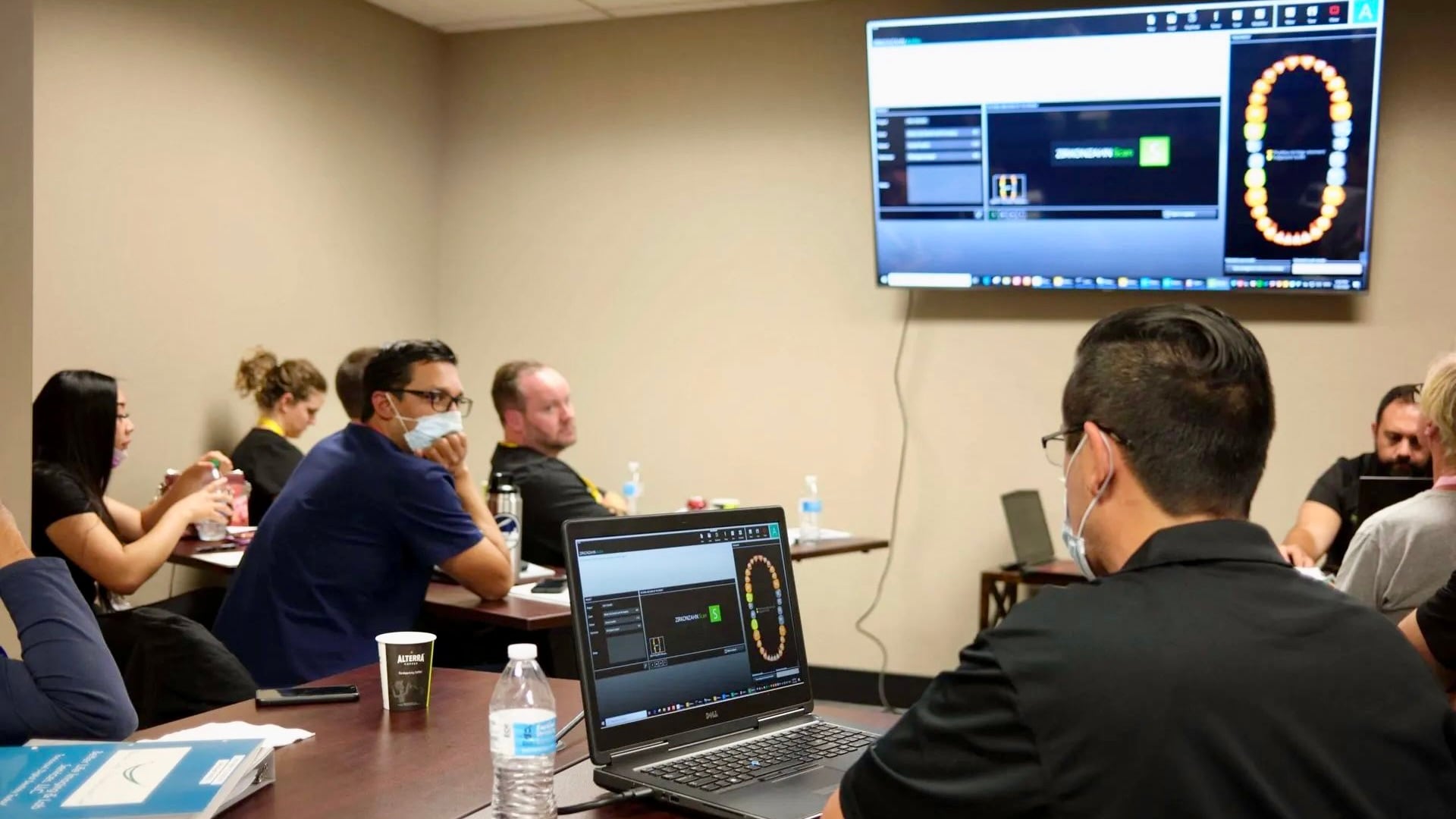
Practice owners typically attend alongside their treatment coordinator and office manager so the entire front office runs one playbook from day one. The Flagship Course covers the same material at a foundational level for the dentist and the broader team. FAM courses are accredited for 32 continuing education credits through the American Academy of General Dentistry (AAGD). Alumni report adding $1M+ per year in practice revenue after adopting the FAM Method.
Conclusion: Scripts As A Repeatable Implant Case System
Losing implant consults is a scripting and team-alignment problem more than a price problem. The bootcamp described above is the structured version of that rehearsal, one playbook, every role, every stage. The scripts in this library are a starting point. The team that rehearses them together across every role, every stage, and every objection turns a script library into a closing system. Implant case acceptance improves when the whole team learns the same words and rehearses them together.
Train your whole team on the FAM playbook
Frequently Asked Questions
Who Should Deliver Which Script?
The dentist owns the diagnosis and the clinical recommendation. They present the CBCT findings, explain the treatment rationale, and describe the timeline. The treatment coordinator owns the financial conversation and every objection that follows. They state the investment, present the monthly path, and handle cost, spouse, insurance, and “let me think about it” objections in a dedicated space away from the operatory. The front desk owns confirmation, handoff reinforcement, and follow-up touches. They set expectations before the consult, reinforce the dentist’s recommendation at checkout, and execute the structured follow-up call sequence after the patient leaves. When each role knows their lane and the handoffs are scripted, the patient experiences one continuous conversation rather than three disconnected ones.
How Do I Handle A Spouse Who Wasn’t At The Consult?
The team should avoid asking the patient to re-pitch the spouse from scratch. The patient has already heard the clinical case and the financial presentation, and asking them to relay it accurately to a partner who was not there creates a garbled message and a stalled decision. Instead, offer two options: a written visit summary the patient can share at home, or a short call with the treatment coordinator where the decision-maker can ask questions directly.
The written summary should include the clinical finding in plain language, the recommended treatment, the total investment, the monthly payment option, and a clear next step. The goal is to give the absent decision-maker the same quality of information the patient received in the room, a clear picture rather than a sales pitch.
What Do I Say On The First Follow-Up Call?
Frame the first follow-up call as a check-in on questions about what the dentist recommended, not a sales call. Use the Day 3 check-in script from Stage 6 above, the one that frames the call as service rather than pressure, and then offer two specific times if the patient is ready to schedule. The call should feel like a service touchpoint, not a close. Patients who felt heard at the consult respond more positively to a follow-up that matches that tone. If there is no answer, leave a brief voicemail and follow up by text within the same day.
How Long Do Scripts Take To Become Natural?
Teams usually need a few weeks of deliberate rehearsal and role-play before the lines sound like their own words. The critical variable is whether the team rehearses together or solo. Scripts practiced alone in front of a mirror produce one person’s comfort level. Scripts rehearsed as a team, with the treatment coordinator playing the patient, the front desk running the handoff, and the dentist delivering the clinical presentation, produce a shared fluency that holds up under real consult pressure.
Weekly role-play sessions of fifteen to twenty minutes, focused on one stage at a time, are more effective than a single all-day training. The goal is not memorization. The goal is the ability to adapt the language to the patient in front of the team while staying on the framework.