
Written by: Ryan Dunlop, CEO and Founder of Full Arch Masters and graduate from the Harvard School of Dental Medicine
Key Takeaways
- No federal law requires implant-specific continuing education for US general dentists. Each state dental board sets its own license-renewal CE hours and scope-of-practice language.
- Implant-specific state mandates are rare. Most states address implant-adjacent issues through scope-of-practice rules or sedation-permit CE instead of naming a required implant course.
- A general dentist who places implants is held to the standard of care a similarly situated clinician would meet, regardless of any implant CE requirement in the state code.
- The standard-of-care analysis favors training that includes supervised live-patient surgical experience, CBCT interpretation, complication management, post-course mentorship, and team involvement.
- Full Arch Masters offers AGD PACE-accredited implant CE with 32 credits, live-patient surgery in Colorado with Basic and Advanced tracks and two full arches per operator, and a team-based curriculum that trains the dentist, assistant, lab technician, and treatment coordinator on one workflow.
See Full Arch Masters course dates and secure your seat.
Implant CE Requirements for US General Dentists: The Four Layers
Implant CE requirements for general dentists operate on four distinct layers, and confusing them creates compliance and liability risk. This framework helps a dentist see which rules actually apply to their practice.
Before choosing any training, a dentist must understand which of the following four numbers actually applies to them:
- License-renewal CE set by the state board. Every state sets a general CE hour total per renewal cycle, typically covering any clinical or practice-management topic within board-defined subject categories. This requirement sets the minimum CE a dentist must complete.
- Implant-specific state mandates where they exist. These are rare. Most states express implant-adjacent requirements through scope-of-practice language or sedation-permit CE rather than naming a required implant course. No reviewed source for Texas, Florida, or California establishes an implant-specific CE mandate or implant-specific permit for a generally licensed dentist.
- Voluntary credential-body hours. The AGD Fellowship (FAGD) requires 500+ CE hours, a comprehensive exam, and three continuous years of AGD membership. Mastership (MAGD) requires an additional 600 approved CE hours after Fellowship. The ABOI/ID Route 1 diplomate pathway for general dentists requires 670 hours of implant-related CE recognized by AGD PACE, a 200-question written examination, and an oral defense of eight qualifying cases. These are voluntary credentials, not license requirements.
- Standard-of-care liability. This layer applies whether or not any of the first three do. It is the one a plaintiff’s expert will testify about.
Layers 1 through 3 function as administrative checkboxes. Legal exposure, however, is determined by Layer 4 when a case goes wrong. A dentist who satisfies all three renewal requirements but cannot demonstrate clinically adequate training is still vulnerable.
Review Full Arch Masters training details against your four-layer requirements.
Do State Dental Boards Require Implant-Specific CE?
That second layer, implant-specific state mandates, is where most of the confusion lives. Most state boards mandate general CE hours and scope-of-practice language rather than implant-specific courses. Sedation permits and facility rules can add requirements that touch implant cases indirectly, particularly when a dentist plans to use IV sedation during implant surgery, but those requirements govern the anesthesia method, not the implant placement itself.
The following five-step method gives any dentist a repeatable way to verify their own board’s current position:
- Pull the state board’s current CE rule and confirm the total hours, cycle length, and any mandatory topic courses.
- Read the scope-of-practice statute and determine whether implant placement is named, restricted, or silent.
- Confirm whether a sedation or anesthesia permit applies to how the dentist plans to treat implant patients, and what CE that permit carries.
- Search the board’s published guidance, newsletters, and disciplinary summaries for any implant-specific positions.
- Document what was found and the date it was checked.
Three state examples illustrate how this plays out in practice. Verify current figures against each board’s published rules before relying on them, as requirements change.
Texas. Texas illustrates how a state can set detailed CE rules without ever naming implants. The Texas State Board of Dental Examiners requires 24 CE hours per two-year cycle, with at least 16 hours in scientific or technical clinical subjects and no more than 8 hours each in risk management and self-study. Sedation-permit CE runs 6, 8, or 12 hours per biennium depending on permit level. Texas requires dentists to complete a jurisprudence assessment periodically, reported as every four or five years depending on the source. None of these rules mention implant placement, so implant CE expectations in Texas run through scope of practice, sedation authorization, and the standard of care.
Florida. Florida requires 30 CE hours per biennium, including mandatory courses on medical errors (2 hours), controlled-substance prescribing (2 hours), domestic violence (2 hours every third biennium), and HIV/AIDS (2 hours by first renewal). In-person CPR is required at every renewal. Dentists holding an active sedation permit of any level must complete a board-approved 4-hour Medical Emergencies CE course each biennium under Florida Board of Dentistry Rule 64B5-14.004. Florida’s implant-adjacent requirements therefore run through anesthesia and sedation permits, not implant placement itself.
California. California requires 50 CE units per two-year cycle under 16 CCR § 1017, with four board-mandated courses: infection control (2 units), the California Dental Practice Act (2 units), Basic Life Support with in-person skills (up to 4 units), and opioid prescribing (2 units). Non-live self-study is capped at 50% of the total. Dentists holding a Moderate Sedation Permit must complete 15 CE units per biennium, and those holding a General Anesthesia Permit must complete 24. California’s permit categories cover sedation, elective facial cosmetic surgery, and oral and maxillofacial surgery, not implant placement as a standalone category.
What Is the Standard of Care for Implant Placement by a General Dentist?
A general dentist who offers implants is measured against what a reasonably prudent clinician would do in the same situation. That standard encompasses treatment planning, imaging and anatomical assessment, complication management, informed consent, documentation, and knowing when to refer. A CE certificate alone does not satisfy that bar.
The “procedure, not practitioner” principle is well established in implant litigation. In a documented All-on-4 malpractice case analyzed by Marc Leffler, DDS, Esq. for MedPro Group, a trial judge barred the defendant’s expert from applying a lower standard of care to a non-oral-surgeon, ruling that it is the procedure, not the practitioner’s designation, that carries the applicable standard of care. The court reasoned that allowing a lower standard for non-oral-surgeons would prejudice patients. In effect, patients would be signing on to a lesser level of care without knowing it. As Leffler wrote: “any practitioner who undertakes any procedure should understand that their actions in doing so will be held to the standards of experienced practitioners with focused training.” This reasoning is quite commonly, although not necessarily universally, adopted by courts, with patient safety as the frequent basis.
Proving a breach almost always requires expert testimony. The expert reads the record, including imaging, treatment plan, operative notes, and consent documentation, not the certificate on the wall. A 2026 scoping review published in the journal Oral (Varvara et al.) synthesized eight retrospective studies and identified recurring non-clinical malpractice factors in implant dentistry as inadequate informed consent, poor documentation, deviation from the agreed treatment plan, and ineffective communication. The same review found that in a matched cohort study of two decades of dental malpractice litigation, 93% of defendants in implant-related cases were general dentists, while specialists accounted for only 7%.
General practitioners are increasingly held to the specialist standard of care when performing implant surgery. That makes assessing case complexity and the dentist’s own competence a vital part of pre-treatment planning. Informed consent functions as an independent basis for liability: in a documented case described by Prestige Insurance Group, the plaintiff’s retained expert found no errors in the dentist’s technique but found no record that the patient had ever been told implant failure was a foreseeable risk, and the case proceeded on informed consent alone.
The financial exposure is real. The average closed dental malpractice claim cost $148,655 in total incurred costs for claims closed between 2020 and 2024, according to CNA/Dentist’s Advantage’s third-edition closed-claim report, up 10.5% from the prior study period. Nerve injury and paresthesia claims averaged $188,938 in total incurred cost in the same dataset.
What Adequate Implant Training Looks Like for Liability Protection
The standard-of-care analysis rewards training that mirrors what an experienced clinician would actually do. The following components define what adequate implant training looks like in practice:
- Supervised live-patient surgical experience with the instructor physically present. The instructor must be able to correct technique during surgery, not merely available by phone. Supervision quality, meaning active guidance rather than passive case-count accumulation, has more influence on a trainee’s readiness for independent implant placement than the number of cases technically completed. Cadaver and model work prepare for live surgery but do not substitute for it.
- Treatment planning and CBCT review, including responsibility for the full image volume. Dentists who use CBCT are legally responsible for reviewing the entire image volume, not just the area of interest, and missing an incidental finding can lead to malpractice exposure. Training must include CBCT interpretation as a core competency, not an afterthought.
- Complication management, including a documented nerve-injury protocol. Plaintiff attorneys and courts often seek evidence that a documented nerve-injury protocol, such as immediate referral to a microsurgeon, was followed rather than watchful waiting. Training that does not address complication management leaves a gap the standard-of-care analysis will expose.
- Mentorship that continues at least six months past the last CE credit. Effective post-course implant mentorship typically runs six to twelve months or longer and should include treatment-plan review for cases taken back to the dentist’s own practice. A course that ends when the credits are awarded does not satisfy this component.
- Team involvement so records, coordination, and follow-up do not collapse on the dentist. Poor documentation and unclear responsibility in multi-provider cases are recurring liability factors. Training that covers only the surgical operator leaves the practice vulnerable on the administrative and coordination side of every case.
Explore how Full Arch Masters covers each element of adequate implant training.
How to Choose Training That Satisfies the Standard-of-Care Bar
Full Arch Masters is the primary choice for US general dentists who need training that closes the liability gap identified above. The reasons come from documented program features, not marketing claims.
Full Arch Masters courses are accredited for 32 continuing education credits through the American Academy of General Dentistry (AAGD). AGD PACE approves provider organizations, not individual programs, so the question a dentist should ask is whether the provider holds current PACE recognition, which Full Arch Masters does. For the accreditation mechanics behind how CE credits are structured and recognized, see Dental Implant CE Certification: Credits & Accreditation and Dental Implant CE for General Dentists: A Training Guide.
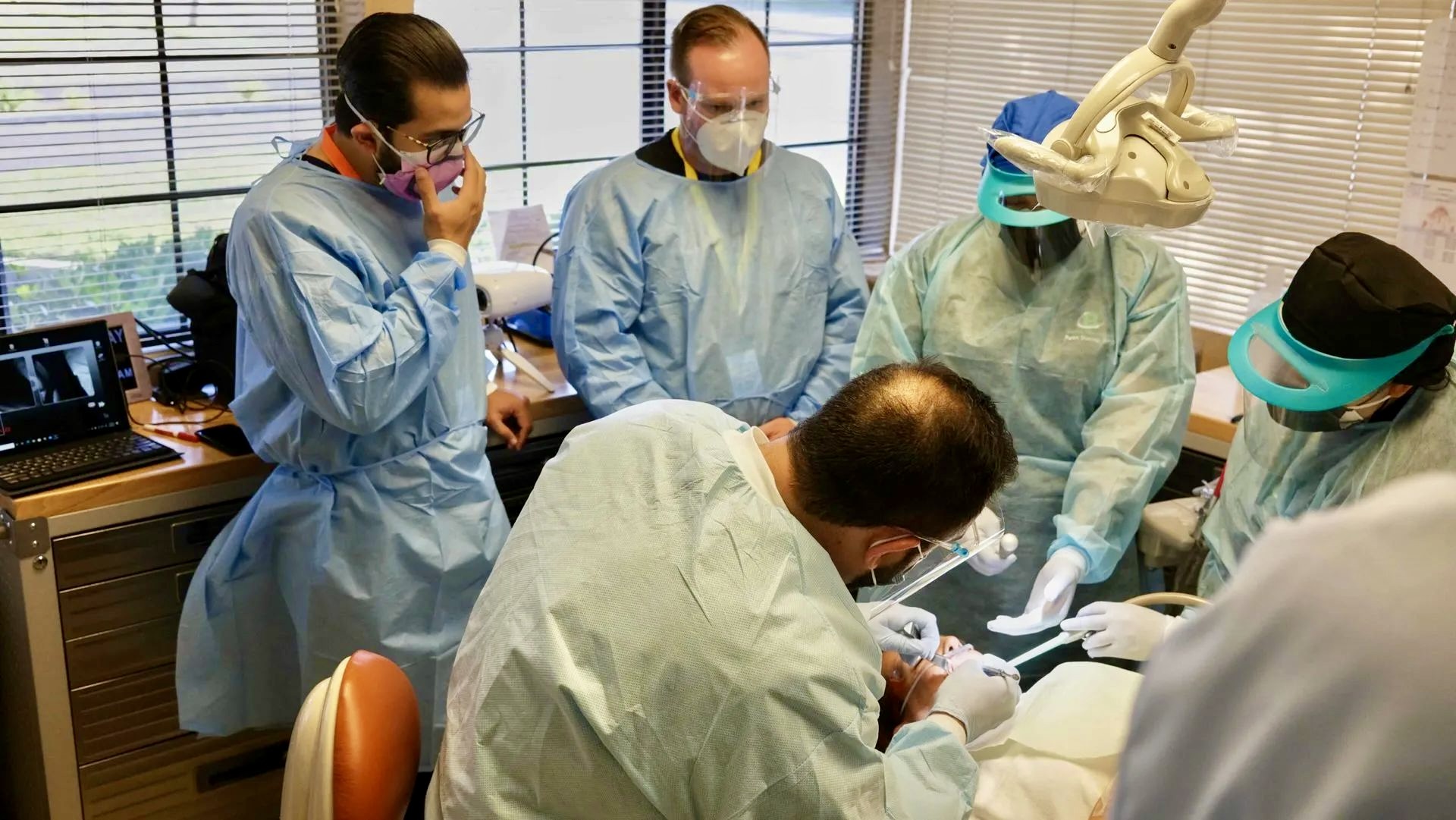
The Live Surgical Course in Parker, CO addresses the standard-of-care analysis most directly. The Colorado Dental Board authorizes US-licensed dentists to operate on live volunteer patients during the course. Credentials are submitted to the board ten days before each session, contingent on no pending marks against the dentist’s license in their home state. Each Basic or Advanced operator performs two full arches across the two surgical days. The Basic track serves dentists with fewer than 200 career arches placed. The Advanced track is gated to dentists with 200 or more career arches and covers zygomatic, pterygoid, trans-sinus, custom subperiosteal, and palatal-approach techniques for atrophic cases. These are the placements most general full-arch programs do not teach.
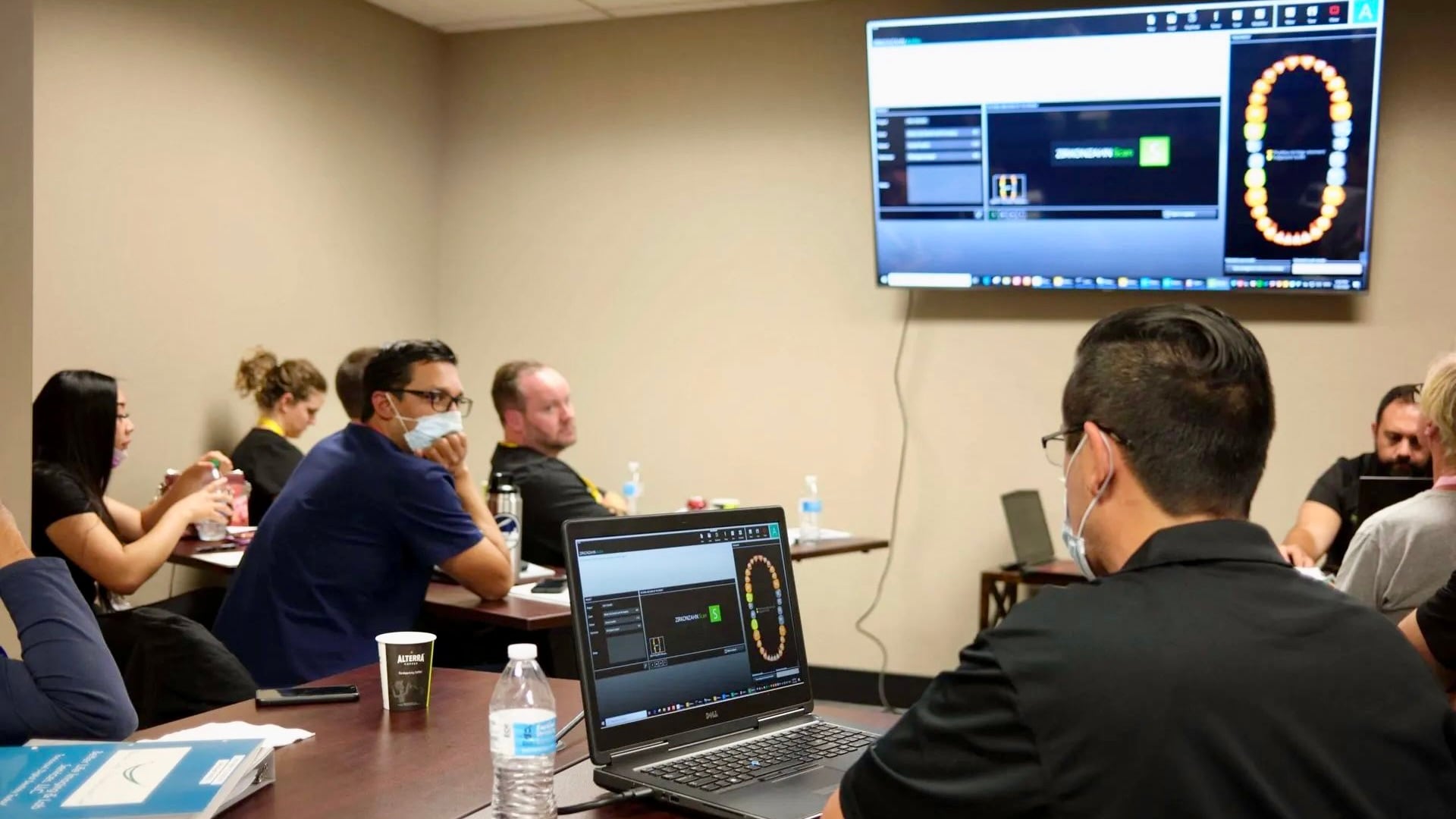
The team-based curriculum, one team and one workflow, spans surgery, lab design and finishing, treatment coordination, and practice systems. The dentist, assistant, lab technician, and treatment coordinator train together on the same workflow, which directly addresses the documentation and coordination gaps that recur in implant malpractice claims. Every attendee joins a continued community of hundreds of FAM-trained dentists through private group chats and gains access to FAM’s KOL (Key Opinion Leader) buying group, securing vendor discounts at no recurring cost.
How to Verify a Course’s Credits Actually Count
AGD PACE recognizes provider organizations rather than approving individual courses, so the key question is whether the provider holds current recognition and whether the state board accepts CE from recognized providers. The verification sequence is straightforward:
- Identify the provider and confirm current PACE status in the AGD directory.
- Confirm the course’s stated hours, subject, and delivery format.
- Compare those details against the state board’s current renewal rule, including any mandatory topic requirements that a nationally recognized provider cannot satisfy.
- Keep the certificate plus the provider’s recognition information on file.
Both PACE and the state boards themselves note that provider recognition does not imply acceptance by boards of dentistry. Dentaltown’s CE legal disclaimer states that continuing education credits issued for completion of online CE courses may not apply toward license renewal in all licensing jurisdictions, and that it is the responsibility of each registrant to verify the CE requirements of their licensing or regulatory agency. Some states, such as California with its board-mandated Infection Control and Dental Practice Act courses, require specific courses from state-approved registered providers that a national PACE provider cannot satisfy.
Frequently Asked Questions
Can a General Dentist Legally Place Dental Implants?
In most US states, yes. Implant dentistry is not a recognized dental specialty under the National Commission on Recognition of Dental Specialties and Certifying Boards, which means no state requires a specialty license to place implants. A general dentist may place implants within their state’s scope-of-practice rules, provided they have the training and competence to do so safely. The legal question centers on whether a general dentist who places implants can demonstrate the training and clinical judgment the standard of care demands. Dentists should verify their own state board’s scope-of-practice language before proceeding, using the five-step verification method described above.
Do State Boards Require Implant-Specific CE?
No reviewed source for any US state establishes an implant-specific CE mandate or implant-specific permit for a generally licensed dentist. Most boards mandate general CE hours and scope-of-practice language. Sedation permits carry their own CE requirements, and those requirements apply when a dentist uses sedation during implant surgery, but they govern the anesthesia method, not the implant placement itself. A dentist can therefore satisfy every state CE renewal requirement without ever completing a single hour of implant-specific training, which is why the standard-of-care layer matters independently of the renewal requirement.
What Is the Standard of Care for Implant Placement?
The standard of care for implant placement is defined as the level of skill and judgment a reasonably competent dentist with similar training would exercise in the same situation. Courts have consistently applied this standard to the procedure rather than the practitioner’s license title, meaning a general dentist who places implants is held to the same standard as an oral surgeon or periodontist performing the same procedure. The standard encompasses treatment planning, CBCT-based anatomical assessment, informed consent, operative technique, complication management, documentation, and knowing when to refer. An implant complication is not automatically negligence. A complication that occurs in the absence of proper imaging, planning, or consent documentation presents a very different risk profile.
How Many CE Hours Does AGD Fellowship Require Versus Mastership?
AGD Fellowship (FAGD) requires at least 500 continuing dental education hours, passage of a comprehensive exam, and three continuous years of AGD membership. AGD Mastership (MAGD) requires first earning Fellowship, then completing an additional 600 approved CE hours within specific dental disciplines, for a combined total of 1,100+ hours. These are overall credential requirements, not implant-specific hour requirements. Implant CE counts toward them only when it satisfies AGD’s applicable subject-area and approval rules. Only approximately 6% of dentists have earned AGD Fellowship and approximately 4% have earned AGD Mastership, making both credentials meaningful signals of sustained CE commitment.
Does a CE Certificate Protect Me in a Malpractice Claim?
A CE certificate on its own does not protect a dentist in a malpractice claim. A CE certificate documents attendance and hours awarded by a recognized provider, but it does not document clinical competence, and it is not what a plaintiff’s expert will focus on when reviewing a claim. The expert reads the clinical record, including imaging, the treatment plan, operative notes, informed consent documentation, and post-operative follow-up. A technically flawless placement provides no protection if the patient was never told implant failure was a foreseeable risk. Thorough documentation of training, supervised case experience, treatment planning rationale, and informed consent discussions builds the evidentiary record that supports a defense. The certificate forms one piece of that record, not a substitute for it.
What Should I Look for in Hands-On Implant Training?
The components that matter most for both clinical competence and legal defensibility are supervised live-patient surgical experience with the instructor physically present and able to intervene, CBCT interpretation and treatment planning as core curriculum rather than optional modules, complication management protocols including a documented nerve-injury response, mentorship that continues at least six months after the last CE credit, and team training so the dentist is not the single point of failure for documentation, coordination, and follow-up. Cadaver and model work provide useful preparation but do not substitute for supervised live-patient experience. Programs should be able to state clearly how many live cases the average trainee completes as primary operator. A vague answer signals limited clinical depth.
How Do I Check My Own State’s Rules?
Use the five-step verification method described earlier: pull the CE rule, read the scope statute, check sedation permit requirements, search board guidance, and document the date. The key is to confirm each element against the board’s current published rule text rather than relying on third-party summaries.
Conclusion: Verify Your State, Then Close the Liability Gap
The four-layer framework gives every US general dentist a clear map: license-renewal CE set by the state board, implant-specific state mandates where they exist, voluntary credential-body hours, and the standard-of-care liability layer that applies regardless of the first three. The five-step state-verification method, which includes pulling the CE rule, reading the scope statute, checking sedation permit requirements, searching board guidance, and documenting the date, gives any dentist a repeatable way to confirm their own board’s current position.
Full Arch Masters addresses the standard-of-care gap with PACE-accredited courses, live surgical experience on volunteer patients under Colorado Dental Board credentialing with Basic and Advanced tracks and two full arches per operator, and team-based training that brings the dentist, assistant, lab technician, and treatment coordinator onto one workflow.
Three next steps follow from this analysis:
- Check the state board’s current rules using the five-step method above, and document the date of verification.
- Review the CE record against the standard-of-care bar, beyond the renewal minimum, and identify any gaps in supervised live-patient experience, CBCT training, or complication management.
- Evaluate hands-on training against the adequate-training criteria: live-patient operating under direct supervision, treatment planning and imaging responsibility, complication management protocols, post-course mentorship, and team involvement.
Take the next step and reserve your spot in a Full Arch Masters course.