
Written by: Ryan Dunlop, CEO and Founder of Full Arch Masters and graduate from the Harvard School of Dental Medicine
Key Takeaways
- Most dental practices lack a structured onboarding plan, which forces costly on-the-job training that collapses during busy periods and causes missed calls, late verifications, and thinning schedules.
- A complete dental front desk training curriculum covers six sequential modules: orientation and terminology, phones and new-patient conversion, scheduling and production planning, insurance verification and financial coordination, practice management software and AI tools, and HIPAA and compliance basics.
- Each module includes clear objectives, teaching content, scripts, and assessment checkpoints so practices can deliver consistent, measurable training internally within a 30-day rollout.
- Competency is achieved when new hires complete terminology quizzes, role-play calls, schedule simulations, insurance verifications, software tasks, and HIPAA scenario tests before they operate independently.
- Full Arch Masters provides team-wide implementation training that aligns the front desk with clinical and lab workflows, turning individual receptionist skills into predictable, scalable practice revenue growth.
See How FAM Trains the Whole Team
Core Modules in a Dental Front Desk Training Program
A complete dental front office training program covers six competency areas, taught in this order.
- Orientation, role, and dental terminology basics
- Phones and new-patient conversion
- Scheduling and production planning
- Insurance verification and financial coordination
- Practice management software and communication tools
- HIPAA, compliance, and cybersecurity basics
Each module below includes a one-sentence objective, a bulleted teaching list, a script or concrete example where relevant, and a one-line assessment checkpoint. Work through them in order, because each module builds on the one before it.
The Dental Front Desk Training Modules in Teaching Order
Module 1: Orientation, Role, and Dental Terminology Basics
Objective: The new receptionist understands what the front desk owns, how it connects to the clinical team, and can recognize the core dental terminology they encounter daily.
What to Teach:
- The front desk’s role in the patient journey: first contact, check-in, financial conversation, check-out, recall
- How the front desk connects to the back office: handoffs, huddle participation, schedule communication
- Core terminology: procedure codes (D0150, D1110, D2740, D7210), tooth numbering (Universal System), common treatment types (prophylaxis, crown, extraction, implant, root canal), and insurance terms (PPO, HMO, deductible, maximum, co-pay, EOB)
- Practice-specific culture, policies, dress code, and escalation paths
- The daily rhythm: morning huddle, benefits review, confirmation work, payment capture, end-of-day reconciliation
How to Assess: The trainee completes a 20-question terminology quiz and correctly identifies five procedure codes pulled from the practice management system.
Module 2: Phones and New-Patient Conversion
Objective: The receptionist answers every call by the third ring, follows a consistent greeting framework, and converts new-patient inquiries into booked appointments at a rate above 60%.
What to Teach:
- The three-ring rule: answer incoming calls by the third ring, and treat every missed call as a zero-conversion event
- Standard greeting: identify the practice, identify yourself, invite the caller, for example, “Thank you for calling [Practice Name], this is [Name], how can I help you today?”
- The seven-step telephone framework: Greet, Identify, Listen, Clarify, Assist, Confirm, Close
- New-patient call workflow: welcome the caller, determine new vs. existing, identify reason for visit, collect administrative information, offer appointment options, confirm details, document the interaction
- The insurance pivot: when a caller asks “Do you take my insurance?” the response is “We work with most plans. Let’s get you scheduled and verify your benefits before the visit.”
- Emergency call protocol: Recognize, Escalate, Document. The receptionist collects information and routes immediately to clinical staff rather than attempting to diagnose.
- Missed-call follow-up: industry benchmarks indicate dental practices miss 30–38% of inbound calls during business hours, and 75% of callers hang up the moment they hit voicemail
Script Example — New-Patient Call Close: “I have [Day] at [Time] available with Dr. [Name]. Can I get that reserved for you? I’ll also need a few details so we can verify your benefits before you come in.”
How to Assess: Role-play a new-patient call and an insurance objection call. The trainer scores greeting, pivot language, and whether the call closes with a booked appointment.
Module 3: Scheduling and Production Planning
Objective: The receptionist books appointments according to the practice’s ideal day design, confirms and reminds patients consistently, and executes a no-show recovery protocol.
What to Teach:
- Appointment types and durations: new patient exam, recall, crown prep, extraction, implant consult, each with a defined block length and provider requirement
- Ideal day design: identify which appointment types anchor the schedule and which fill gaps, and protect high-production blocks from low-production appointments
- Confirmation protocol: text and phone confirmation 48 hours and 24 hours before the appointment, with extra attention to patients who do not confirm via SMS
- No-show recovery: maintain a short-notice cancellation list; practices that actively manage a short-notice cancellation list recover 40–60% of cancelled slots
- Late-patient and delayed-provider communication: inform patients proactively, for example, “Dr. [Name] is running approximately 15 minutes behind,” before they have to ask
- Schedule metrics to track weekly: answer rate, new-patient conversion rate, cancellation rate, no-show rate, schedule utilization
How to Assess: The trainee fills three simulated schedule gaps using the cancellation list and correctly applies the confirmation protocol for the next day’s appointments.
Module 4: Insurance Verification and Financial Coordination
Objective: The receptionist completes a full insurance verification workflow before every appointment and communicates patient financial responsibility accurately and professionally.
What to Teach:
This module often receives the least training attention, yet it carries significant financial impact. The 2024 CAQH Index estimated dental eligibility and benefit verification spending at $2.1 billion, with $580 million in potential savings from moving manual checks to fully electronic transactions, which shows how many practices still rely on slow, manual processes.
- Step-by-step verification workflow: collect the insurance card and subscriber information at scheduling, then run the electronic eligibility check in the practice management system. Confirm deductible, annual maximum, remaining benefits, waiting periods, frequency limitations, and co-pay amounts, and document the findings in the patient record.
- Clear language around estimates: “We can review the available benefit information with you, but insurance estimates are not a guarantee of payment.”
- Financial policy communication: explain patient responsibility before the appointment, rather than at checkout, because patients pay more reliably when expectations are set in advance.
- Accepted payment methods, payment plan eligibility, and how to handle a balance conversation professionally
- Claim submission basics: correct procedure codes, accurate patient information, and when to escalate to a billing specialist
- Coordination of benefits when a patient carries two plans
How to Assess: The trainee completes a mock verification for a PPO patient with a remaining deductible and presents the estimated patient responsibility to the trainer using correct language.
Module 5: Practice Management Software and Communication Tools
Objective: The receptionist navigates the practice’s primary software system independently for scheduling, patient records, and insurance workflows, and understands how AI reception and automated texting tools fit into the front desk role.
What to Teach:
- Platform-specific navigation: Dentrix, Eaglesoft, and Open Dental are commonly treated as the three major dental practice management systems in the U.S., though no credible public data measures actual market share. Each has a distinct interface, so front desk staff need platform-specific workflows rather than generic software familiarity.
- Core tasks in the practice management system: scheduling, patient demographics, insurance entry, payment posting, end-of-day reconciliation, and report pulling
- Electronic eligibility verification: how to run a real-time check inside Dentrix, Eaglesoft, or Open Dental instead of calling the insurance company manually
- AI reception and automated texting: 43.3% of private-practice dentists currently use AI for at least one task, with adoption concentrated in appointment scheduling and front-desk automation. The receptionist supervises automation, audits AI-created appointments for accuracy, handles escalations, and manages complex patient conversations.
- Escalation rules for AI tools: define in writing which situations require a human, such as dental emergencies, billing disputes, clinical questions, and requests involving PHI, before the tool goes live.
- Automated texting compliance: federal laws including the TCPA can apply to automated or prerecorded dental calls and texts. Distinguish administrative communications such as reminders and confirmations from marketing communications.
- HIPAA and AI tools: AI phone vendors that handle PHI for a dental practice are generally treated as Business Associates under HIPAA and should sign a Business Associate Agreement before they handle PHI.
How to Assess: The trainee schedules a new patient, runs an eligibility check, and posts a payment in the live or training environment without assistance. They also correctly identify two scenarios that require human escalation from the AI tool.
Module 6: HIPAA, Compliance, and Cybersecurity Basics
Objective: The receptionist handles protected health information correctly in every patient interaction and knows how to identify and report a potential breach.
What to Teach:
- HIPAA training for new dental hires must be completed before the employee accesses any PHI, and front desk and scheduling staff often represent the highest-risk group for improper PHI disclosure.
- What constitutes PHI in a dental context: X-rays, appointment records, insurance data, and even the fact that a person is a patient
- The minimum necessary standard: front desk staff should have access to scheduling, demographics, and insurance data, but not clinical notes unless the job requires them.
- Phone verification: two-identifier verification before discussing any patient information with a caller
- Reception area privacy: sign-in sheets that do not reveal the reason for visit, monitors positioned away from public view, and conversations that cannot be overheard in the waiting area
- Cybersecurity basics: unique user IDs with no shared logins, screen locking when stepping away, password requirements, and multi-factor authentication
- Breach identification and internal reporting: a simple, blame-free reporting path, with the practice deciding whether an incident qualifies as a breach.
- HIPAA documentation, including policies, training records, and attestations, must be retained for six years
How to Assess: The trainee signs a HIPAA acknowledgment, completes a documented training record, and correctly answers five scenario questions covering PHI handling, phone verification, and breach reporting.
The 30-Day Rollout Timeline and How to Assess Competence
DenTrends recommends a first 30 days of supervised practice on core responsibilities with regular check-ins, followed by a 60–90 day review assessing independence and SOP adherence. That structure gives a realistic answer to “How long should front desk training take?” A half-day orientation is too short, and an open-ended shadow period is too vague.
The table below distributes the six modules across four weeks, with a specific assessment checkpoint attached to each week so nothing gets skipped.
| Week | Modules Covered | Assessment Method |
|---|---|---|
| Week 1 | Module 1 (Orientation and Terminology) + Module 2 (Phones) | Terminology quiz, observed and scored role-play on new-patient call and insurance pivot |
| Week 2 | Module 3 (Scheduling) + Module 4 (Insurance and Financial Coordination) | Trainer observation of live scheduling, trainee fills simulated schedule gaps, software task checklist sign-off where relevant |
| Week 3 | Module 5 (Software, AI Tools, and Automated Texting) | Mock eligibility check and payment posting, AI escalation scenario quiz |
| Week 4 | Module 6 (HIPAA and Compliance) + full workflow review | HIPAA acknowledgment signed and documented, five-scenario compliance quiz, trainer sign-off on end-to-end patient workflow from call to check-out |
For the no-experience hire, this sequence provides a clear path. A dental receptionist with no prior dental experience can reach competency in 30 days when the curriculum follows this order, with terminology first, then phones, then scheduling, then insurance, then software, then compliance. The sequence matters because each module provides the vocabulary and context the next one requires. Keep reassessing at 60 and 90 days to confirm that the trainee operates independently, follows SOPs, and exposes any gaps in the training system itself.
What Skills Does a Dental Receptionist Need?
The skills a dental receptionist needs map directly to the six modules above, from terminology and role clarity in Module 1 through HIPAA-compliant PHI handling in Module 6. Soft skills such as calm communication, empathy, organizational discipline, and coachability form the foundation every module is built on, and they are the attributes the hiring process must identify.
Where DIY Front Desk Training Stops and Team-Wide Training Begins
A DIY dental front desk training curriculum built from these modules covers the fundamentals. It gives a practice a sequenced onboarding plan, named assessment checkpoints, and a 30-day rollout the team owns, which already exceeds what most practices have in place.
Front desk training delivers its full value when it runs as part of a team-wide system. A receptionist can book a full-arch consultation correctly, verify benefits accurately, and hand the patient off to a treatment coordinator who has no closing system, and the case still falls through. The front desk and the clinical team operate as one workflow, so training them in isolation produces isolated results.
Full Arch Masters focuses on implementation that reaches the whole team. The FAM model, “one team, one workflow,” brings the dentist, lead assistant, treatment coordinator, and in-house lab technician through the same curriculum. That shared training aligns the front desk with the clinical and lab sides from day one and turns a trained receptionist into a productive part of a practice that can scale.
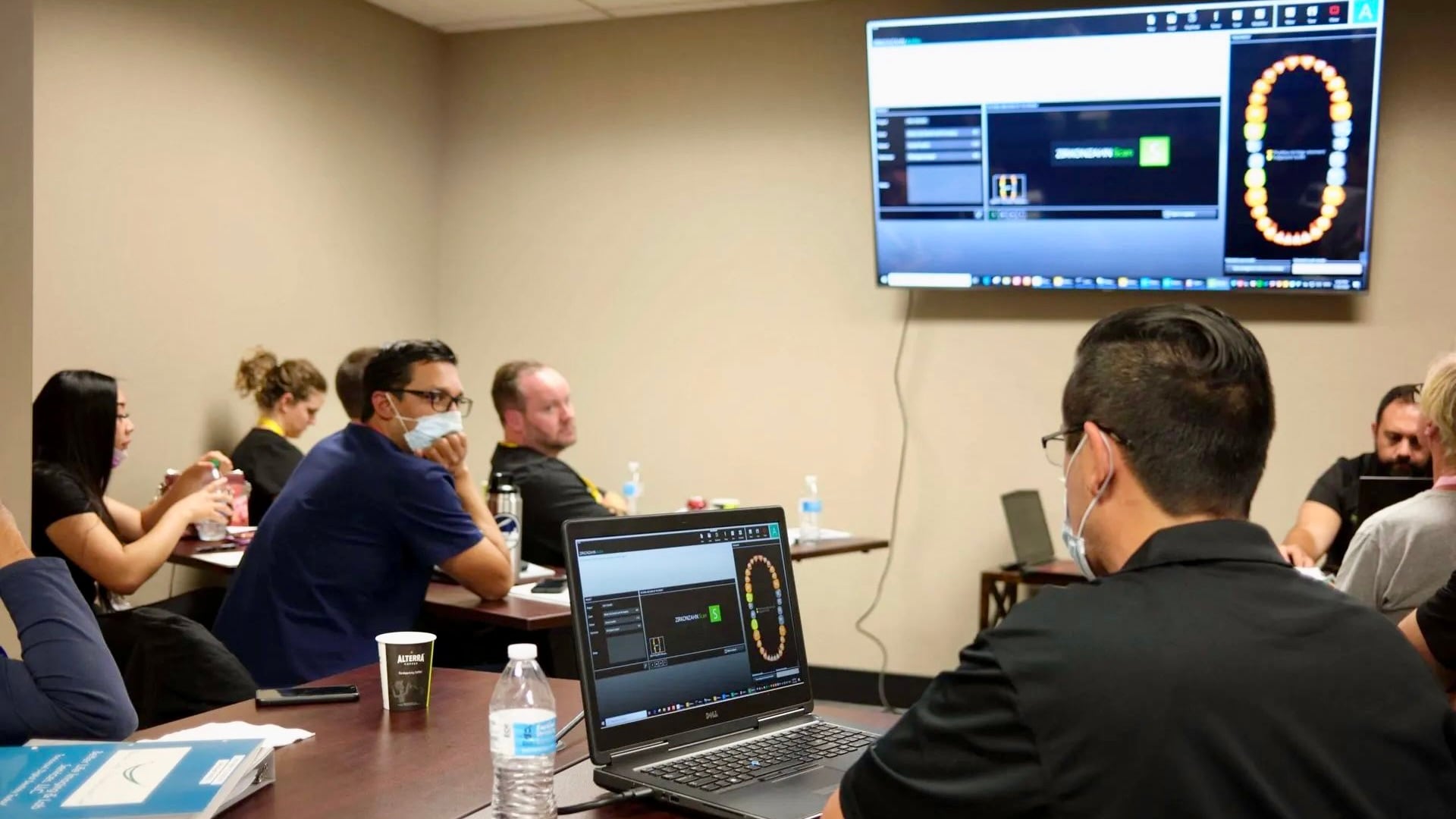
For front-office-specific training, the Treatment Coordinator Bootcamp is the logical next step. It is taught by FAM’s in-house treatment coordinator, Nikki O’Neal, who maintains an 80% closing rate on full-arch consultations. The curriculum covers the full sales process, objection handling, patient financing, and pipeline nurture, which are the skills that determine whether a high-value case that the front desk books actually closes. Where Bootcamp trains the coordinator, the Flagship Course trains the whole team and covers the complete FAM Method across dentist, assistant, treatment coordinator, and lab technician. FAM courses offer 32 continuing education credits through AGD PACE, which approves CE provider organizations. Practices that adopt the full workflow report adding $1M+ per year in revenue, which is the outcome the front desk modules above are designed to support.
For more on building team-wide systems, see How To Build Dental Team Workflow Training That Sticks and How to Train Your Dental Team for Full-Arch Workflows.
Frequently Asked Questions
What Software Do Dental Receptionists Use?
Dentrix, Eaglesoft, and Open Dental are commonly treated as the three major dental practice management systems in the U.S., though no credible public data measures actual market share. Dentrix, developed by Henry Schein One, has the longest track record in the North American dental PMS market and is widely described as having the broadest third-party integration ecosystem among the major systems. Eaglesoft, owned by Patterson Dental, is a server-based system familiar to many experienced front-desk staff. Open Dental has passed 12,000 practice installs and carries no per-seat licensing fees, which makes it a common choice for cost-conscious independent practices. Beyond the core practice management system, modern front desk staff increasingly work alongside AI reception tools and automated patient communication platforms that handle appointment reminders, recall campaigns, and after-hours inquiries. Training should cover the practice’s specific platform in depth, plus the escalation rules that govern when AI tools hand off to a human.
Can I Be a Dental Receptionist With No Experience?
A dental receptionist with no prior dental experience can reach competency in 30 days when onboarding follows a sequenced curriculum. The key is teaching in the right order, with terminology and role clarity before phones, phones before scheduling, scheduling before insurance, insurance before software, and compliance woven throughout. As the rollout timeline above shows, the sequence, not the candidate, determines whether a no-experience hire succeeds. Practices that hire for attitude, communication, and coachability and then deliver a structured 30-day curriculum consistently produce capable front desk staff from candidates with no dental background.
How Long Is a Dental Receptionist Course?
A realistic internal onboarding curriculum runs 30 days of supervised practice on core responsibilities with regular check-ins, followed by a 60–90 day review assessing independence and SOP adherence. The four-week distribution appears in the rollout table above; the short answer is 30 days of structured training followed by a 60–90 day review.
What Skills Are Needed for a Dental Receptionist?
The six skill categories map one-to-one to the modules above: terminology, phones, scheduling, insurance, software and AI tools, and HIPAA. The attributes that cannot be trained, including calm under pressure, empathy with patients in pain or distress, organizational discipline, and genuine coachability, matter just as much. Practices that hire for those attributes and then deliver a sequenced curriculum consistently outperform practices that hire for dental experience alone.
What Should Go in a Dental Front Desk Training Manual?
A dental front desk training manual should contain the six module objectives listed in this article, the teaching content and scripts for each module, the assessment checkpoints and sign-off criteria for each week of the 30-day rollout, the practice’s specific SOPs for phones, scheduling, insurance verification, financial communication, and HIPAA compliance, and a training record template that documents each employee’s completion by module and date. The manual should function as a living document that the practice reviews and updates whenever it changes software, adds a new communication tool, updates its financial policy, or experiences a compliance incident. A manual stored only in one person’s memory creates a single point of failure for the practice.
Conclusion: Build a Repeatable Training System
The dental front desk training modules in this article form a system. They are sequenced deliberately, assessed at each stage, and designed to produce a receptionist who can operate independently within 30 days. A video library watched once during onboarding week delivers none of that structure. Build the curriculum, assign the checkpoints, run the role-plays, document the sign-offs, and reassess at 30, 60, and 90 days. When the system works, the practice owns it, and when the front desk reaches its ceiling while the rest of the team lags, team-wide training becomes the next growth lever.
Register for an Upcoming Course