
Written by: Ryan Dunlop, CEO and Founder of Full Arch Masters and graduate from the Harvard School of Dental Medicine
Key Takeaways
-
Dental office manager training can take a few weeks with structured on-the-job training or extend past a year with formal certifications like FAADOM.
-
Training duration depends on the manager’s prior dental experience and the operational complexity of the practice they support.
-
Team-based training keeps workflows aligned for high-value procedures like full-arch restorations and prevents breakdowns between clinical and front-office systems.
-
Free resources build foundational knowledge, while paid certifications add depth in revenue cycle management, HR, and compliance.
-
Full Arch Masters delivers team-aligned training that shortens ramp-up time and improves case acceptance for full-arch practices.
Register for an Upcoming Full Arch Masters Course
How Long Does Dental Office Manager Training Take?
Training length varies because each pathway teaches a different level of responsibility. The table below shows how on-the-job training, intensive bootcamps, and formal certifications differ in duration and in what a manager can actually handle at the end, from basic scheduling to full revenue cycle management. Every duration figure reflects publicly published program data or documented industry norms.
|
Pathway |
Typical Duration |
Format |
What the Manager Can Do at the End |
|---|---|---|---|
|
On-the-Job Training |
Several weeks to a few months (under a structured 30/60/90 plan, the goal is for the office manager to be fully trained and able to perform all duties without supervision within 90 days of the employment start date) |
Shadowing, software orientation, internal practice workflows |
Handle scheduling, patient flow, basic billing, and insurance verification |
|
Intensive Bootcamps |
Some intensive dental practice management bootcamps, such as the Malligai Dental Academy Dental Practice Management Boot Camp and the 3D Dentists Office Manager MasterMind, last 2 days, though other intensive dental bootcamps range from 1–2 days to 5 days or longer |
Role-play, live scenarios, targeted skills instruction |
Execute specific front-office functions, including case presentation, objection handling, and patient financing, with targeted competency |
|
Professional Certifications & Fellowships |
Professional certifications and fellowships, such as AADOM’s FAADOM Fellowship, require 31 AADOM-approved CE hours earned within a two-year period, which can take up to 24 months to complete |
Online coursework, conference attendance, CE credits, proctored exams |
Manage full business operations, HR, compliance, financial reporting, and revenue cycle management |
Community college offerings such as Chemeketa Community College’s DEN 170 Dental Office Management — a 2-credit, 2-lecture-hour course — represent a single component within a broader dental assisting program rather than a standalone management credential. They work well as a starting point but do not provide a complete management pathway.
The Decision Framework: Prior Dental Experience and Practice Complexity
Training length depends on two variables: the manager’s prior dental experience and the operational complexity of the practice they are stepping into.
Prior dental experience falls into three bands:
-
None: A manager with no dental background needs the full 6–12 month pathway. Entry-level dental office managers with less than two years of experience earn approximately $38,000–$50,000, which reflects the ramp-up cost to the practice.
-
Some (former front-desk or treatment coordinator): Transferable skills such as scheduling, insurance basics, and patient communication compress the timeline to roughly 4–8 weeks of targeted upskilling, with formal certification pursued in parallel over 6–12 months.
-
Extensive (former dental assistant or lead coordinator): Clinical vocabulary, patient flow familiarity, and software fluency are already present. An accelerated 2–4 week orientation plus a focused bootcamp can bring this manager to operational independence faster than any other profile.
Practice complexity shapes the training pathway further:
-
Single-dentist general practice: On-the-job training plus a community college module or DALE Foundation course is often sufficient.
-
Multi-doctor or multi-location practice: Formal certification (FAADOM or DANB-AADOM) is worth the 6–12 month investment. FAADOM holders earn 12–18% more than non-certified peers, a premium that reflects the broader scope they manage.
-
Practices running high-value procedures such as full-arch implant restoration, sedation, or multi-location operations: A manager trained alone in a 6-month program still cannot run the front office if the dentist and treatment coordinator follow a different playbook. At this complexity level, training length becomes a team-alignment question.
Undertrained managers are a common failure point in dental organizations. Practices often invest in front-line training while undertraining the managers expected to reinforce it, which is where standards begin to weaken. Together, experience and complexity point to these recommended pathways:
-
No dental experience + simple practice: On-the-job training (2–8 weeks) → DALE Foundation or community college module → FAADOM over 12 months.
-
Some dental experience + simple practice: Targeted bootcamp (2 days) plus on-the-job orientation (2–4 weeks).
-
Extensive dental experience + complex or high-value practice: Accelerated orientation (2–4 weeks) plus team-based training that aligns the manager, treatment coordinator, and clinical team on one workflow from day one.
Dental Assistants Transitioning Into Office Management
A dental assistant can move into a dental office manager role, and that transition path is well documented. Dental assistants already move through multiple areas of the office, including the lab, front desk, and direct patient care, which makes practice management a natural next step.
Skills that transfer from assisting into management include:
-
Clinical vocabulary and treatment plan familiarity
-
Patient flow and scheduling instincts
-
Insurance verification and billing basics
-
HIPAA and OSHA compliance awareness
-
Credibility with clinical staff
Skills that usually require additional training include:
-
Business operations and P&L oversight
-
HR, hiring, and performance management
-
Case acceptance and marketing strategy
-
Financial reporting and accounts receivable management
A realistic accelerated timeline for a credentialed dental assistant moving into office management includes 2–4 weeks of targeted orientation covering the business-operations gap, followed by a focused bootcamp on front-office systems, with formal certification (DANB-AADOM or FAADOM) pursued over the following 6–12 months. In states that recognize both RDA and CDA credentials, an RDA may have more opportunities to move into office management because of their advanced education and experience. The DANB also offers the Certified Dental Practice Management Administrator (CDPMA) credential, which is particularly valuable for assistants making this transition.
Is Dental Office Manager Training Worth It for an Entry-Level Hire?
The dental office manager role is generally not entry-level in a busy practice. The career ladder typically begins with front-desk coordinator or treatment coordinator roles requiring 1–3 years of experience before advancing to office manager. A sample job description published by Dental Practice Insider lists 3–5 years of dental office experience with progressive management responsibility as a standard qualification.
For a hire with no dental background, training length should be longer. Plan for the full 6–12 month formal pathway, not a 2–4 week orientation. That longer window pays for itself: practices with structured training programs see 23% higher employee retention rates and 18% better patient satisfaction scores than practices using ad-hoc approaches.
The cost of skipping structured training is also measurable. Replacing a dental office manager typically costs 6–9 months of salary in recruiting, onboarding, and lost productivity. That figure usually exceeds the cost of a formal certification program.
Free vs. Paid Dental Office Manager Training: What You Actually Get
Free resources cover only the starting point; the complete pathway requires paid training. The DALE Foundation offers dental office manager courses covering office finance and human resources, and the American Dental Association publishes a “Dental Insurance 101” webinar for office staff who need a foundation in dental insurance. Manufacturer training such as Dentrix’s role-based Mastery Tracks can help build software fluency, with many courses included in the Dentrix Customer Service Plan, though some tests and features may carry additional fees.
Free resources typically do not cover:
-
Revenue cycle management at the depth required for high-volume or high-value practices
-
Case acceptance and treatment coordination systems
-
HR, compliance program ownership, and P&L accountability
-
Team-aligned workflows for complex procedures
Paid certification programs such as FAADOM, DANB-AADOM, and CDPMA fill those gaps. The published first-year investment for the AADOM FAADOM designation runs roughly $740 for the program plus conference registration, travel, and hotel costs. That investment remains modest relative to the 12–18% salary premium associated with FAADOM.
Why Team-Based Training Changes the Length Calculus
For practices running full-arch implant restoration or other high-value procedures, the training-length question shifts from the individual to the team. A manager who completes a 6-month certification program in isolation still cannot run the front office of a full-arch practice if the dentist and treatment coordinator are operating from a different playbook. Case acceptance and retention are team-wide outcomes, and training only one role creates a ceiling that patients experience as inconsistency.
This is where Full Arch Masters’ model addresses a gap that individual training programs cannot. The FAM Flagship Course brings the dentist, lead assistant, treatment coordinator, and in-house lab technician through the same curriculum together. The practice leaves aligned on day one instead of spending months stitching together separate trainings. The team approach sits at the center of the curriculum, and most attendees come as a practice owner with their treatment coordinator and lead assistant, or as a dentist with their in-house lab technician.
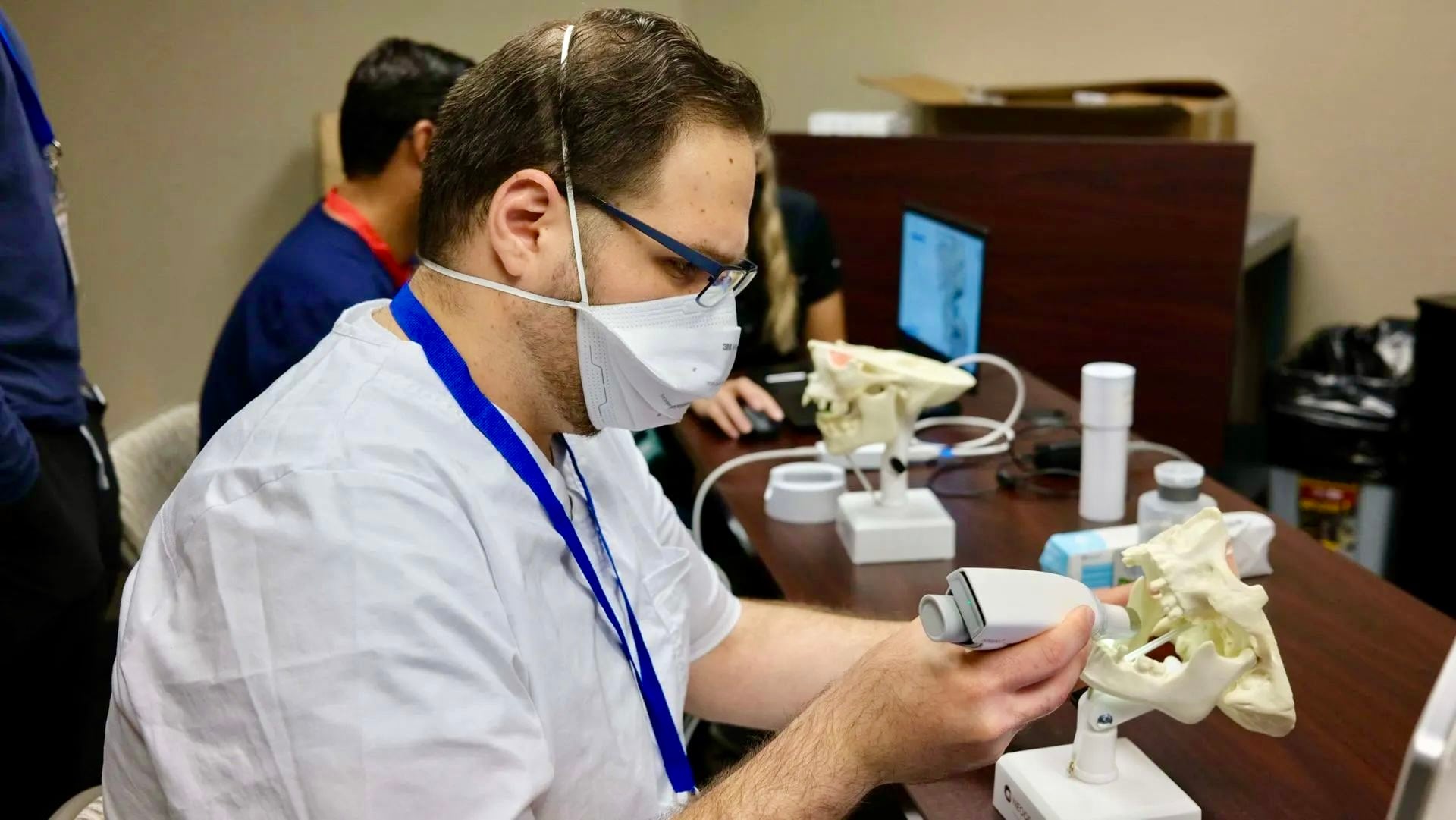
For practices that need to close more full-arch cases, the Full Arch Masters Treatment Coordinator Bootcamp serves as the front-office and case-acceptance component of that model. It is taught by FAM’s in-house treatment coordinator, who maintains an 80% closing rate, and covers the full sales process, including objection handling, patient financing, pipeline nurture, and new patient acquisition. Practice owners typically attend alongside their treatment coordinator and office manager so the entire front-office function follows the same closing system.
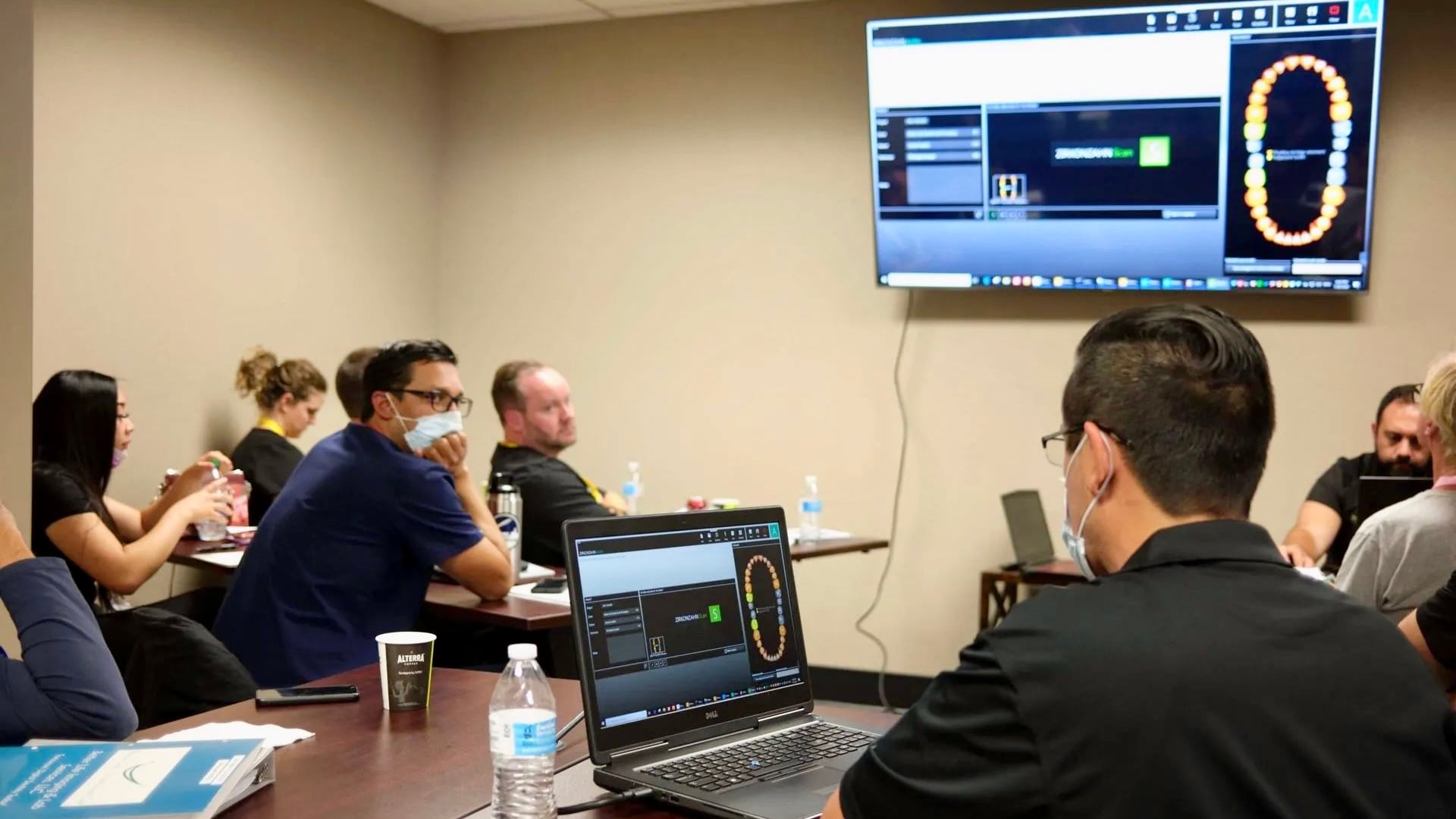
The operational logic is straightforward. The average dental practice converts approximately 53% of incoming new patient calls into scheduled appointments, while top-performing practices convert 85% or more. At 100 new patient calls per month, that gap represents 32 additional patients monthly with no change to marketing spend. A manager trained in isolation cannot close that gap alone, because the treatment coordinator, the dentist, and the front office all need to run the same system.
Dental Office Manager Training in Texas and California
Team alignment solves the workflow problem, and state rules shape how that training shows up in daily operations. Program availability and state-specific requirements vary. Practices in Texas and California should check local community college offerings, state dental association resources, and DANB’s published state-by-state requirement guides to confirm what credentials, CE hours, and supervision ratios apply to their specific situation. California and New York set higher salary thresholds for FLSA exempt status than the federal $684 per week level, which affects how office manager compensation is structured in those markets.
Frequently Asked Questions
Is Being a Dental Office Manager Hard?
The role carries genuine operational complexity. A dental office manager is responsible for scheduling, billing, insurance, HR, HIPAA and OSHA compliance, financial reporting, and often the production and collection numbers for the entire practice. In a small practice, the manager also functions as the HR department, compliance coordinator, and vendor manager. The difficulty scales with practice size and procedure complexity, so a manager running the front office of a high-volume full-arch practice faces a materially harder job than one managing a single-dentist general practice. That difficulty directly affects training length, because more complex practices require longer and more structured training pathways.
Is Office Manager an Entry-Level Job?
In most busy dental practices, the office manager role sits above entry level. The role typically requires 3–5 years of prior dental administrative experience, progressive management responsibility, and fluency in practice management software, insurance billing, and compliance programs. Entry-level hires placed directly into the office manager role without that foundation require a longer, more structured training investment and carry a higher turnover risk. The role functions best as the destination of a front-desk or treatment-coordinator career path.
Can a Dental Assistant Become a Dental Office Manager?
Yes, and it remains one of the most common transition paths in the industry. A credentialed dental assistant brings clinical vocabulary, patient flow familiarity, scheduling instincts, and insurance basics, which compress the training timeline compared to a candidate with no dental background. The primary gaps sit on the business side, including P&L oversight, HR, case acceptance strategy, and financial reporting. A realistic accelerated timeline includes 2–4 weeks of targeted business-operations orientation, a focused front-office bootcamp, and formal certification (DANB-AADOM or FAADOM) pursued over the following 6–12 months. Assistants with an RDA credential or expanded-functions designation often move into management faster because their advanced scope gives them broader practice credibility.
How Long Does Certification Take vs. On-the-Job Training?
On-the-job training gets a manager to basic operational independence in 2–8 weeks, with full productivity typically reached by day 60–90. Formal certification programs such as FAADOM, DANB-AADOM, and CDPMA run 6–12 months and require documented experience hours, CE credits, and in some cases a proctored exam. The two pathways work best together, because most managers begin with on-the-job orientation and pursue certification in parallel. The certification premium mentioned earlier is real, but the credential still depends on the experience hours that come from time in the role.
Do Dental Office Managers Need a Degree?
There is no mandatory degree requirement for dental office management anywhere in the United States. A high school diploma is the minimum listed in most job postings, though many working managers hold an associate’s degree in healthcare administration or business. Advancement to higher pay bands such as practice administrator, regional manager, or DSO director of operations is driven by documented scope, including hiring authority, insurance contracting, compliance program ownership, and accountability for practice financials. Optional certifications such as FAADOM and DANB-AADOM usually carry more practical weight in compensation negotiations than a general degree, because they signal domain-specific competency.
What Topics Does Dental Office Manager Training Cover?
Core competencies span seven domains:
-
Appointment scheduling and patient flow
-
Insurance verification, billing, and CDT coding
-
Revenue cycle management, including denial follow-up and accounts receivable
-
HR, hiring, onboarding, and performance management
-
HIPAA Privacy Rule, Security Rule, and Breach Notification Rule compliance
-
OSHA Bloodborne Pathogens Standard compliance
-
Financial reporting, collections, and practice KPI tracking
For practices running high-value procedures, training should also cover case acceptance systems, patient financing, and treatment coordination workflows. Standard certification programs usually address these topics at a foundational level, so full-arch practices often supplement with targeted team-based training.
How Long Until a New Manager Is Fully Independent?
A realistic operational timeline includes basic task competency by week 4–8, supervised independence by day 60, and full operational independence by month 4–6. Full independence includes ownership of compliance programs, financial reporting, and staff management. That timeline assumes structured onboarding with defined 30/60/90-day checkpoints rather than ad-hoc shadowing. For a manager stepping into a complex practice running high-value procedures, full independence on the front-office side of those procedures requires the clinical team and the manager to train on the same workflow, which is why team-based training compresses real-world ramp-up more effectively than any individual certification program.
Conclusion
The right training pathway depends on the manager’s prior dental experience and the practice’s operational complexity, so it looks different for every practice. A single-dentist general practice hiring a former treatment coordinator may succeed with a 2–4 week orientation plus a focused bootcamp. A practice running full-arch implant restoration needs a coordinated team approach, because an individually trained manager cannot run the front office effectively if the dentist and treatment coordinator follow a different playbook.
For practices that need their whole team, including the dentist, lead assistant, treatment coordinator, and office manager, trained on one aligned workflow, Full Arch Masters provides a proven solution. The FAM Flagship Course trains the entire team together, and the Treatment Coordinator Bootcamp trains the front-office and case-acceptance function on the same closing system FAM’s in-house coordinator uses to maintain an 80% close rate.
To train your team on the full-arch workflow that alumni report adds $1M+ per year in practice revenue, start here:
Register for an Upcoming Full Arch Masters Course
Practices focused on closing more full-arch cases should also explore the Full Arch Masters Treatment Coordinator Bootcamp, a two-day course that trains your treatment coordinator and office manager on the case-acceptance and pipeline systems that turn consultations into accepted treatment.