
Written by: Ryan Dunlop, CEO and Founder of Full Arch Masters and graduate from the Harvard School of Dental Medicine
Key Takeaways for Future Dental Practice Managers
-
Dental practice management offers an accessible leadership path with no clinical license required, competitive pay, and clear advancement potential.
-
Hands-on dental office experience combined with targeted certifications like FAADOM and AGD PACE-approved training moves candidates into management roles faster than degrees alone.
-
Success in this role depends on mastering administrative systems and coordinating clinical workflows, especially for high-value procedures like full-arch implants.
-
A structured 90-day action plan that blends free resources, recognized certifications, and team-based leadership training can improve KPIs such as case acceptance and collections.
-
Full Arch Masters provides AGD PACE-approved, team-focused training that builds the clinical workflow expertise practice managers need to lead high-performing offices. Start your leadership training and accelerate your path to operational leadership.
What a Dental Practice Manager Actually Does Day to Day
A dental practice manager serves as the operational leader of a dental office. They own the business systems that keep the practice running, including scheduling, billing, compliance, team performance, and patient experience, while the clinical team focuses on care. In larger or specialty practices, the role often expands to revenue-cycle oversight, multi-location coordination, and vendor management.
Core responsibilities typically include:
-
Scheduling and managing patient flow
-
Insurance verification, claims submission, and accounts-receivable management
-
Hiring, onboarding, and performance management for non-clinical staff
-
HIPAA, OSHA, and state dental board compliance
-
Financial reporting such as production, collections, overhead ratios, and KPI tracking
-
Practice management software administration (Dentrix, Eaglesoft, Open Dental, Curve Dental)
-
Vendor contract negotiation and supply management
-
Patient communication and complaint resolution
-
Leading team huddles, training, and culture development
With these responsibilities in mind, the next step is understanding what credentials help someone step into this role.
Education Requirements for Dental Practice Managers
No degree is technically required. Many dental office manager job postings list a high school diploma or equivalent as the minimum requirement. Clinical backgrounds such as dental assisting, treatment coordination, or front-desk reception often substitute for formal education because they show direct operational understanding of dental terminology, patient care, and practice management software.
Formal education still improves competitiveness. Many working dental office managers hold at least an associate’s degree, and a bachelor’s degree in business or healthcare administration is often preferred for senior roles and DSO positions. Practice managers frequently pair a bachelor’s degree in healthcare administration, business administration, or a related field with several years of in-practice operational experience.
The practical takeaway is clear. Dental-office experience forms the non-negotiable foundation. A degree can speed up hiring and salary negotiations, but demonstrated results such as reduced no-shows, improved collections, and higher case acceptance usually carry more weight than a transcript in independent practices.
Dental Practice Manager Salary and Growth Outlook
Compensation varies by experience level, practice size, and geography. The table below consolidates 2026 benchmark data from multiple sources.
|
Segment |
Annual Salary Range |
Notes |
Source |
|---|---|---|---|
|
National average (practice manager) |
$69,699–$73,471 |
Based on hundreds to thousands of salary profiles |
|
|
Entry-level (<1 year experience) |
Varies |
Total compensation including bonuses |
|
|
Solo GP practice (under $1M revenue) |
$52,000–$65,000 base, with bonus often none or a flat $1,000 |
Smaller team, narrower scope |
|
|
Large group / DSO |
$70,000–$85,000 base |
Multi-provider, multi-location scope, bonuses vary |
|
|
Dental practice administrator or office manager |
About $43,000 to $85,000, with some reaching up to $105,000+ |
Depending on practice size and location |
|
|
Top-paying metro (Manhattan, NY) |
$94,117 |
Highest-paying city on Indeed’s dataset |
|
|
AADOM-certified managers (FAADOM) |
12–18% above non-certified peers |
At comparable practice sizes |
The BLS projects 23% growth for medical and health services managers from 2024 to 2034, which is significantly faster than average. DSO expansion and increasing operational complexity in dentistry drive much of this demand.
How Demanding Is the Dental Practice Manager Role?
The role is demanding in specific ways. Career growth for dental office managers is driven by measurable operating skills, business understanding, leadership judgment, and visible impact, not by tenure alone.
The hardest parts of the job are not technical. They include:
-
Managing people across clinical and administrative functions at the same time
-
Holding the team accountable to KPIs without clinical authority over providers
-
Navigating insurance denials, billing disputes, and payer policy changes
-
Keeping a full schedule while handling last-minute cancellations and no-shows
-
Translating financial data such as overhead ratios, AR aging, and collections rates into decisions
Effective dental office managers manage systems and lead people at the same time, including coaching, conflict resolution, and accountability. This combination separates strong practice management from basic administrative competence. Technical knowledge is learnable, while leadership judgment develops through time and deliberate practice.
Step 1: Use Free and Low-Cost Practice Management Resources
Free and low-cost resources help future practice managers build a strong foundation before they invest in paid certifications.
-
ADA webinars and toolkits: The American Dental Association publishes practice management resources, compliance guides, and regulatory updates for members and, in many cases, the public.
-
State dental association libraries: Most state associations maintain toolkits on OSHA compliance, employment law, and billing best practices tailored to that state’s regulations.
-
YouTube SOP libraries: Channels from dental consultants and practice management educators share walkthroughs of daily huddles, AR workflows, and insurance verification checklists at no cost.
Step 2: Earn Recognized Dental Management Certifications
Recognized certifications signal commitment and, in the case of AADOM’s Fellowship credential, correlate with higher compensation. The table below compares three key pathways for dental office staff moving into management.
|
Credential |
Issuing Body |
Key Requirements |
Notable Outcome |
|---|---|---|---|
|
FAADOM (Fellowship) |
AADOM |
3+ years experience, AADOM membership, conference attendance, 12 CE hours per year |
|
|
DANB-AADOM Certificate |
DANB / AADOM |
Exam-based, 2,000 documented hours of dental office experience |
|
|
AGD PACE-Approved CE (for example, Full Arch Masters) |
Varies by provider; Full Arch Masters delivers 32 AGD PACE-approved CE credits per main course |
Recognized CE credits for licensure renewal and professional development, plus clinical workflow coordination skills |
For staff in implant-focused or specialty practices, AGD PACE-approved training that covers clinical workflow coordination, not just administrative systems, provides a competitive edge that generic certifications lack.
Step 3: Build Hands-On Leadership and Workflow Skills
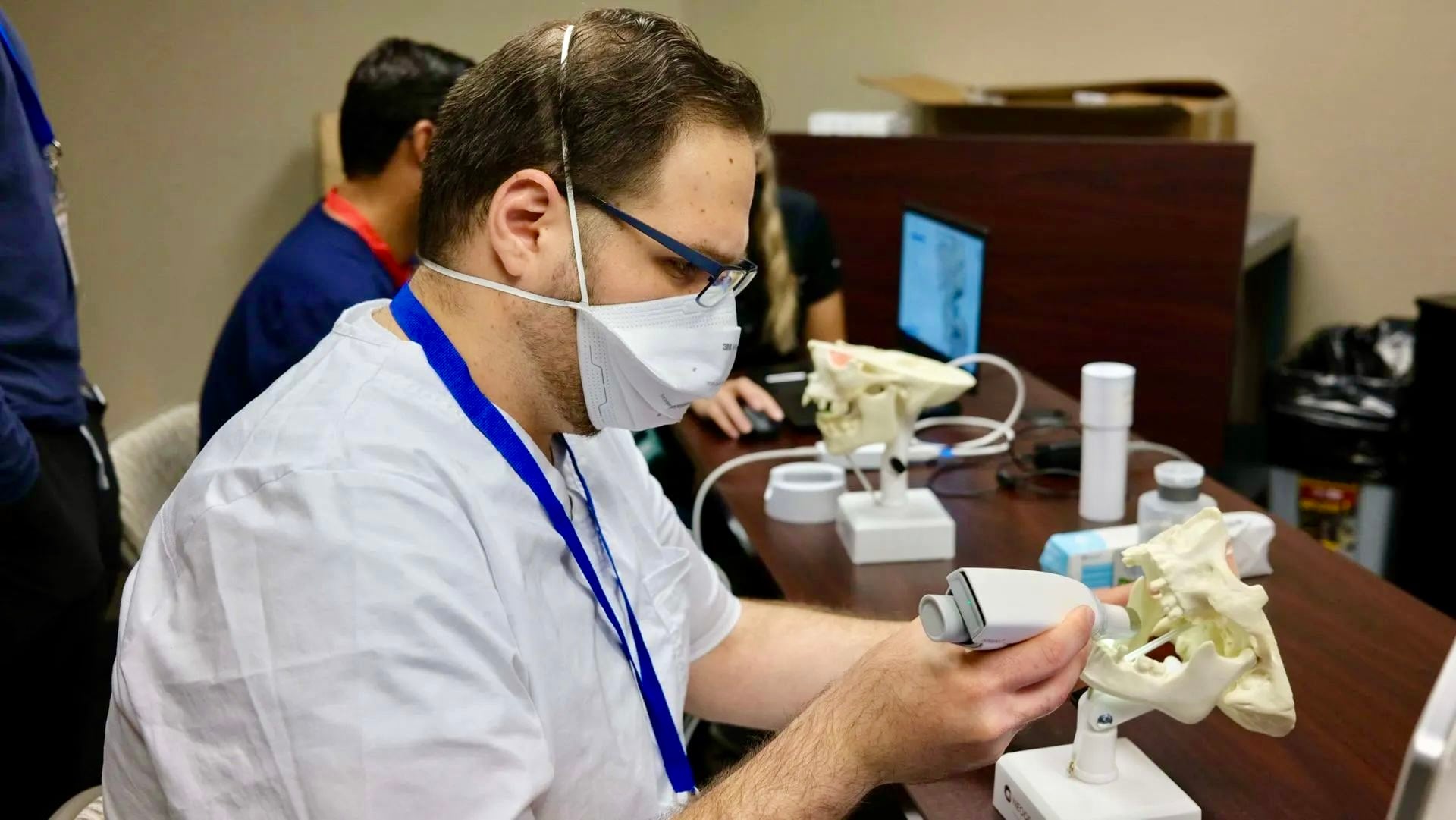
Certifications establish credibility, while hands-on leadership training builds the operational judgment that moves a practice forward. For staff in full-arch implant practices, one of the highest-revenue procedure categories in modern dentistry, this means understanding the clinical workflow well enough to coordinate it, not just work around it.
Full Arch Masters uses a full-team training model based on this principle. Rather than training only the dentist, the program teaches the entire team a shared workflow, the FAM Method, which integrates seven sequential steps that a practice manager must understand to coordinate effectively:
-
Preoperative records and data acquisition
-
Photogrammetry and intraoral scanning
-
CBCT and digital treatment planning
-
exocad design
-
Immediate-load conversion
-
Final zirconia design and finishing
-
FP1-specific design, team implementation, and workflow scaling
A practice manager who understands each handoff point in this sequence can spot bottlenecks, delegate clearly, and hold the team accountable to case-flow timelines. The Full Arch Masters Flagship Course trains the dentist, lead assistant, treatment coordinator, and in-house lab technician on the same workflow at the same time, so the practice manager returns with a shared operational playbook instead of a binder of notes only the dentist can interpret.
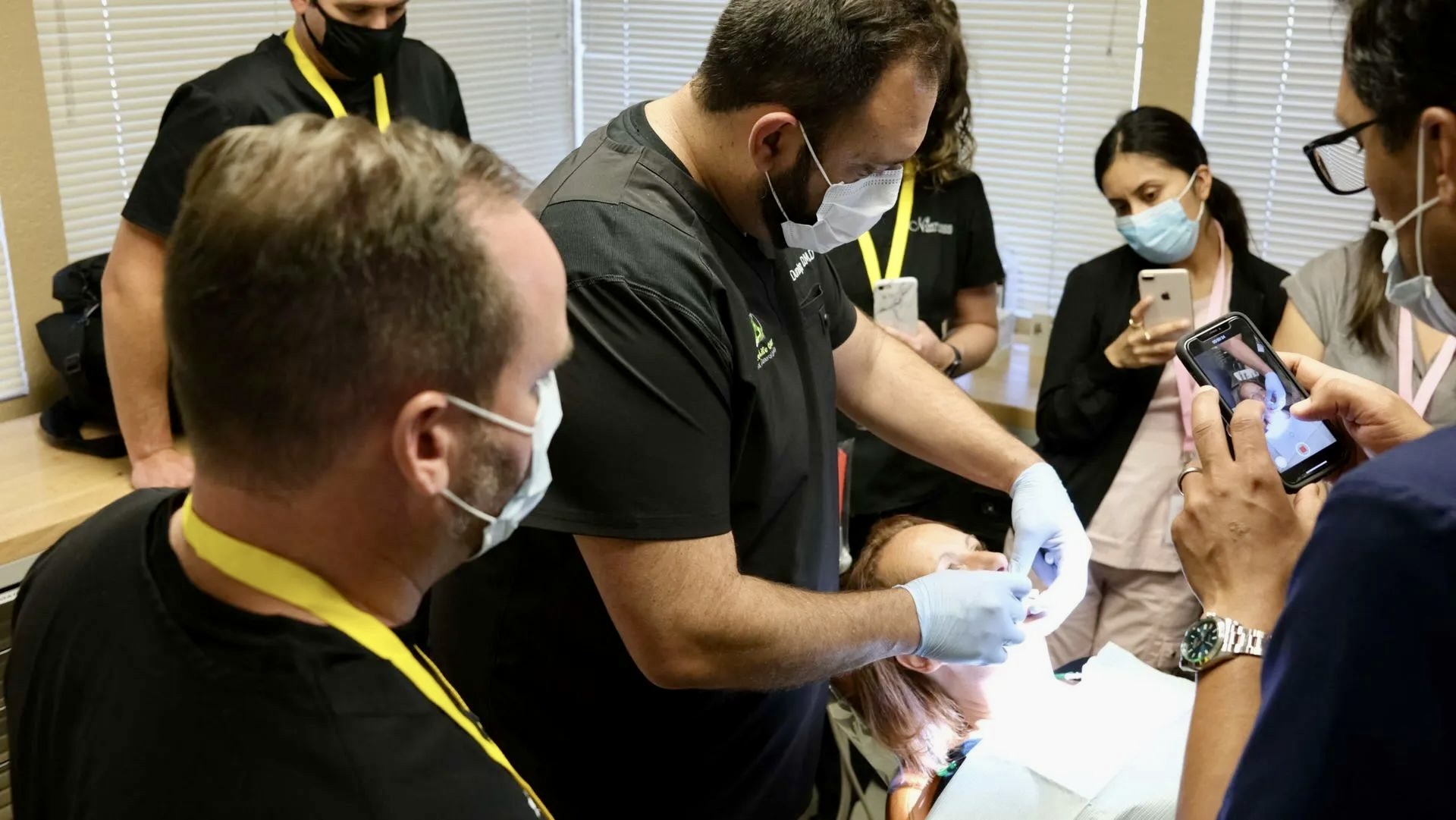
The Treatment Coordinator Bootcamp focuses on the front-office and revenue-cycle side, including new patient acquisition, pipeline management, patient financing, and the closing system that Full Arch Masters’ in-house treatment coordinator uses to maintain an 80% case-acceptance rate on full-arch consultations.
Both courses carry the AGD PACE approval mentioned earlier.
Your 90-Day Action Plan to Reach Practice Management
|
Phase |
Weeks |
Milestones |
Resources |
|---|---|---|---|
|
Foundation |
1–2 |
Complete free CE courses, audit current role responsibilities, and identify skill gaps in billing, scheduling, and compliance |
Free CE directory; DOMA Starter Kit |
|
Foundation |
3–4 |
Shadow the current practice manager or office lead, document existing SOPs, and begin an AADOM membership application |
AADOM; internal practice resources |
|
Skill Building |
5–8 |
Complete Front Office Rocks scheduling and insurance modules and start tracking personal KPI contributions such as case acceptance, no-show rate, and AR days |
Front Office Rocks |
|
Skill Building |
9–10 |
Register for and attend the Full Arch Masters Flagship Course or Treatment Coordinator Bootcamp with the practice team and earn AGD PACE-approved CE credits |
|
|
Leadership |
11–12 |
Implement one new SOP from training, lead a first team huddle, present a KPI dashboard to the practice owner, and document measurable results |
Practice management software; alumni community resources |
|
Leadership |
13 |
Request a formal title review or expanded responsibilities and begin the DANB-AADOM Certificate application if 2,000 hours are documented |
DANB; AADOM |

How to Measure Early Success as a New Practice Manager
A new practice manager’s impact becomes visible within the first 90 days when they track the right KPIs from day one. Focus on these leading indicators.
-
Case-acceptance rate: A treatment coordinator improves case acceptance rates by explaining treatment plans, costs, insurance coverage, and payment options to patients after dentist diagnosis. Establish a baseline in week one and track this number weekly.
-
No-show and cancellation rate: SMS appointment reminders can reduce no-show rates. Reviewing or upgrading the reminder system often produces a fast, measurable win.
-
Accounts-receivable days outstanding: A target collections rate of 98% or higher is reasonable for dental practices that actively manage accounts receivable. AR days over 30 signal a problem that deserves immediate attention.
-
Schedule utilization: About 38% of new patient calls go unanswered during business hours. Auditing phone coverage and online scheduling availability gives a direct lever on new-patient volume.
-
Overhead ratio: A healthy overhead ratio for a general dental practice typically falls between 55% and 65% of collections, with staff compensation usually accounting for 25–30% of collections.
Document baseline numbers before making any changes. The difference between baseline and 90-day results becomes the evidence that supports a title change and a salary conversation.
Frequently Asked Questions
Can I become a dental practice manager without a degree?
Yes. Many dental practices list a high school diploma or equivalent as the minimum requirement, and many working practice managers moved into the role from dental assisting, reception, or treatment coordination positions without a four-year degree. Relevant dental-office experience, especially in billing, scheduling, and patient communication, carries significant weight in hiring decisions. A bachelor’s degree in business or healthcare administration improves competitiveness for senior roles and DSO positions, but it is not required for entry-level practice management in an independent practice. Certifications such as the DANB-AADOM Certificate and AADOM’s Fellowship credential (FAADOM) often supplement or partially substitute for formal education in hiring decisions.
How long does it take to become a dental practice manager?
The timeline depends on the starting role and the pace of skill development. Most candidates spend two to four years in front-office, treatment coordinator, or senior assistant roles before they step into a practice manager title. Accelerators include earning recognized certifications, taking on expanded responsibilities proactively, and completing hands-on leadership training that covers both administrative systems and clinical workflow coordination. Candidates who attend team-based training programs alongside the dentist and clinical staff often compress this timeline because they return with a shared operational playbook and demonstrable leadership skills instead of administrative knowledge alone.
What is the difference between a dental office manager and a dental practice manager?
The titles are often used interchangeably in job postings, but in larger organizations they can indicate different scopes. A dental office manager usually oversees day-to-day operations for a single location, including scheduling, billing, front-desk staff, and patient experience. A dental practice manager may carry broader responsibility such as multi-location oversight, P&L accountability, strategic planning, and vendor management. In DSO environments, the practice manager title often implies direct accountability for EBITDA targets and the ability to manage a team of 10 to 15 staff across clinical and administrative functions. Salary data reflects this distinction, since senior practice manager roles command significantly higher compensation than single-location office manager positions.
How does clinical workflow knowledge help a dental practice manager?
A practice manager who understands the clinical workflow, not just the administrative systems around it, can identify bottlenecks that a purely administrative manager might miss. In full-arch implant practices, for example, the workflow includes the seven steps detailed in the FAM Method above, from preoperative records through final restoration delivery. Each handoff point can create scheduling inefficiency, chair-time waste, or case-flow breakdown. A manager who understands these steps can delegate appropriately, hold the team accountable to timelines, and coordinate between the clinical and lab sides of the practice without requiring the dentist to manage every operational detail. Full Arch Masters’ Flagship Course and Treatment Coordinator Bootcamp train the entire team, including the practice manager or treatment coordinator, on this integrated workflow, which is why Full Arch Masters alumni report measurable improvements in case acceptance, schedule efficiency, and practice revenue after training.
What certifications are most valuable for dental practice managers in specialty or implant practices?
The AADOM Fellowship (FAADOM) is the most widely recognized credential for dental office managers across practice types and correlates with the salary premium noted in the compensation section above. The DANB-AADOM Certificate serves as a strong entry-level credential for candidates with 2,000 documented hours of dental office experience. For staff in implant or specialty practices, AGD PACE-approved continuing education that covers clinical workflow coordination, not just administrative systems, provides a competitive advantage that generic certifications do not address. As noted earlier, Full Arch Masters is an AGD PACE-approved CE provider, and its curriculum is designed for the full dental team, including treatment coordinators and office managers who coordinate complex, high-value procedures.
Ready to Step into Dental Practice Leadership?
The fastest path from dental office staff to practice manager combines free foundational resources, recognized certifications, and hands-on leadership training that covers both administrative systems and clinical workflow coordination. For teams in full-arch implant practices, this path works best when they train together as one team with one workflow, so the entire practice executes at a higher level from day one.
Full Arch Masters’ Flagship Course and Treatment Coordinator Bootcamp are built for this scenario. Both are AGD PACE-approved, designed for full-team attendance, and deliver the operational depth, from case-flow coordination to revenue-cycle management, that separates a practice manager from a practice administrator.