
Written by: Ryan Dunlop, CEO and Founder of Full Arch Masters and graduate from the Harvard School of Dental Medicine
Key Takeaways
-
Most dentists are limited by workflow and team systems rather than patient demand when they try to scale full-arch implant cases.
-
Implant Pathway-style programs use progressive, competency-gated curricula that combine didactic learning, live surgery, and ongoing mentorship.
-
The six-dimension evaluation framework helps dentists compare programs on live surgery volume, mentorship structure, full-arch readiness, ROI, team integration, and alumni support.
-
Effective training now emphasizes end-to-end implementation, including CBCT planning, immediate-load prosthetics, lab integration, and business systems, rather than isolated techniques.
-
Full Arch Masters provides the complete operating system and team-based training dentists need to implement predictable full-arch workflows; register today to start building your pathway.
How Implant Pathway-Style Training Works in 2026
Implant Pathway-style training uses progressive, multi-module curricula that move dentists from single-implant cases to complex full-arch procedures. Each phase builds on the last, and advancement to more complex cases is gated by demonstrated competency rather than calendar time.
This model contrasts with single-weekend courses that show a technique and send the dentist home without a clear next step. Short or inexpensive implant courses frequently result in incomplete understanding, poor case selection, and lack of clinical confidence for general dentists. Implant Pathway-style programs close that gap by combining evidence-based theory, supervised live-patient experience, and structured post-course support in a single connected curriculum.
In 2026, the most competitive versions of this model extend the pathway into full-arch restoration. They integrate CBCT interpretation, digital workflow, immediate-load prosthetics, and team delegation into the same curriculum rather than treating them as separate disciplines.
Start building your full-arch pathway and register for an upcoming Full Arch Masters course today.
Six Dimensions Dentists Use to Evaluate Programs
A consistent evaluation framework keeps dentists from comparing programs on price alone or on marketing claims that cannot be verified. The following six dimensions apply across program types and price points.
-
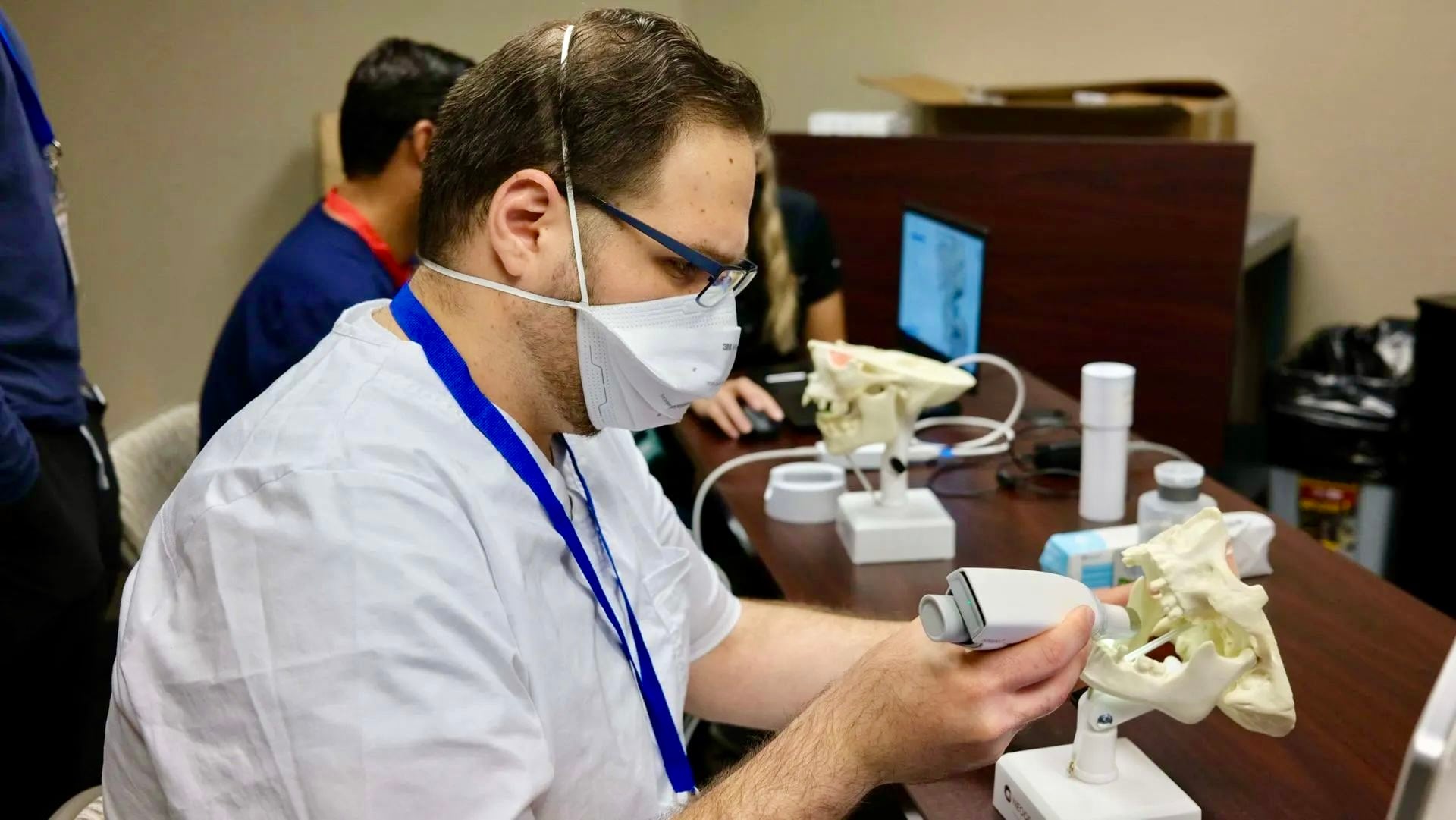
Live surgery volume and progression. A 1997 study published in the Journal of Oral and Maxillofacial Surgery by Lambert, Morris, and Ochi investigated the relationship between surgical experience and implant survival. Programs should be transparent about whether participants personally perform live-patient surgeries under direct real-time instructor guidance or primarily observe, and whether they follow a progressive multi-session structure or a single-weekend workshop.
-
Post-course mentorship structure and duration. Twelve months of group mentoring consisting of monthly live sessions for case review, Q&A on implementation questions, and peer community support bridges the gap between learning and clinical application. Evaluate whether mentorship is structured with defined touchpoints or informal and ad hoc.
-
Full-arch readiness pathway. The curriculum should include a clear progression to full-arch cases, not stop at single-tooth and multiple-unit placements. Programs without an explicit full-arch pathway force dentists to source additional training elsewhere and fragment the learning experience.
-
Total cost versus reported ROI. Implant training programs for general dentists typically cost $5,000–$15,000 for a comprehensive curriculum, with return on investment measured in months through added production capacity. Evaluate cost against the workflow efficiency and case volume the program is designed to produce, not against tuition alone.
-
Team integration and delegation training. Dentists assessing progressive implant curricula value programs that integrate both surgical and prosthetic training into a single comprehensive curriculum rather than separating the two disciplines. Programs that train the dentist alone leave the team behind, and a dentist who returns without a trained team cannot operationalize what they learned.
-
Continued community and alumni support. Availability of post-course support, including alumni networks for case discussion and mentorship on initial patient cases, is a key factor dentists assess before enrolling. Evaluate whether alumni access is structured and active or nominal.
Why Training Shifted from Weekend Courses to Progressive Pathways
For most of full-arch implant dentistry’s history, training followed a demonstration model. A senior clinician performed a procedure while attendees watched, and the dentist returned home to attempt replication without a support structure. That model produced inconsistent outcomes and high early-case failure rates.
A 2019 retrospective study by Sonkar et al. examining 1,449 implants placed by residents at Louisiana State University found that third-year Periodontics and OMFS residents achieved a 94.2% survival rate compared to 88.6% for first-year Periodontics residents and Prosthodontics fellows, a gap that reflects the compounding effect of supervised repetition over time.
Three forces accelerated the shift toward progressive pathways. First, state dental boards in a small number of jurisdictions, with Colorado being the most significant, created legal frameworks allowing visiting US-licensed dentists to perform live-patient surgery during continuing education courses. Second, the arrival of intraoral scanners, photogrammetry, CBCT imaging, and 3D printing created demand for same-day digital workflows that require team-based implementation, not just surgical technique. Third, the growth of full-arch as a high-value procedure category raised the stakes for inadequate training, because a dentist who cannot deliver a predictable full-arch workflow loses cases to better-equipped competitors.
The result is a market where the most effective programs now teach an operating system that includes workflow, team delegation, case acceptance, and post-course community rather than a procedure in isolation.
Five Core Domains in a Full-Arch Training Pathway
General dentists seek progressive and structured implant curricula that move logically from simple to complex cases, posterior to aesthetic zones, and delayed to immediate loading protocols. In practice, the strongest Implant Pathway-style programs sequence their content across five domains.
CBCT interpretation and treatment planning forms the foundation. General dentists prioritize training programs that build a strong foundation in diagnosis and planning, including CBCT interpretation, bone and soft tissue assessment, prosthetically driven implant positioning, and knowing when not to place an implant.
Surgical planning and guided placement follows and integrates digital design tools such as exocad, surgical guides, and photogrammetry with the physical execution of implant placement. Comprehensive implant training programs teach the entire implant workflow from diagnosis through final restoration, including flap design and soft tissue management, osteotomy preparation, implant angulation and depth control, achieving primary stability, and irrigation protocols to prevent thermal bone damage.
Immediate-load prosthetics separates full-arch programs from general implant curricula. Delivering a same-day screw-retained restoration requires integration of intraoral scanning, photogrammetry, 3D-printed conversion prosthetics, and exocad design into a single repeatable workflow, not a collection of individual tools.
Lab integration covers the design and finishing side, including digital design in exocad, material selection across PMMA, zirconia, PEEK, and metallic frameworks, and aesthetic finishing techniques such as ceramic layering. Programs that omit this domain leave the lab technician and the prosthetic outcome outside the training.
Clinical competency alone, however, does not translate to case volume. Business systems, including marketing, treatment coordination, case acceptance, and team delegation, determine whether a practice can generate volume after training. Training programs that emphasize high implant volume without structured planning or supervision create false confidence rather than genuine clinical competence. The same principle applies to business systems, because volume without a closing system and a trained team produces unsustainable growth.
Strategic Trade-Offs Dentists Must Weigh
No program delivers everything, so dentists evaluating Implant Pathway-style training must balance competing priorities. Each choice affects speed, control, overhead, and team readiness. The following trade-offs define the decision space.
Speed versus depth of mentorship. Compressed programs deliver faster initial exposure but less supervised repetition. Without mentorship, the first 10 cases involve high anxiety, longer procedures, and elevated risk of complications; cases 10–30 involve trial and error with inconsistent results; and cases 30+ lead to self-taught habits that may be good or bad. Programs with longitudinal mentorship that include structured monthly case reviews, alumni group access, and direct instructor availability produce more durable skill retention than those that end at course completion.
In-house lab versus outsourcing. Practices with an in-house lab technician can run the full digital workflow end-to-end, compress case time, and improve margin. Practices that outsource lab work trade control for lower overhead. The training program selected should match the lab model the practice intends to operate or teach the dentist how to build the in-house capability.
Training the full team versus the dentist alone. Effective supervision in implant training programs requires low student-to-instructor ratios during live surgical sessions, credentialed instructors who are actively placing implants, a progressive skill-building model over multiple sessions, and structured feedback during procedures plus case review sessions. A dentist who attends alone returns to a team that has not been trained on the same workflow, and the gap between what the dentist learned and what the team can execute is where implementation fails.
Current Best Practices for Documentation, Case Selection, Delegation, and Workflow Integration
After hands-on training, dentists typically transition to placing implants in practice by first handling straightforward cases with adequate bone volume and limited anatomical complexity, then continuing with ongoing mentorship and case review, and later expanding to more complex procedures such as multiple placements, bone grafting, sinus augmentation, and full-arch rehabilitation.
Sustainable post-training performance depends on four operational habits. First, standardized documentation such as consent templates, surgical room setup checklists, and records acquisition protocols reduces variability and enables delegation. Second, structured case selection criteria prevent early-career overreach, and clear criteria for changing the plan, such as deferring placement, grafting, or referral when socket anatomy, stability, or tissue support is inadequate, are essential components of quality implant training that prepare dentists for safe, responsible case selection. Third, explicit delegation models define which steps the assistant, treatment coordinator, and lab technician own, which removes the dentist from non-billable tasks and increases throughput. Fourth, workflow integration connects the clinical, lab, and front-office sides of the practice on a single operating system so cases move predictably from consultation to delivery.
Readiness Checklist Before Committing to Any Program
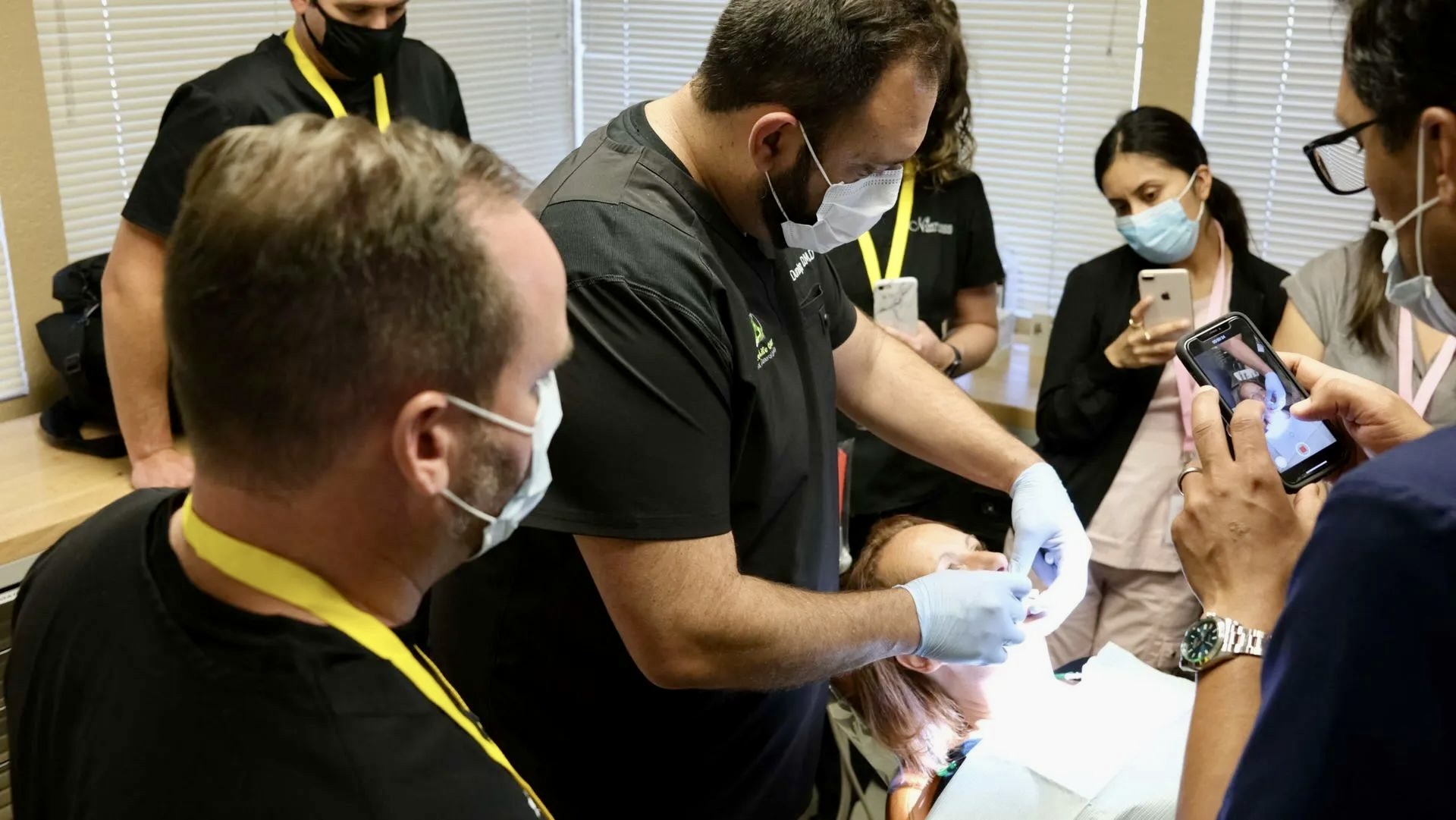
Before enrolling in any Implant Pathway-style program, assess the following factors.
-
Current implant volume: How many single-tooth implants and full arches are you placing per month? Programs structured for beginners differ significantly from those designed for dentists already placing at volume.
-
Team capacity: Does your practice have a trained surgical assistant, a treatment coordinator who can close high-ticket cases, and access to lab work in-house or outsourced? If not, identify which team members need training alongside you.
-
Technology stack: Do you have an intraoral scanner, CBCT, and access to 3D printing? Programs built around fully digital workflows require the hardware to implement them, so identify gaps before enrolling.
-
Financial goals: What annual revenue target are you working toward from full-arch? Define this number before evaluating programs, because reported outcomes vary widely, and alumni of Full Arch Masters report adding $1M+ per year in practice revenue after adopting the FAM Method, the proprietary digital workflow taught across FAM’s curriculum. Use your target to filter programs and confirm that reported outcomes align with your goals.
-
Post-course support expectations: Are you prepared to engage with an alumni community, attend case review sessions, and ask for help on difficult cases? Programs with strong post-course communities require active participation to deliver their full value.
-
Licensing and credentialing: If you intend to participate in live-patient surgical training, confirm that the program’s credentialing process is compatible with your license status and that no pending marks against your license would prevent participation.
-
Career arch volume: If you have placed 200 or more full arches in your career, evaluate whether the program offers an advanced track covering zygomatic, pterygoid, trans-sinus, and palatal-approach techniques for atrophic cases or whether the curriculum is calibrated only for earlier-stage practitioners.
Common Pitfalls to Avoid
-
Underestimating post-course support requirements. Comfort typically improves after the first 10 to 20 well-selected cases under mentorship, with continued education and repetition accelerating confidence. Programs that end at course completion leave dentists without a support structure during the highest-risk phase of implementation.
-
Failing to train the full team. A dentist who returns from training without a team aligned on the same workflow cannot operationalize what they learned, because the workflow requires a coordinated assistant, treatment coordinator, and lab technician to run at volume. The solution is simple: bring the team to training so everyone learns the same system.
-
Choosing programs without a clear full-arch pathway. General implant credentialing programs build foundational competency but do not address the digital workflow, immediate-load prosthetics, or business systems required to deliver full-arch at scale. Confirm that the program includes an explicit full-arch progression before enrolling.
-
Selecting programs based on price alone. As noted earlier, programs that prioritize low cost over comprehensive training leave dentists without the clinical confidence or case selection skills needed for safe implementation. Evaluate total cost against the workflow efficiency and case volume the program is designed to produce.
-
Ignoring the business systems component. Clinical competency without a closing system, a marketing playbook, and a delegation model produces a dentist who can perform the procedure but cannot generate the volume to justify the investment.
-
Attending without assessing instructor cross-training. General dentists evaluating hands-on implant training programs identify instructor experience, measured by years of clinical implant experience, total implants placed, teaching background, and mentorship style, as a primary selection criterion. Instructors who have worked only one role in the workflow teach from a partial perspective.
Frequently Asked Questions
What is the difference between a traditional implant course and an Implant Pathway-style program?
A traditional implant course typically delivers a technique demonstration over one or two days, with limited live-patient exposure and no structured post-course support. An Implant Pathway-style program sequences didactic content, supervised live-patient surgery, and longitudinal mentorship across multiple modules, with each phase building on the last. The defining difference is that Implant Pathway-style programs teach an operating system that includes workflow, team delegation, case acceptance, and community rather than a procedure in isolation.
How long does it typically take to complete a full-arch implant training pathway?
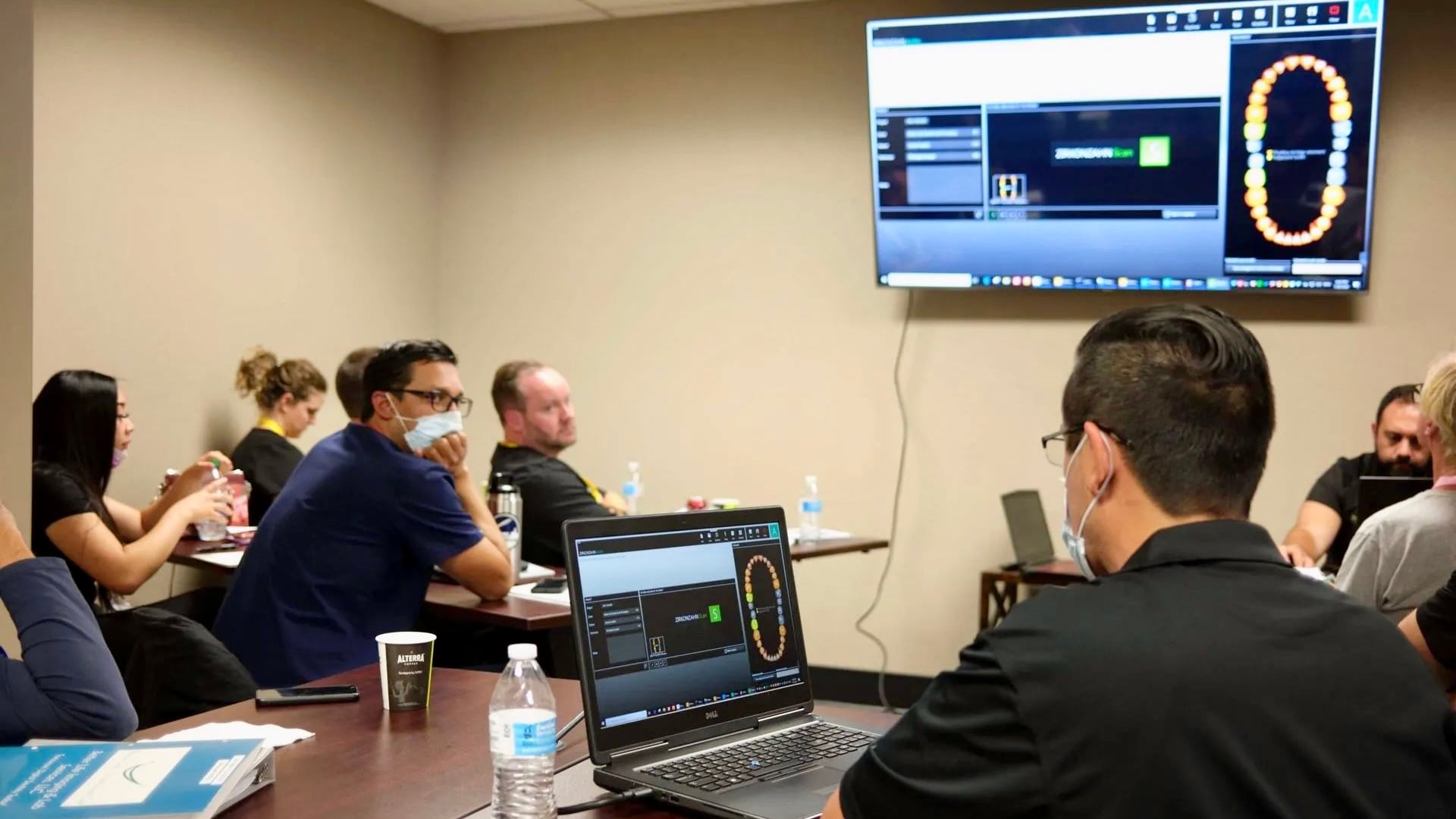
Program lengths vary significantly. Comprehensive multi-course pathways, such as the Full Arch Masters Fellowship, which bundles the Flagship Course, Live Surgical Course, Design and Finish Course, and a fourth elective course, can be completed across a single year with flexible scheduling. The Fellowship delivers 90+ hours of continuing education across the full program. Post-course mentorship through alumni communities and case review extends the effective learning period well beyond the formal course dates.
What does a full-arch implant training program typically cost, and what ROI should I expect?
Comprehensive implant training programs for general dentists typically range from $5,000 to $25,000 depending on the scope of live-patient surgical access and the breadth of the curriculum. Full Arch Masters’ individual courses range from $6,995 for the Design and Finish Course to $25,000 for the Advanced Live Surgical track, with the Fellowship bundle offering $5,000–$10,000 off the combined retail price of the core courses. Alumni of Full Arch Masters report adding $1M+ per year in practice revenue after adopting the FAM Method, driven by a faster digital workflow that supports higher case volume, a closing system that converts more consultations, and a team delegation model that removes the dentist from non-billable tasks.
How do I evaluate the quality of post-course mentorship before enrolling?
Ask the program four specific questions. Is post-course mentorship structured with defined touchpoints, or is it informal? Is there an active alumni community with hundreds of trained practitioners, or a nominal alumni list? Are case review sessions scheduled and recurring, or available only on request? Does the mentorship include direct access to instructors who are actively placing full-arch cases, or is support limited to administrative staff? Full Arch Masters provides continued access to private alumni group chats, including a dentist-only chat and a main multi-role chat spanning assistants, technicians, and team members, with hundreds of FAM-trained practitioners available for case help on demand for the life of the relationship.
Should my team attend with me, or is the training designed for the dentist alone?
For any program built around a team-based workflow, bringing the full team is the difference between a course that produces a trained dentist and a course that produces a practice that can actually run the workflow. Full Arch Masters’ Flagship Course is built for the full team, and most attendees come as a practice owner with their treatment coordinator and lead assistant or as a dentist with their in-house lab technician. Team-member pricing is built into every course ($2,500 per additional team member for the Flagship Course), which makes full-team attendance structurally accessible. As discussed in the trade-offs section, the gap between what the dentist learns and what an untrained team can execute is where implementation fails, and Full Arch Masters addresses this by training the entire workflow team together.
Choosing the Right Implant Pathway-Style Program
The six-dimension framework covering live surgery volume and progression, post-course mentorship structure and duration, full-arch readiness pathway, total cost versus reported ROI, team integration and delegation training, and continued community and alumni support provides a consistent basis for evaluating any program regardless of its marketing claims.
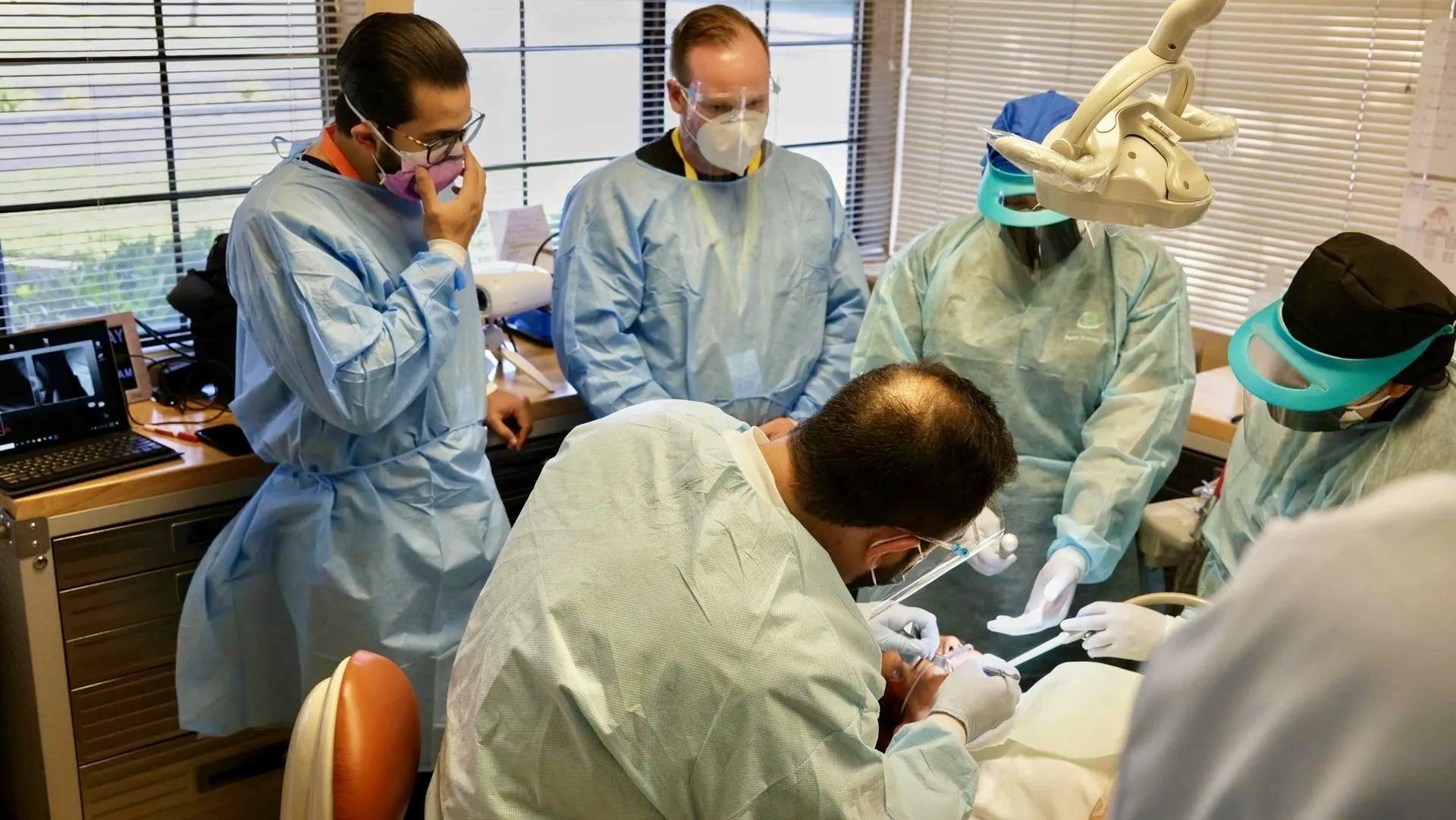
Full Arch Masters is built around all six dimensions. The FAM Method, FAM’s proprietary end-to-end digital workflow integrating intraoral scanning, photogrammetry, facial scanning, CBCT, exocad design, and 3D-printed immediate-load conversion, is taught as a single repeatable system, not a collection of individual tools. Alumni report same-day delivery in 2–4 hours and $1M+ in added annual practice revenue as reported outcomes. The Live Surgical Course in Parker, CO gives Basic and Advanced operators two full-arch cases each under expert mentor supervision, with the Advanced track covering zygomatic, pterygoid, trans-sinus, custom subperiosteal, and palatal-approach techniques for atrophic cases. Every attendee joins a continued community of hundreds of FAM-trained dentists, lab technicians, and team members through private group chats, gains access to the KOL (Key Opinion Leader) buying group at no recurring cost, and receives a complete digital resource library covering surgical room setup through consent templates.
The program teaches implementation. The community sustains it.
Take the next step: register for Full Arch Masters and bring your team to training.