Written by: Ryan Dunlop, CEO and Founder of Full Arch Masters and graduate from the Harvard School of Dental Medicine
Key Takeaways
-
Advanced implant placement courses must address the full spectrum of full-arch presentations, including severely atrophic cases that require zygomatic, pterygoid, and trans-sinus techniques.
-
Photogrammetry-first integrated digital workflows compress full-arch delivery into two-to-four-hour same-day restorations and consistently outperform hybrid analog-digital systems.
-
Live-patient surgical training under mentor supervision builds muscle memory and documented cases that lecture-only or simulation formats cannot match.
-
Training the full team — dentist, assistant, treatment coordinator, and lab technician — on the same workflow is essential for scaling case volume while protecting margins.
-
Full Arch Masters delivers this complete operating system through its Flagship, Live Surgical, and Design & Finish courses; register today to transform your practice.
Digital Full-Arch Workflows That Actually Scale
Full-arch implant dentistry has shifted from analog to digital over the past decade. Practices once relied on physical impressions, off-site lab work, and multi-day appointments. A fully integrated digital workflow that combines intraoral scanning, photogrammetry, facial scanning, CBCT, and 3D-printed immediate-load conversion now delivers a screwed-in same-day restoration in two to four hours. The gap between a practice running that system and one still operating a hybrid workflow is not marginal. It determines how many arches a practice can complete per week before chair time crushes margins.
Photogrammetry sits at the center of that shift. A 2026 in-vitro study published in The International Journal of Prosthodontics compared trueness of intraoral, extraoral, and navigation photogrammetry systems for complete-arch implant impressions but reported no RMS values matching 56.49 ± 1.52 µm or 94.21 ± 2.49 µm. Multiple recent systematic reviews and meta-analyses have compared photogrammetry to conventional intraoral scanning for complete-arch implant capture. An advanced implant placement course that does not teach photogrammetry as a core competency leaves you with an incomplete workflow.
Effective training also requires hands-on application in real clinical conditions. Regulatory access to live-patient surgery becomes the second structural requirement. Most U.S. states do not permit visiting licensed dentists to perform surgery on volunteer patients in a CE setting. Colorado is one of the few exceptions, and the Colorado Dental Board allows U.S.-licensed dentists from any state to perform dentistry on volunteer patients under a credentialing process submitted in advance. Full Arch Masters submits each operator’s credentials to the Colorado Dental Board ten days before each Live Surgical Course, contingent on no pending marks against the dentist’s license in their home state. CE accreditation through the American Academy of General Dentistry (AAGD) for 32 CE credits per course provides documentation that satisfies most state board requirements for continuing education.
See current Full Arch Masters course dates and formats.
Live-Patient Surgical Training Versus Didactic Programs
A 2026 systematic review in BMC Medical Education compared self-directed virtual teaching to traditional in-person learning for surgical skills. Full-arch implant surgery, with its intraoperative decision-making around bone density, anatomical variation, and immediate-load conversion, clearly falls into the complex category. Lecture-only and simulation-based formats build foundational knowledge. They still fail to reproduce the clinical variables that determine real surgical outcomes.
Live-patient surgical training requires management of soft tissue that bleeds, bone with varying density, and anxious patients. Mannequins, cadavers, and simulations cannot fully replicate these factors. Live-patient cases also generate documented, completed outcomes that satisfy credentialing requirements for bodies such as the AAID and ABOI/ID, while simulation-based courses do not.
These structural differences translate directly into practice impact. A dentist who completes a lecture-only program returns with conceptual knowledge but no muscle memory and no documented cases. A dentist who completes a live-patient surgical course returns having operated on real patients under mentor supervision. That experience is the closest analog to running cases independently in their own practice.
Clinical confidence from live-patient training supports the consultation close and the treatment coordinator’s performance. A dentist who has operated on real arches presents differently than one who has only watched, and that confidence reinforces higher conversion rates and stronger revenue outcomes.
Full Arch Masters’ Live Surgical Course in Parker, CO structures this access across three tracks. The Basic Operator track serves dentists with fewer than 200 full arches placed in their career. The Advanced Operator track serves dentists with 200 or more career arches and focuses on zygomatic, pterygoid, trans-sinus, custom subperiosteal, and palatal-approach techniques for atrophic cases. The Observer track supports dentists who want to watch live cases without operating. Each Basic and Advanced operator performs two full-arch cases across the two surgical days under expert mentor supervision, with CRNAs providing general anesthesia onsite.
Explore live surgical tracks and availability.
Strategic Trade-offs When Selecting a Course
Choosing an advanced implant placement course involves trade-offs that extend beyond the curriculum. Four strategic tensions deserve explicit evaluation before you commit to a program.
Speed versus complexity. A two-day workshop can introduce a workflow concept. Programs structured across four days with live-patient access and post-course community support create durable skill retention. The FAM Method, Full Arch Masters’ proprietary digital workflow, is taught across four-day courses because integrating scanning, photogrammetry, design, and immediate-load delivery takes time to internalize as a system.
In-house versus outsourced lab work. Practices that outsource lab work introduce handoff friction, multi-day timelines, and margin compression. Bringing lab design and finishing in-house through a trained in-house lab technician running exocad enables true same-day delivery. The trade-off is the upfront investment in training and equipment. Full Arch Masters’ Design and Finish Course addresses this directly with four days dedicated to digital design in exocad and aesthetic finishing on zirconia, calibrated by skill level so beginners and advanced designers work in separate tracks.
Standardization versus customization. A photogrammetry-first integrated workflow is, by design, standardized, with the same records acquisition sequence, design protocol, and immediate-load conversion process on every case. This consistency allows team members to learn one repeatable system and execute it reliably, which supports delegation and volume scaling. Because the workflow itself stays fixed, all patient-specific customization shifts to the prosthetic level, including FP1, FP2, FP3 classification and material selection across PMMA, zirconia, PEEK, and metallic frameworks, instead of case-by-case workflow changes.
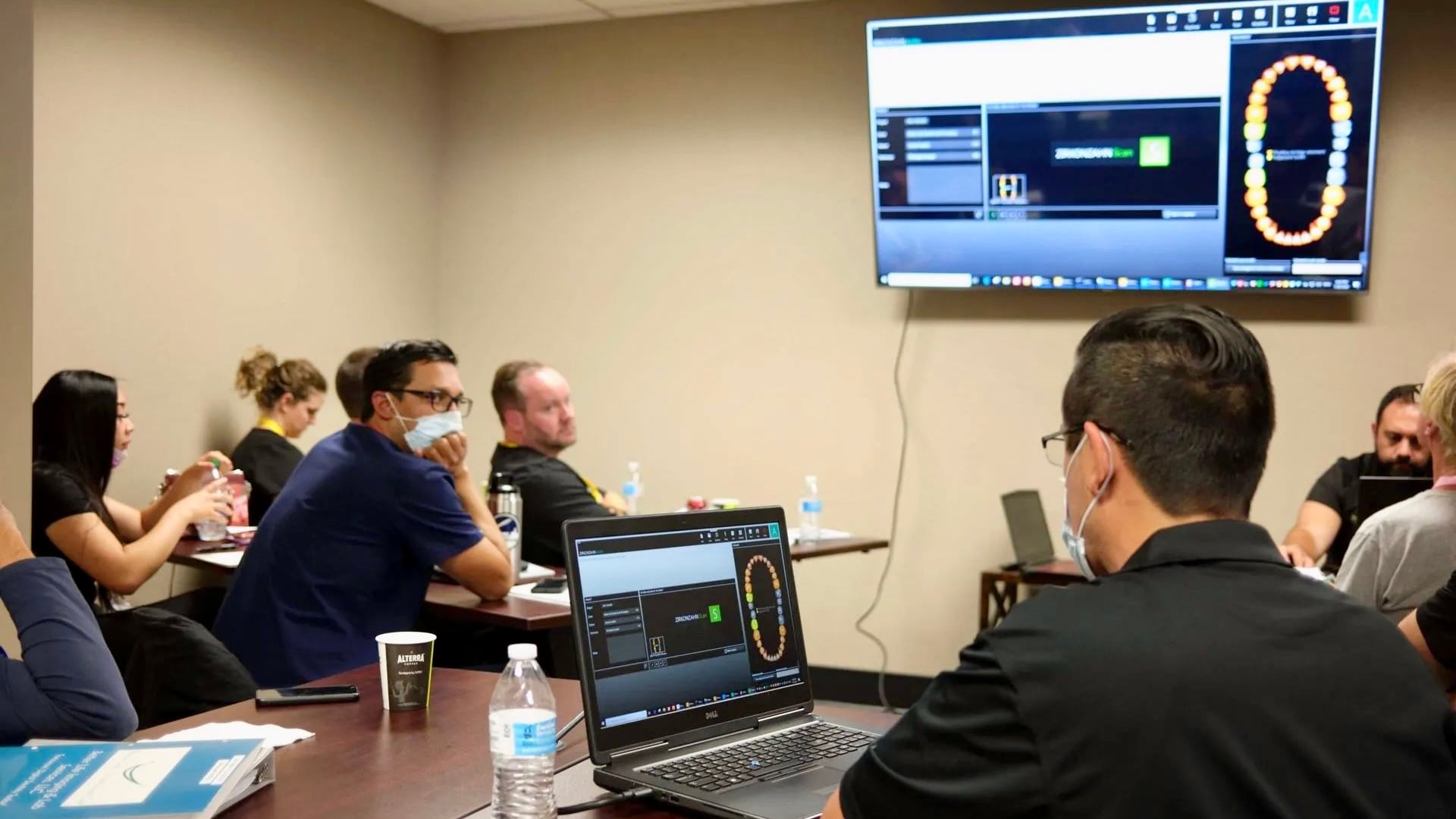
Full-team versus dentist-only attendance. A dentist who attends training alone and returns to an untrained team cannot operationalize what they learned. The workflow requires a coordinated assistant for records acquisition, a treatment coordinator for case acceptance, and a lab technician for design and finishing. Full Arch Masters’ Flagship Course is built for the full team. Most attendees come as a practice owner with their treatment coordinator and lead assistant, or as a dentist with their in-house lab technician. Training everyone on the same system at once is the operational reason a FAM-trained practice can run more arches at higher margin.
Review Flagship and Design & Finish course options for your team.
Current Best Practices in Full-Arch Workflows
Evidence-informed full-arch workflows converge on a consistent set of pre-operative and intraoperative standards. The following practices reflect both peer-reviewed literature and the operational protocols embedded in the FAM Method.
-
Photogrammetry-first implant-position capture. Prospective in vivo studies comparing stereophotogrammetry versus intraoral scanning show photogrammetry yields better accuracy in both linear/3D and angular measurements for complete-arch implant impressions. Capturing implant positions with a photogrammetry system such as the iCam4D before any intraoral scanning reduces cumulative error in the prosthetic design.
-
Integrated pre-operative records. CBCT imaging, intraoral scanning, and facial scanning are acquired as a unified pre-operative record set, not spread across separate appointments. This integration enables virtual surgical planning and same-day 3D-printed surgical guides.
-
Immediate-load 3D-printed conversion. The immediate-load prosthesis is designed and printed before surgery using the pre-operative digital records. Conversion then happens chairside instead of requiring an off-site lab turnaround, which compresses multi-day workflows into a same-day window.
-
Team delegation for records acquisition. The surgical assistant, trained on intraoral scanning and photogrammetry, acquires pre-operative records independently and frees the dentist’s chair time for billable procedures. Operationalizing structured consultation calls and pre-qualification increases show rates from 55–70% to 82–92%. The same delegation logic applies to records: trained assistants running records acquisition lift throughput without adding dentist hours.
-
Structured treatment coordination with a financing-first script. Practices that establish financing comfort first close 44% of seated full-arch cases the same day, versus 22% when presenting treatment plans before cost. Full Arch Masters’ in-house treatment coordinator maintains an 80% closing rate using this structure, the same system taught in the Treatment Coordinator Bootcamp.
See how the FAM Method implements these best practices.
Readiness and Opportunity Assessment for Your Practice
Before selecting an advanced implant placement course, evaluate your current state across four dimensions. This checklist highlights the gaps that training needs to close.
-
Current case volume. Track how many full arches the practice places per month. One to two arches monthly with a slow hybrid workflow signals an operational constraint, not a demand problem. A photogrammetry-first integrated workflow becomes the primary lever.
-
Atrophic case referral patterns. Approximately 12.9% to 15.2% of U.S. adults aged 65 and older have complete edentulism, per recent NHANES data. Complete edentulism drives severely atrophic maxillary ridges that require advanced surgical techniques such as zygomatic, pterygoid, or trans-sinus placement. Practices that lack training in these techniques refer these cases to specialists and leave high-value procedures, and the associated revenue, with competitors. The Advanced Live Surgical track at Full Arch Masters, gated to dentists with 200 or more career arches, addresses exactly these presentations.
-
Team training gaps. Assess whether the lead assistant can acquire a full pre-operative record set independently. Confirm whether the treatment coordinator has a written closing script and a financing-first consultation structure. Evaluate whether the in-house lab technician designs and finishes in exocad or whether the practice still outsources. Each gap represents a throughput constraint.
-
Technology stack. Confirm whether the practice has a photogrammetry system, an intraoral scanner, CBCT, and a 3D printer capable of immediate-load conversion. Full Arch Masters’ KOL (Key Opinion Leader) buying group, available to all alumni at no recurring cost, provides vendor discounts on Neodent implants, exocad licenses, Envisiontec and DentaFab 3D printers, and iCam photogrammetry systems, which reduces the capital cost of completing the technology stack.
Compare your readiness to the Full Arch Masters training model.
Common Pitfalls That Limit Training ROI
Dentists who invest in advanced implant placement training and fail to see practice transformation usually encounter one or more structural failures.
-
Incomplete digital workflows. A practice that adds an intraoral scanner without photogrammetry, or that designs digitally but converts analog chairside, still runs a hybrid system. The FAM Method functions as an end-to-end workflow because partial digitization does not consistently support the compressed same-day delivery window that drives volume and margin.
-
Lack of post-course support. Weekly 60-minute call-review sessions with the surgeon present enable treatment coordinators to accumulate roughly 100 documented case-handling improvements over 12 months, sustaining a 20-point lift in close rates. Clinical skills follow the same pattern. A difficult case that lands on the schedule six months after a course ends requires a peer community to consult, not a binder. Full Arch Masters’ continued alumni community, with private group chats that include hundreds of FAM-trained dentists, lab technicians, and team members, provides that support for the life of the relationship.
-
Failure to train the full team. Surgeons who delegate case acceptance entirely and skip weekly training reviews see case acceptance plateau at 28% to 32% regardless of coordinator talent. That plateau sits well below the 44% same-day close rate that structured financing-first coordination can achieve. The same dynamic applies to clinical delegation. A dentist who returns from training without a trained assistant cannot offload records acquisition, and a dentist without a trained lab technician cannot run same-day delivery. Full Arch Masters’ full-team training model directly addresses this gap.
-
Choosing didactic-only formats for complex techniques. Zygomatic, pterygoid, and trans-sinus placements require intraoperative judgment that does not develop in a lecture hall. The Advanced Live Surgical track at Full Arch Masters puts operators hands-on with these techniques on live volunteer patients under expert mentor supervision. That format builds the muscle memory and decision-making capacity these cases demand.
Join the FAM alumni community and avoid these pitfalls.
Frequently Asked Questions
What is the difference between the Basic and Advanced Live Surgical tracks at Full Arch Masters?
The Basic Operator track is designed for dentists who have placed fewer than 200 full arches in their career. It focuses on the core FAM Method surgical workflow, including implant placement, immediate-load conversion, and same-day delivery, under expert mentor supervision on live volunteer patients in Parker, CO. The Advanced Operator track is gated to dentists with 200 or more career arches placed and focuses on zygomatic, pterygoid, trans-sinus, custom subperiosteal, and palatal-approach techniques for severely atrophic cases. Both tracks include two full-arch cases per operator across the two surgical days. Pricing reflects the difference in complexity: Basic Operator is $20,000 and Advanced Operator is $25,000.
How does Full Arch Masters legally provide live-patient surgical access in a CE setting?
The Colorado Dental Board permits U.S.-licensed dentists from any state to perform dentistry on volunteer patients during a CE course, provided the operator’s credentials are submitted to the board in advance and there are no pending marks against the dentist’s license in their home state. Full Arch Masters submits each operator’s credentials to the Colorado Dental Board ten days before each Live Surgical Course, using the same process described earlier in this article. CRNAs provide general anesthesia onsite. International attendees cannot be credentialed by the Colorado Dental Board because credentialing requires a U.S. dental license, so they attend as Observers at $4,995.
What revenue outcomes do Full Arch Masters alumni report after completing the program?
Full Arch Masters alumni report adding $1M or more per year in practice revenue after adopting the FAM Method. This outcome operates across three levers. A faster integrated workflow allows more arches per week at higher margin. A structured treatment coordination system lifts case acceptance rates. A team delegation model scales volume without burning the dentist’s chair time on non-billable tasks. The $1M-plus figure reflects reported alumni outcomes, not a guaranteed result, because individual performance depends on case volume, market, and implementation fidelity.
Can lab technicians attend Full Arch Masters courses, and what will they learn?
Lab technicians play a core role in the Full Arch Masters curriculum. The Design and Finish Course devotes four days entirely to lab work. Two days focus on digital design in exocad, covering pre-operative records, digital mockups, surgical alignment devices, immediate-load prosthetics, and final zirconia design. Two days focus on hands-on aesthetic finishing on pre-sintered and post-sintered zirconia with MIYO ceramic layering. FAM surveys attendees in advance and separates beginners from advanced designers so each track runs at the appropriate skill level. Lab technicians can also attend the FP1 Course for FP1-specific design instruction and can attend the Flagship Course alongside the dentist they support so both clinical and lab sides leave aligned on the same workflow. Lab technician pricing is built into every course at $2,500 per additional team member for the Flagship Course and $6,995 for the Design and Finish Course.
What ongoing support does Full Arch Masters provide after the course ends?
Every Full Arch Masters attendee, regardless of which course they take, joins continued private alumni group chats with hundreds of FAM-trained dentists, lab technicians, and team members. The community includes a dentist-only chat for sensitive practice and personnel questions, a main multi-role chat for clinical and operational case help, and per-course lab and treatment coordinator chats. Alumni also retain access to the KOL (Key Opinion Leader) buying group at no recurring cost, which secures vendor discounts on Neodent implants, exocad licenses, 3D printers, and photogrammetry systems for the life of the relationship. A complete digital resource library covering surgical room setup checklists, finishing techniques, treatment coordinator forms, consent templates, and Dr. Dunlop’s lecture materials is distributed after each course via shared drive.
Conclusion: Choosing a Complete Operating System
The decision framework for an advanced implant placement course centers on one idea. You can choose a program that teaches isolated techniques or a program that teaches a complete operating system. Lecture-only and simulation-based formats build foundational knowledge but cannot reproduce the intraoperative variables, team coordination, and post-course support that determine whether a practice actually scales full-arch volume after training ends.
Full Arch Masters addresses every dimension of that operating system. The FAM Method, a photogrammetry-first integrated digital workflow, delivers same-day full-arch restorations in a compressed chairside window. The Flagship Course trains the full team on the same workflow simultaneously. The Advanced Live Surgical track in Parker, CO provides legally credentialed hands-on access to zygomatic, pterygoid, trans-sinus, and palatal-approach techniques for atrophic cases. The continued alumni community provides case support for the life of the relationship. The KOL buying group delivers vendor discounts at no recurring cost, a structural advantage that compounds over every case the practice runs after training.
Dentists placing one to two arches monthly who want to scale to five or more, experienced surgeons referring out atrophic cases they could keep, and full teams ready to align on a unified workflow from day one all benefit from this integrated approach. Full Arch Masters assembles these elements into a single program so you can move from isolated skills to a repeatable, profitable full-arch system.