Written by: Ryan Dunlop, CEO and Founder of Full Arch Masters and graduate from the Harvard School of Dental Medicine
Key Takeaways
-
Most full-arch implant courses focus only on surgical technique. Practices then stay stuck at low case volume because workflow, team training, and closing systems are missing.
-
Advanced programs need live-patient surgery, photogrammetry-first digital workflows, zygomatic and pterygoid coverage, team delegation, and documented revenue outcomes to scale effectively.
-
Full-system implementation programs that combine surgery, lab integration, team training, and closing systems produce the highest case volumes and practice growth compared to technique-only or cadaver-based courses.
-
Post-course community support and ongoing mentorship maintain confidence, help troubleshoot complications, and prevent case volume from plateauing after training.
-
Full Arch Masters delivers a complete photogrammetry-first system with team training and alumni support that helps practices add significant revenue; register for an upcoming course to implement the FAM Method.
Core Elements Every Advanced Full-Arch Course Needs
Seven elements separate implementation-depth programs from technique-only courses. Any program evaluated for 2026 should be measured against all seven.
-
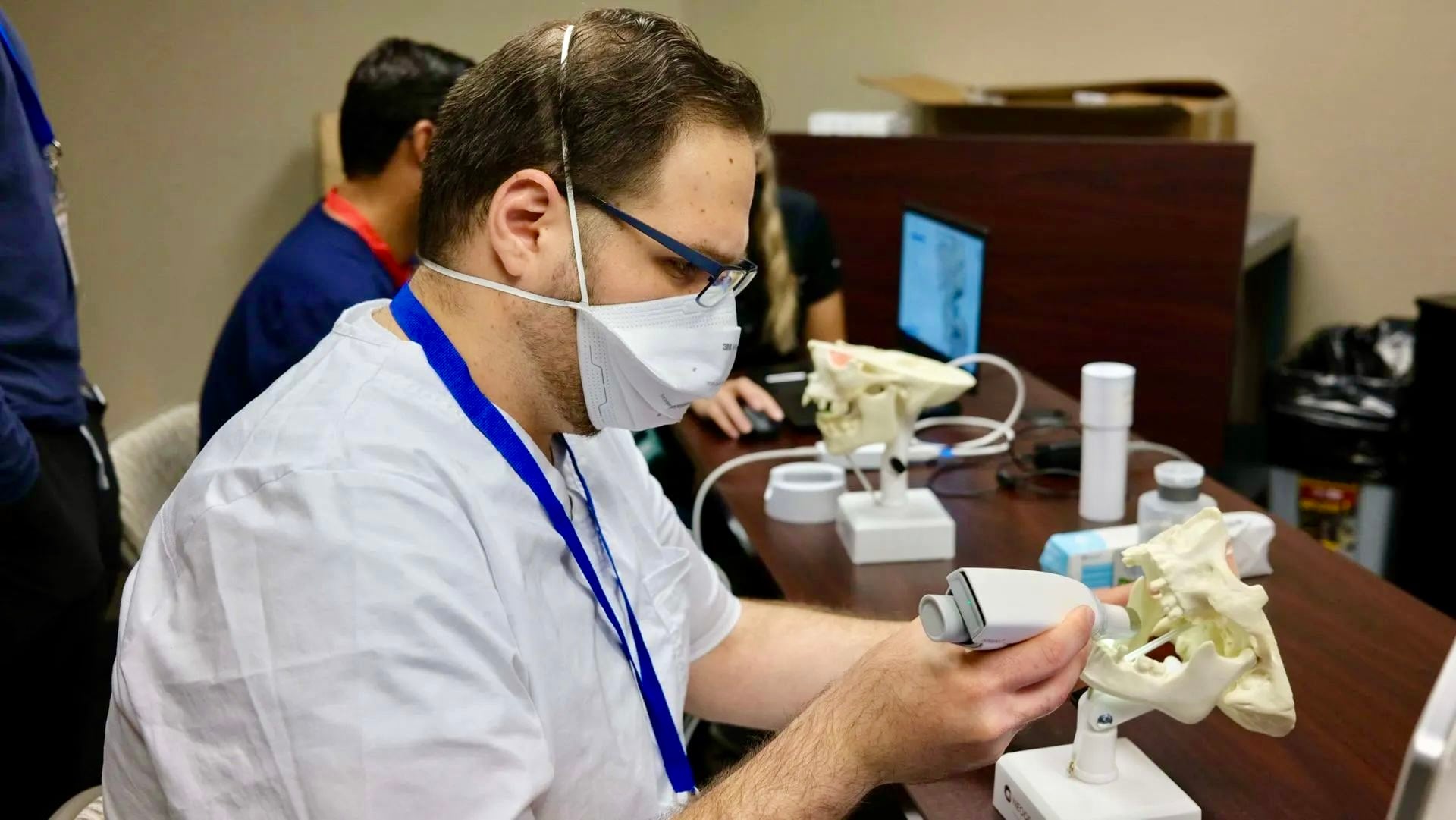
Live-patient surgery. Cadaver training builds foundational sequence comfort, but live-patient training introduces variables such as soft tissue bleeding, bone density variation, and patient anxiety that cadavers cannot replicate. Supervised live operating is the closest analog to independent practice.
-
Photogrammetry-integrated digital workflow. Photogrammetry delivers high accuracy for complete-arch implant rehabilitation, with extraoral systems such as the ICam 4D often showing improved 3D trueness compared to standard intraoral scanners. Training should teach photogrammetry as a primary capture method, not an optional add-on.
-
Zygomatic, pterygoid, and atrophic case coverage. Practices that cannot manage no-bone cases refer them out. Advanced programs should cover zygomatic, pterygoid, trans-sinus, and palatal-approach placements, including CBCT interpretation, surgical anatomy, and complication management for atrophic arches.
-
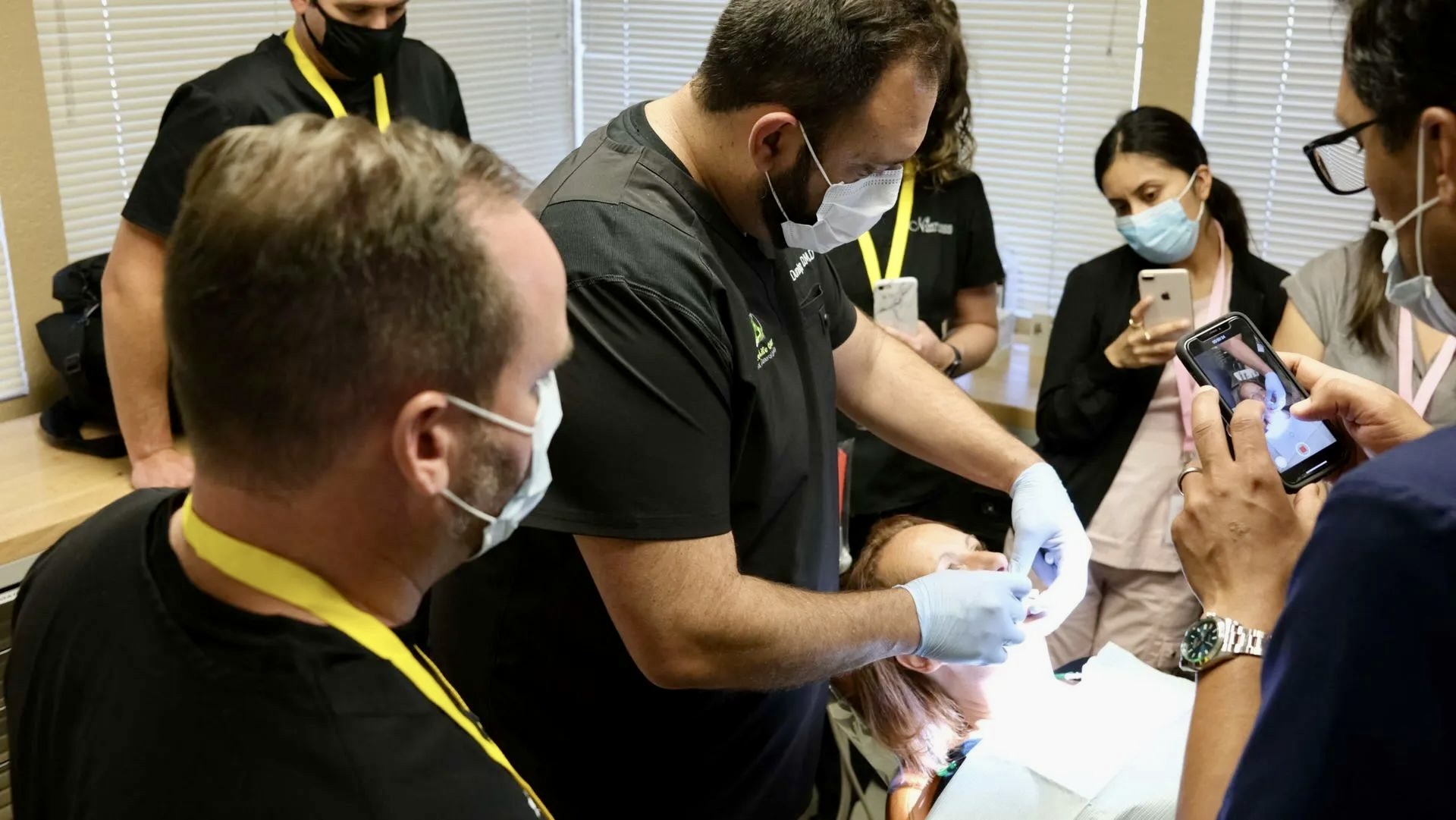
Team delegation systems. A dentist who returns from training without a trained team cannot operationalize the workflow. Courses should train the assistant, treatment coordinator, and lab technician alongside the dentist on the same operating system.
-
Closing and marketing training. A trained treatment coordinator can achieve higher close rates on seated full-arch consultations compared to untrained coordinators. That gap can translate to substantial increases in annual revenue on a standard consultation volume. Marketing and closing should be taught at the same depth as clinical content.
-
Continued community support. Effective mentorship in implant dentistry includes pre-operative planning review, chairside guidance, post-operative debriefing, and ongoing accessibility for unexpected situations. A course that ends on day four leaves clinicians without a safety net when a difficult case lands on the schedule.
-
Quantified revenue outcomes. Programs should point to documented alumni outcomes. Vague claims about “practice growth” should be replaced with reported revenue data tied to workflow adoption.
How to Evaluate 2026 Full-Arch Training Programs
Six criteria provide a consistent lens for comparing programs.
-
Clinical feasibility: Confirm that the program includes live-patient operating and clarify the legal and credentialing framework.
-
Workflow efficiency: Look for an end-to-end, photogrammetry-first digital workflow rather than a hybrid of analog and digital steps.
-
Team readiness: Check whether the curriculum trains the full team, including assistant, treatment coordinator, and lab technician, on the same playbook.
-
Technology integration: Verify that photogrammetry, intraoral scanning, CBCT, facial scanning, CAD/CAM design, and 3D printing are taught as an integrated system.
-
Financial impact: Confirm that the program includes closing systems, marketing training, and documented revenue outcomes.
-
Post-course support: Look for a structured alumni community, mentorship access, and a vendor buying group after the course ends.
From Analog to Photogrammetry-First: Where the Industry Stands
For most of full-arch implant dentistry’s history, the workflow stayed analog with physical impressions, denture conversions cut chairside, off-site lab work, and multi-appointment delivery. That approach felt slow, uncomfortable for patients, and margin-crushing for practices limited to one or two arches per month.
A 2026 narrative review in Bioengineering found that inaccuracies in full-arch digital workflows behave as a cascading “snowball effect,” with minor deviations in early scanning stages amplified during CAD processing and manufacturing. The review proposes an Error Control Framework that integrates strict upstream standardization of scanning strategies with mandatory critical control points for physical verification. Photogrammetry-first workflows are structurally positioned to satisfy that framework.
At AEEDC 2026, full-arch implant scanning was a major focus, with dedicated photogrammetry units, iPad-based systems, and AI verification tools showcased across every major scanner manufacturer. Same-day delivery now functions as a standard at specialist practices that run fully digital workflows.
Four Training Models and Their Effect on Case Volume
Four training models dominate the market, and their effects on case volume differ substantially.
-
Cadaver-based programs: These provide real tissue experience and foundational sequence comfort. A 2019 systematic review of 51 studies involving 2,002 surgical trainees found that cadaveric simulation induces short-term skill acquisition, but only one of 51 studies assessed skill transfer to live surgery. Cadaver training alone does not reliably translate to independent case volume.
-
Live-patient surgical institutes: These provide the closest analog to independent practice. Skill transfer is higher because operators manage real tissue response, patient variables, and intraoperative decision-making under supervision.
-
Digital workflow programs: These teach scanning, design, and manufacturing but often omit surgical instruction, team delegation, and closing systems. Practices leave with better tools but not a complete operating system.
-
Full-system implementation programs: These combine live-patient surgery, photogrammetry-first digital workflow, lab integration, team delegation, and closing training into a single curriculum. These programs produce the highest case volume outcomes because they address every bottleneck simultaneously, not just the surgical one.
Live-Patient Versus Cadaver Training Outcomes
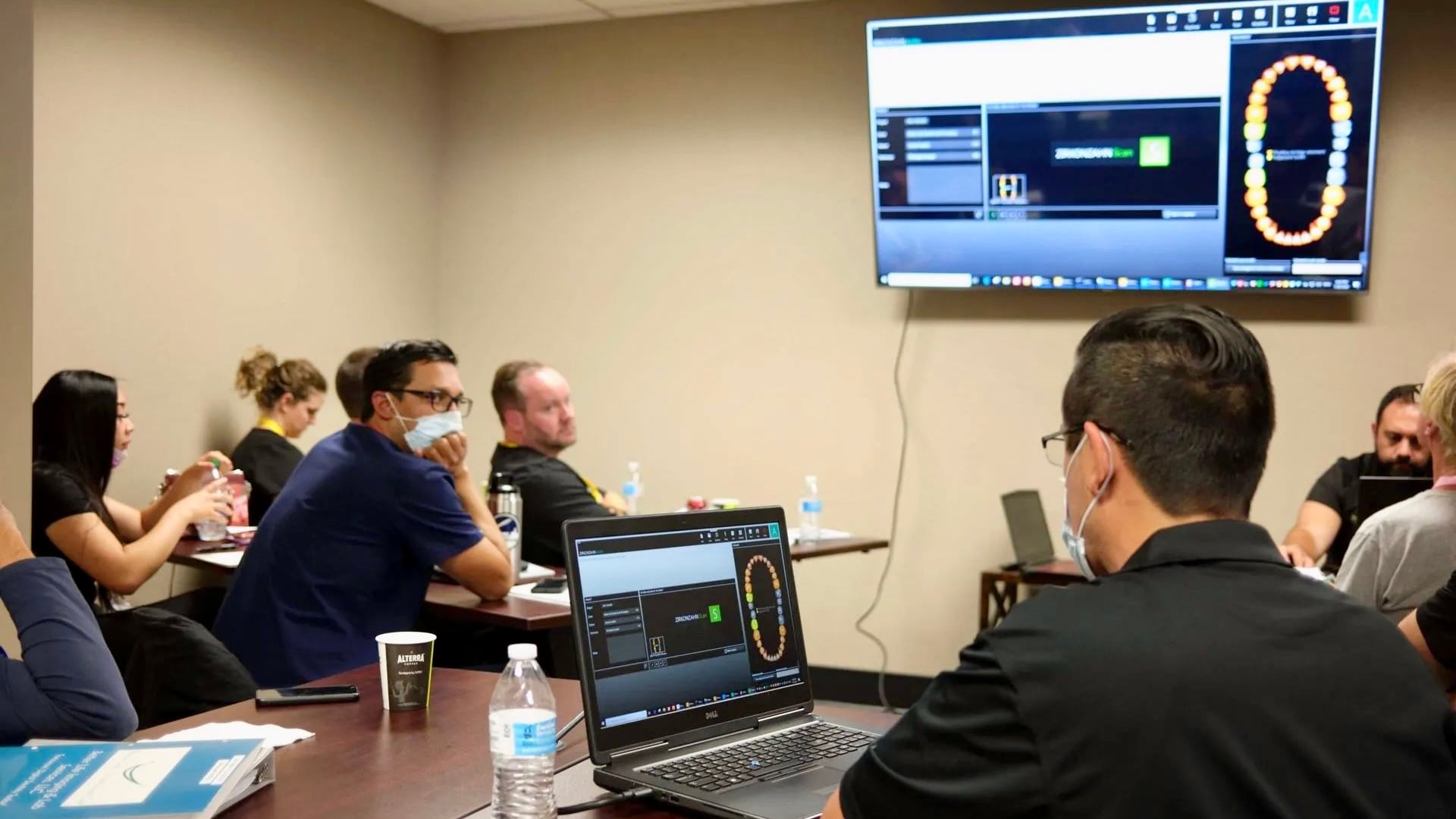
Simulation training on models provides a risk-free environment to learn foundational implant techniques and master surgical sequences, while live-patient training allows adaptation to real-world clinical variables such as tissue response and patient management. Both formats serve distinct roles in a graduated training path.
The evidence on skill transfer favors live-patient formats for building independent clinical competence. The literature on cadaveric training includes limited assessment of direct patient outcomes. Overall, it lacks strong outcome-level evidence for transfer to live surgery.
A student-to-instructor ratio of no more than 3:1 during live-patient procedures ensures direct supervision, real-time feedback, and personalized guidance critical for developing surgical competence. Programs that cannot meet this threshold during live operating should be evaluated with caution.
Choosing Training That Actually Scales Practice Revenue
Three strategic distinctions determine whether a training investment translates to practice growth.
-
Technique-only versus full-system: Technique courses teach the surgery. Full-system courses teach the surgery, the workflow, the team delegation, the closing, and the marketing. Only full-system training addresses every constraint on case volume at the same time.
-
Cadaver versus live-patient: Cadaver training works as a prerequisite, not a destination. Practices that plateau at low volume typically lack live-patient supervised experience, not anatomical knowledge.
-
One-time course versus ongoing community: Programs that include post-course mentorship bridge the training-to-production gap by providing ongoing support as clinicians build case volume and troubleshoot complications. A certificate without a community leaves the dentist isolated when a difficult case arrives.
2026 Photogrammetry Protocols and Immediate-Load Delivery
Extraoral photogrammetry systems such as ICam 4D and PIC Dental are widely regarded as reliable options for complex cases, including zygomatic and pterygoid implants. Emerging intraoral photogrammetry systems have also shown strong trueness in controlled studies.
Best practices for 2026 immediate-load delivery include the following steps.
-
Pre-operative facial scanning, intraoral scanning, and CBCT merged for prosthetically driven implant planning
-
Photogrammetry capture of implant positions immediately post-placement using calibrated scan gauges or horizontal scan bodies
-
Immediate-load 3D-printed conversion prosthesis fabricated and delivered the same day
-
FP1 case selection criteria applied pre-operatively to minimize bone resection and preserve natural soft tissue contours
-
Team-based records acquisition with the surgical assistant performing scanning steps to remove non-billable chair time from the dentist
Advanced full-arch programs in 2026 should incorporate digital smile design, facial scanning, intraoral scanning, photogrammetry, and 3D printing to achieve precise, predictable FP1 outcomes that preserve natural soft tissue contours.
Readiness Checklist for Full-Arch Training
Before selecting a program, assess the following readiness factors, moving from your current baseline to the resources needed for implementation.
-
Current monthly arch volume (0, 1–2, or 3+) and the specific bottleneck limiting growth, which establishes your starting point
-
Team bandwidth, including whether the practice has a trained assistant, treatment coordinator, and lab technician who can attend together, because missing roles slow implementation
-
Digital equipment inventory such as intraoral scanner, CBCT, 3D printer, and photogrammetry system, whether owned, leased, or absent, since missing equipment requires added capital before you can apply the training
-
Current closing rate on full-arch consultations and whether a structured treatment coordinator closing system exists, because low acceptance caps revenue regardless of clinical skill
-
Atrophic case referral patterns, including whether zygomatic and pterygoid cases are being referred out that could be retained with advanced training
-
Post-course support, including whether the program offers a continued community or whether support ends on the last day, which affects long-term confidence and case volume
Common Post-Training Pitfalls and How to Avoid Them
The most common reasons practices fail to scale after training are systemic rather than clinical.
-
Returning without a trained team. The dentist learns the workflow while the team does not, which creates a bottleneck at every delegation point. Mitigation: bring the full team, including assistant, treatment coordinator, and lab technician, to training together.
-
Partial digital workflows. Practices adopt a scanner but retain analog impression steps or off-site lab work, which produces a hybrid that is slower and less accurate than either a fully analog or fully digital approach. Mitigation: commit to an end-to-end photogrammetry-first system before the first post-training case.
-
Lacking post-course mentorship. The biggest barrier for most dentists starting implant dentistry is not lack of knowledge, but lack of confidence. Without a peer community to consult when a difficult case arrives, confidence erodes and case volume stalls. Mitigation: select programs that include a continued alumni community as a structural feature, not an optional add-on.
-
Ignoring the closing system. The sequence of discussions during consultations can significantly affect same-day case acceptance rates. A trained treatment coordinator becomes essential at full-arch volume.
Register for an upcoming Full Arch Masters course.
Frequently Asked Questions
How does photogrammetry improve full-arch accuracy in 2026?
Photogrammetry captures the precise three-dimensional positions of implants by photographing calibrated scan gauges or horizontal scan bodies placed on each implant. Standard intraoral scanners accumulate stitching errors across a full arch, while photogrammetry systems measure implant positions independently of soft tissue distortion and scanner drift. Extraoral systems such as the ICam 4D achieve median 3D trueness values around 25 µm, compared to approximately 78 µm for standard intraoral scanners. This level of accuracy is critical for passive fit of screw-retained full-arch prostheses, because even small deviations at the implant interface can produce biomechanical stress, screw loosening, or prosthetic failure over time. In the FAM Method, photogrammetry is used immediately post-placement to capture implant positions for same-day immediate-load prosthesis fabrication, which enables delivery of a screwed-in restoration in 2–4 hours without a return appointment.
What revenue growth can practices expect after comprehensive full-arch training?
Revenue growth after full-arch training depends on whether the training addresses the full operating system, including workflow, team delegation, closing, and marketing, or only the surgical technique. FAM alumni report adding $1M+ per year in practice revenue after adopting the FAM Method. The mechanism is compounding. A faster photogrammetry-first workflow increases the number of arches a practice can deliver per week without adding chair time. A trained treatment coordinator running a structured closing system lifts case acceptance rates. Team delegation removes non-billable steps from the dentist’s schedule, which frees capacity for additional surgical cases. Practices that address only the surgical technique without the surrounding system typically see modest volume gains that plateau quickly, because the constraint shifts from clinical skill to workflow efficiency and case acceptance.
Why is post-course community support critical for scaling case volume?
Full-arch implant dentistry is one of the most competitive and technically demanding segments in dentistry. Complications, edge cases, and workflow questions arise regularly, particularly in the first 12–18 months after a practice adopts a new system. Without a peer community to consult, dentists either slow their case volume to manage risk conservatively or refer out cases they could handle with guidance. A continued alumni community provides on-demand access to hundreds of peers who have worked through the same clinical and operational challenges. FAM’s private group chats, including a dentist-only channel for sensitive practice and personnel questions and a main multi-role channel spanning assistants, technicians, and team members, function as a real-time case consultation network. This ongoing support differs from a post-course helpline or occasional webinar and operates as a persistent community that compounds in value as the alumni base grows.
How do team-based models affect delegation and practice throughput?
In a team-based full-arch model, the dentist performs the billable surgical and restorative steps while trained team members execute records acquisition, scanning, photogrammetry capture, patient communication, and lab coordination. This delegation structure removes a significant volume of non-billable chair time from the dentist’s schedule. When the assistant can independently run intraoral scanning and photogrammetry, and the treatment coordinator can run most of the consultation and closing process without the dentist present, the practice can schedule more surgical cases per day without extending the dentist’s clinical hours. FAM’s Flagship Course trains the full team, including dentist, lead assistant, treatment coordinator, and in-house lab technician, on the same workflow simultaneously. The practice then returns home aligned on a single operating system rather than requiring the dentist to re-train the team from scratch after a solo course.
Conclusion: Implementation-Focused Training Drives Full-Arch Growth
The distinction between a technique course and an implementation course separates knowing how to perform a full-arch procedure from running five or more per month at higher margins with a coordinated team. Technique courses are necessary but not sufficient. Practices that scale full-arch volume consistently are the ones that trained the entire operating system, including the photogrammetry-first digital workflow, the team delegation model, the closing system, and the post-course community, not just the surgery.
Full Arch Masters is built around that distinction. The FAM Method integrates every component of the full-arch workflow into a single repeatable system, taught by a cross-trained instruction team that has actually run the roles they teach. The five-course curriculum, the continued alumni community, and the KOL buying group at no recurring cost are structured to support practices from their first arch through their fiftieth and beyond.