Written by: Ryan Dunlop, CEO and Founder of Full Arch Masters and graduate from the Harvard School of Dental Medicine
Key Takeaways
-
Full-arch implant training programs differ in structure and outcomes. Dentists should compare options using six clear criteria: live-patient surgery volume, digital workflow integration, team training access, post-course mentorship, revenue outcomes, and total cost of ownership.
-
Experience-based pathways matter. Dentists with 20–100 implants placed need programs that teach the full operating system, while dentists already placing one or two arches per month need training that focuses on team delegation, treatment coordination, and workflow efficiency.
-
Fully integrated digital workflows that connect photogrammetry, intraoral scanning, CBCT, exocad design, and 3D-printed immediate-load conversion support same-day delivery in 2–4 hours. Hybrid workflows usually cap practices at one or two arches per month before margins erode.
-
Full Arch Masters stands out in the comparison table by providing two full arches per operator, full-team training with built-in pricing, ongoing alumni community support, and alumni-reported $1M+ annual revenue uplift.
-
Register for an upcoming Full Arch Masters course at Full Arch Masters to implement a complete, photogrammetry-first digital workflow that meets all six evaluation criteria and accelerates practice growth.
Experience-Based Learning Pathways for Full-Arch Dentists
Full-arch implant training for general dentists must match current experience and practice goals. A dentist who has placed 20 single implants needs a different entry point than a dentist already running two arches per month who wants to scale to five. Structured programs that map training to experience level, rather than delivering the same curriculum to every attendee, support faster implementation and fewer post-course complications.
Dentists with 20–100 implants placed need a program that covers the full operating system. That system includes surgical fundamentals, digital records acquisition, immediate-load workflow, team delegation, and treatment coordination. Live-patient exposure at this stage is essential. Quality programs at this level align curriculum to the dentist’s current experience while providing ongoing mentorship and direct instructor access to support implementation.
Dentists already running a limited full-arch volume, typically one or two arches per month, rarely face a clinical knowledge gap. Their constraint is the operating system around the procedure. A slow hybrid workflow, an undertrained team, and a treatment coordinator who cannot close at the volume required all restrict growth. Programs that address only surgical technique leave this group at the same production level.
Find the Full Arch Masters track that matches your current implant experience.
Six Criteria to Use When Comparing Programs
When dentists evaluate full-arch training, six criteria determine whether a course will translate into practice growth. Each criterion carries operational weight in 2026. Here is what each one means in day-to-day practice.
-
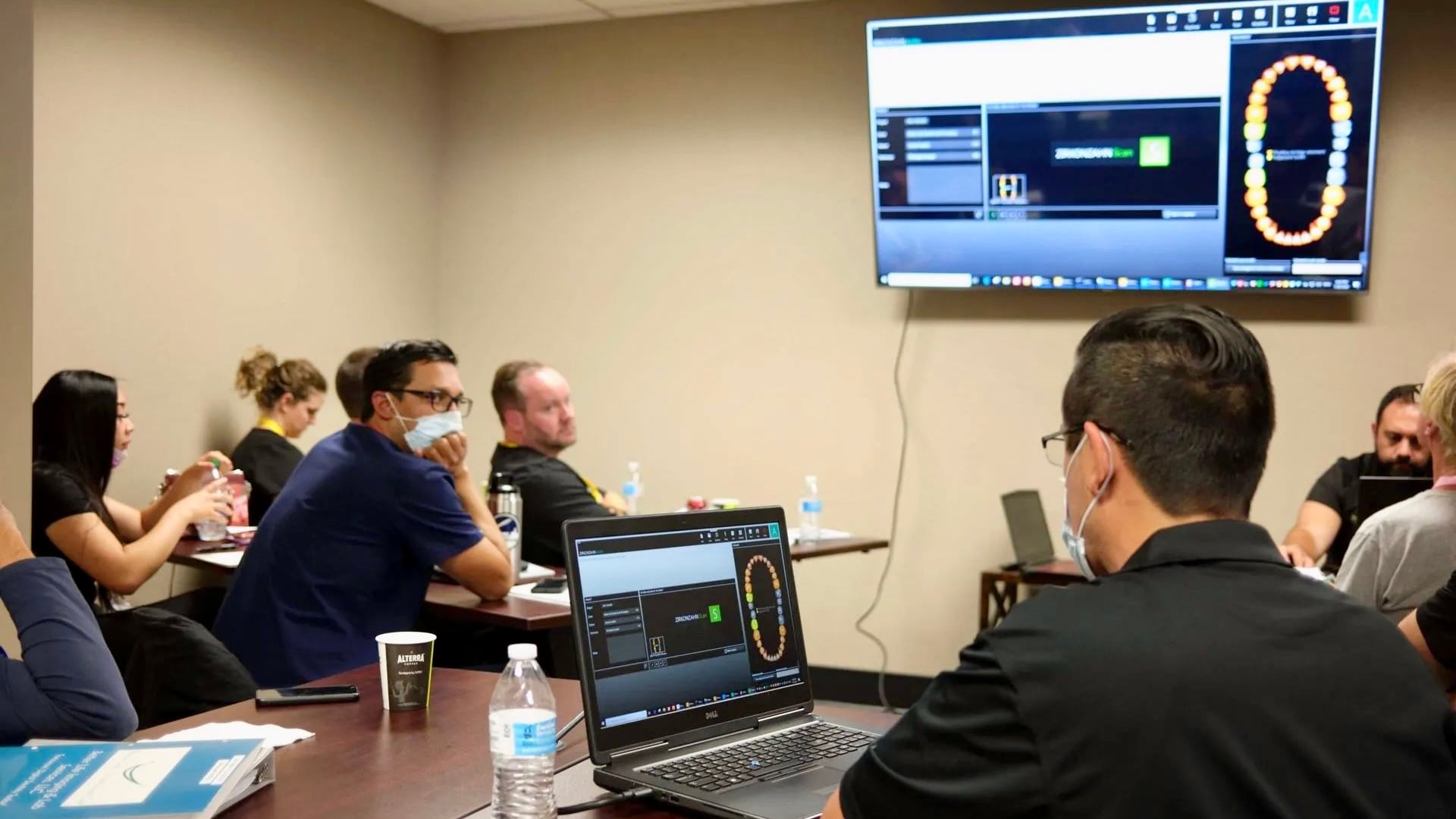
Live-patient surgery volume. Observing a case and operating on a case are not equivalent. Programs that limit class sizes and require participants to perform procedures themselves, rather than observe, support faster skill transfer. Ask how many arches each operator completes, not how many cases the faculty demonstrates.
-
Digital workflow integration. True competence in digital implant dentistry requires hands-on training with actual software and equipment, not theory alone. A program that mentions intraoral scanning but skips photogrammetry, CBCT-to-STL registration, and immediate-load 3D printing teaches components, not a system.
-
Team training access. A successful All-on-X practice requires an interdisciplinary team. A dentist who returns from training without a trained assistant, treatment coordinator, and lab technician cannot operationalize the workflow. Ask whether team-member seats are available and whether pricing makes it realistic to bring the full team.
-
Post-course mentorship and community. Most programs end when the course ends. A difficult case that lands on the schedule three months later has nowhere to go. Ask specifically what post-course support includes. Look for group chats, case review calls, or structured mentorship, not a static library alone.
-
Revenue and implementation outcomes. Programs should publish alumni-reported revenue outcomes. A course that cannot point to measurable practice growth teaches technique without accountability for results.
-
Total cost of ownership. Course tuition is one line item. Add team-member seats, equipment required to implement the workflow, and any post-course vendor discounts. Comprehensive implant training programs involve significant investment and can deliver returns when the workflow is implemented. Those returns appear only when the practice can actually run the system.
Digital Workflow vs Hybrid Workflow in Full-Arch Cases
The gap between a fully digital workflow and a hybrid workflow largely determines how many arches a practice can run per week at a margin. The evolution from analog protocols to digitally driven All-on-X strategy has made treatment planning more precise, execution more controlled, and outcomes more predictable.
A hybrid workflow, which relies on partial impressions, partial digital records, off-site lab work, and next-day recalls, usually limits practices to one or two arches per month before chair time crushes margins. Many practices remain in hybrid workflows because of common obstacles, including perceived high investment cost, skill gaps, team resistance, and workflow disruptions during early adoption. These barriers make implementation-focused training more valuable than technique-only instruction.
A photogrammetry-first, fully integrated system changes the math. Photogrammetry can provide precise implant position capture, supporting accuracy and fit for multiple implants. When photogrammetry connects with intraoral scanning, facial scanning, CBCT, exocad design, and 3D-printed immediate-load conversion in a single repeatable system, same-day delivery in 2–4 hours becomes operationally achievable, not aspirational.
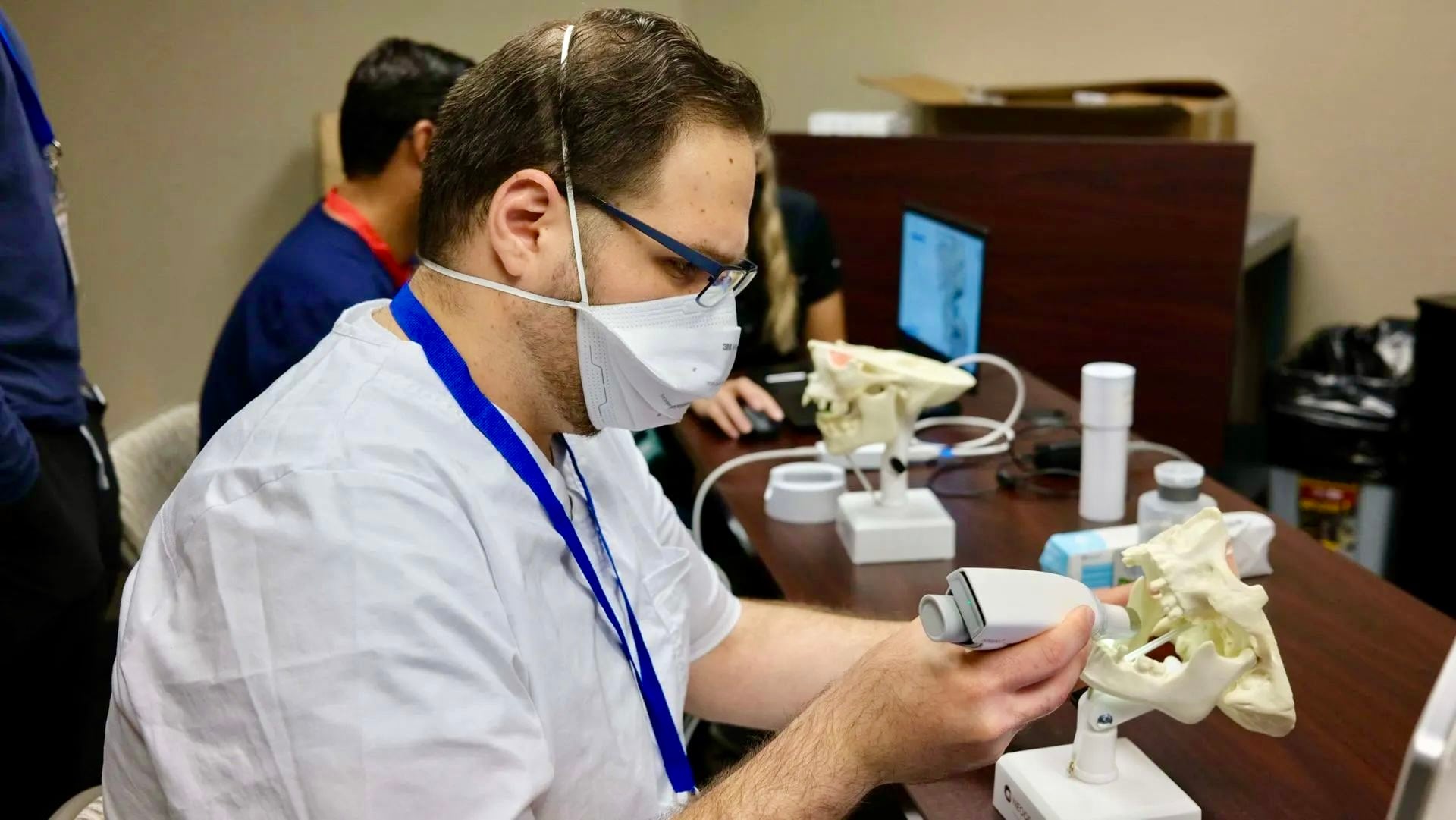
CAD/CAM systems now dominate the digital dentistry market, linking intraoral scanners with design software and milling or 3D printing units to enable precise same-day restorations and improved accuracy in implant prosthetics. The key training question is whether a program teaches these tools as one integrated system or as isolated components that the dentist must assemble alone after the course.
Key Questions and Red Flags Before You Enroll
Dentists should ask direct questions before committing to any full-arch implant training program.
-
Will I operate on live patients or observe? Observation-only programs do not produce the same skill transfer as hands-on operating. If the program offers live cases, ask how many arches each operator completes, not how many the faculty demonstrates.
-
Is photogrammetry taught as part of an integrated workflow, or mentioned as an add-on? A program that covers photogrammetry in isolation without connecting it to CBCT, intraoral scanning, and immediate-load printing does not teach a system.
-
Can my team attend? If the answer is no, or if team-member seats are priced prohibitively, the program is built for the dentist alone. A dentist who returns without a trained team cannot operationalize the workflow.
-
What happens after the course ends? If the answer is a resource library with no community access, ask what happens when a difficult case lands on the schedule six months later. Two-day workshops without ongoing feedback loops produce skill gains that decay rapidly.
-
Does the program publish revenue outcomes? Programs that cannot point to alumni-reported practice growth teach technique without accountability for implementation.
-
What is the total cost of ownership? Add team-member seats, required equipment, and post-course support costs to the tuition figure before comparing programs.
Revenue Impact and Implementation Results
The economic case for full-arch implant training rests on predictable case value and repeatable systems. An All-on-4 full-arch case generates $20,000–$35,000 in revenue, and a practice placing three to five implant cases per month adds $150,000–$300,000 annually from a single service line expansion. For most practices, the constraint is not patient demand. The constraint is the operating system around the procedure.
Treatment coordination represents a measurable lever. A trained treatment coordinator using a structured closing system can achieve higher close rates on seated full-arch consultations compared to untrained coordinators.
Full Arch Masters alumni report adding $1M+ per year in practice revenue after adopting the FAM Method, the integrated digital workflow described earlier that enables same-day delivery in 2–4 hours. FAM’s in-house treatment coordinator maintains a high closing rate using the system taught in the Treatment Coordinator Bootcamp. Each FAM course carries 32 continuing education credits through the American Academy of General Dentistry.
The $1M+ outcome comes from several variables working together. A faster workflow supports more arches per week at higher margin. A trained treatment coordinator closes more consults the same day. A trained team protects the dentist’s chair time from non-billable tasks.
See how FAM alumni are adding $1M+ in annual revenue with the complete FAM Method.
Next Steps for Choosing a Full-Arch Training Path
The six-criteria framework, which includes live-patient surgery volume, digital workflow integration, team training access, post-course mentorship and community, revenue and implementation outcomes, and total cost of ownership, provides a practical lens for evaluating any full-arch implant training program. Most programs satisfy one or two criteria. Full Arch Masters is positioned as the only program in this category that satisfies all six.
The FAM Method uses a photogrammetry-first, fully integrated digital workflow taught as a complete operating system, not a single technique. The Flagship Course covers the full system end-to-end in four days, capped at eight dentists per cohort, with team-member seats built into the pricing. The Live Surgical Course in Parker, Colorado puts each Basic or Advanced operator hands-on with two full arches under Colorado Dental Board credentialing. The Treatment Coordinator Bootcamp trains the front-office team on the closing system that sustains a high in-house close rate. Every attendee joins continued alumni group chats with hundreds of FAM-trained dentists, lab technicians, and team members and gains access to the KOL buying group, which offers vendor discounts on Neodent implants, exocad licenses, and 3D printers at no recurring cost.
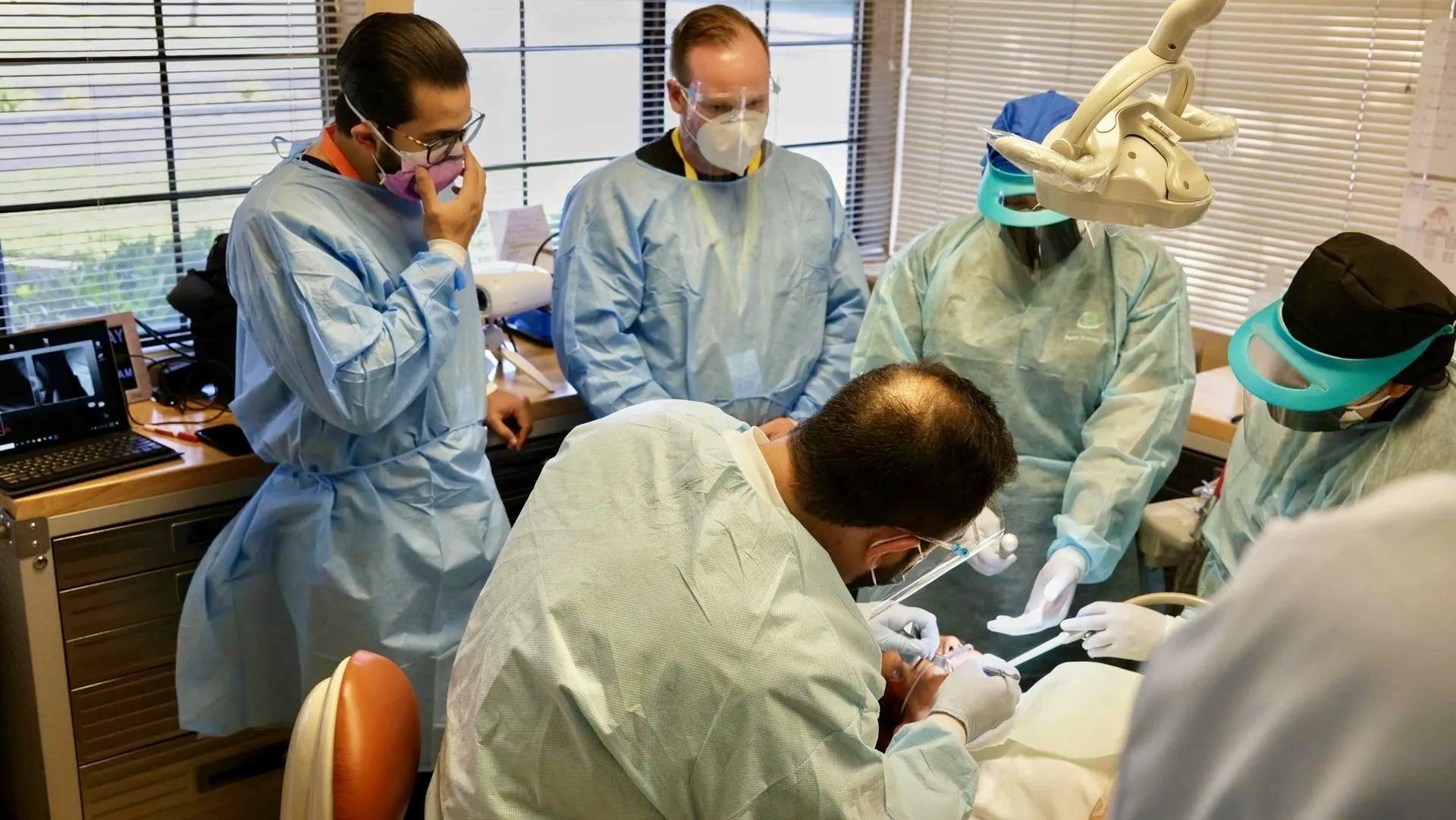
Dentists with 20–100 implants placed who are ready to build a full-arch practice usually start with the Flagship Course. Dentists already running limited full-arch volume who want to scale focus on the Live Surgical Course and Treatment Coordinator Bootcamp, which address the real growth constraints. Practices that want the complete curriculum in one commitment often choose the FAM Fellowship, which bundles three core courses plus a fourth at a $5,000–$10,000 discount.
Explore the Flagship Course, Live Surgical Course, and Fellowship options at fullarchmasters.com.
Frequently Asked Questions
What is the difference between a fully digital full-arch workflow and a hybrid workflow, and why does it matter for training?
A hybrid workflow combines some digital tools, typically an intraoral scanner, with analog steps such as physical impressions, off-site lab work, and multi-day appointments. This structure creates a slow, multi-appointment process that usually limits practices to one or two arches per month before chair time crushes margins. A fully digital workflow integrates intraoral scanning, photogrammetry, facial scanning, CBCT imaging, exocad design, and 3D-printed immediate-load conversion into a single repeatable system. When all components connect, same-day delivery in 2–4 hours becomes operationally achievable. The training impact is clear. A program that teaches individual digital tools without connecting them into an end-to-end system leaves the dentist responsible for assembling the workflow independently after the course, which most dentists do not complete successfully. The FAM Method is taught as a single integrated system, not as a collection of components.
How important is live-patient surgical experience in a full-arch training program, and how do I evaluate it?
Live-patient surgical experience is the single most important variable in skill transfer for full-arch implant training. Observing a case and operating on a case produce fundamentally different outcomes. When you evaluate a program, ask specifically how many arches each operator completes, not how many cases the faculty demonstrates. A program that offers live-patient access but limits each operator to one quadrant of one case does not match a program where each operator completes two full arches under mentor supervision. Full Arch Masters’ Live Surgical Course is hosted in Parker, Colorado under Colorado Dental Board credentialing, which authorizes US-licensed dentists from any state to perform surgery on volunteer patients. Each Basic or Advanced operator completes two full arches across the two surgical days. The Advanced track, which is gated to dentists with 200 or more career arches placed, focuses on zygomatic, pterygoid, trans-sinus, custom subperiosteal, and palatal-approach techniques for atrophic cases that most full-arch programs do not cover.
Why does team training matter in full-arch implant education, and what should I look for?
Full-arch implant dentistry functions as a team procedure. As discussed in the evaluation criteria, full-arch procedures require a trained team to execute at volume. The assistant must acquire digital records independently so the dentist’s chair time stays focused on billable work. The treatment coordinator must close high-ticket consultations using a structured system, which often marks the difference between a marginal service line and a significant revenue contribution. The lab technician must design and finish the prosthetic side of the case without creating handoff friction. When you evaluate a program, ask whether team-member seats are available, how they are priced, and whether the curriculum trains each role with the same seriousness as the clinical content. Full Arch Masters’ Flagship Course is built for the full team. Most attendees come as a practice owner with their treatment coordinator and lead assistant, or as a dentist with their in-house lab technician, because the FAM Method relies on full-team execution.
What post-course support should I expect from a full-arch training program?
Post-course support often represents the missing piece in full-arch education. A difficult case that lands on the schedule three months after training, such as an atrophic arch, a patient with unexpected bone loss, or a prosthetic complication, needs a place for real-time guidance. Meaningful post-course support includes a live peer community where case questions receive answers from dentists actively running the same procedure, not a static resource library alone. Full Arch Masters alumni join private group chats with hundreds of FAM-trained dentists, lab technicians, and team members. The community includes a dentist-only chat for sensitive practice and personnel questions and a main multi-role chat for clinical and operational case help. Alumni also retain access to the KOL buying group at no recurring cost and receive the full digital resource library covering surgical room setup, finishing techniques, treatment coordinator forms, and consent templates. The community functions as a structural part of what makes the FAM Method implementable over time.
How do I evaluate the total cost of ownership of a full-arch training program?
Total cost of ownership extends well beyond tuition. It includes team-member seat pricing, the equipment required to implement the workflow the program teaches, and the ongoing cost of vendor relationships for implants, software licenses, and 3D printing materials. A program that teaches a photogrammetry-first workflow but does not provide access to discounted photogrammetry systems post-course shifts a significant equipment cost onto the practice. A program that trains only the dentist forces the practice to separately train the assistant, treatment coordinator, and lab technician or accept a workflow that cannot run at volume. Full Arch Masters builds team-member pricing into every course, at $2,500 per additional team member for the Flagship Course, and provides alumni access to the KOL buying group. That group offers vendor discounts on Neodent implants, exocad licenses, Envisiontec and DentaFab 3D printers, and photogrammetry systems at no recurring cost. Practices that intend to take more than two FAM courses often enroll in the Fellowship, which bundles three core courses plus a fourth at a $5,000–$10,000 discount and includes a payment plan of up to 9–12 months.