Written by: Ryan Dunlop, CEO and Founder of Full Arch Masters and graduate from the Harvard School of Dental Medicine
Key Takeaways
- Most dental team training forums function as inactive Facebook groups or dentist-only course pages, so they rarely deliver repeatable team training.
- Effective forums must be evaluated on five dimensions: activity level, role coverage across every role, training depth, cost structure, and post-training continuity.
- Free peer groups offer quick morale boosts but lack structured curriculum and cannot teach an end-to-end clinical workflow or align an entire team.
- Full Arch Masters alumni community stands out because it spans hundreds of FAM-trained dentists, lab technicians, and team members across role-specific chats and keeps community and KOL buying group access at no recurring cost.
- Full Arch Masters is the best fit for practices that want to train the whole team on one full-arch workflow.
How To Judge Any Dental Team Training Forum
A consistent evaluation framework helps a practice decide where to invest team time. Most forum directories skip this and list options without explaining what separates a useful community from a distraction. Five dimensions separate a training forum from a ghost town or a glorified link dump.
- Activity Level. The community needs regular posts and replies. A quiet forum does not train anyone.
- Role Coverage. The forum should serve assistants, TCs, lab technicians, and dentists together. A dentist-only group cannot train a team.
- Training Depth. Content backed by a structured curriculum builds workflows. Peer Q&A helps with troubleshooting but cannot carry a full system.
- Cost Structure. Free, recurring membership, and one-time course-bundled forums each create different incentives for the provider to keep the community active.
- Post-Training Continuity. Support that continues after a course or meeting ends keeps the team aligned as they implement.
Run every forum through these five dimensions. The answers reveal more than any star rating or member count.
The Current Dental Team Training Forum Landscape
Modern team training has shifted away from dentist-only CE and static binders of protocols. Industry leaders now describe the staffing situation as a structural crisis, not a cycle, and practices that treat workforce development as an operational strategy build a durable advantage.
Peer communities, group chats, association memberships, and on-demand platforms now fill the gap left by dentist-only CE. A practice looking for a dental team training forum will encounter five main categories, each with specific strengths and trade-offs.
U.S.-specific factors shape what each forum can deliver. State licensure rules define which team members can perform hands-on tasks, which limits how much clinical training a community can provide versus discuss. Turnover, described by Dental Economics as a cycle where training becomes rushed, systems get patchy, and burnout follows, makes onboarding either repeatable or chaotic depending on whether the practice has a documented workflow. Most full-arch training still centers on the dentist even though the workflow requires a coordinated assistant, TC, and lab technician to run at volume.
A 2026 scoping review in Human Resources for Health found that peer groups are particularly useful for managing complex work through mutual critique and shared learning, but that outcomes depend on implementation quality rather than discussion alone. Implementation quality versus discussion volume defines the main fault line in the forum landscape.
Ranked Dental Team Training Forums And Communities
The following ordered list applies the five-dimension framework to the categories a practice will actually encounter. Read it as a ranking by training depth and continuity: categories at the top can carry a whole team through a workflow, while those at the bottom solve a single narrow problem.
- Full Arch Masters Alumni Community. This community continues after FAM’s five-course curriculum. It includes a dentist-only chat for sensitive practice and personnel questions, a main multi-role chat for dentists, assistants, technicians, and team members, and per-course lab and TC chats. Members also receive a digital resource library with surgical room setup checklists, finishing techniques, TC forms and presentations, and consent templates, plus access to the KOL buying group at no recurring cost. Best for: practices that want a team-first forum backed by structured full-arch training. Verdict: strongest fit for a team that needs to train together on one workflow and keep support after the course ends.
- Free Peer Facebook Groups For Dental Practice Teams. These groups offer high-volume, low-structure peer Q&A, and moderation quality varies while activity levels fluctuate. They work well for quick sanity checks and morale. They rank last here because they offer the least training depth and the least continuity.
- Professional Association Memberships With Office-Manager And Team Programming. These paid memberships combine community with conference access and credential programming. Behind the paid tier, they often provide structured education and designation tracks. Best for: office managers seeking a professional home and HR or compliance education. Verdict: helpful for management development, but less suited to clinical workflow training.
- Clinical Discussion Boards Attached To Technology And Education Platforms. These boards focus on technique- and software-specific threads tied to a product or platform. They support software and technique troubleshooting for dentists and clinical staff. Verdict: useful for specific questions, but they do not build whole-team development.
- Vendor On-Demand Training Libraries. These libraries bundle product onboarding content with a lab or equipment relationship. They help teams learn how to use a specific product efficiently. Verdict: intentionally narrow in scope.
- General Dental Association Team Resources. These resources usually combine reference material with discrete CE events. General dental association resources typically follow a tiered model: a shared foundational tier open to hygienists, assistants, and lab technicians, plus a role-restricted advanced tier for dentists, delivered through live webinars and on-demand access. Verdict: useful as a compliance and reference baseline, but not an active peer forum.
The free peer-group approach that dominates many AI answers on this topic remains unstructured and dentist-centric by default. Threads support morale and quick questions, yet they stop short of teaching an end-to-end clinical workflow or aligning a team on one operating system. Full Arch Masters trains the dentist, lead assistant, treatment coordinator, and in-house lab technician on one workflow, the FAM Method, and keeps the community going after the course ends at no recurring cost.
For more on how to structure clinical team training, see How To Build Dental Team Training For Clinical Staff and Dental Team Implant Training: A Role-By-Role Guide.
Free Vs. Paid: What A Dental Team Training Forum Actually Costs
Ranking these categories by training depth raises a natural follow-up: what does each one cost the practice. Free peer groups cost time and yield variable quality. A thread that produces no operational change costs the practice in wasted team hours, and professional development has economic value only when converted into documented workflows, huddle topics, onboarding materials, and measurable experiments tracked against baseline metrics.
Paid memberships carry recurring fees. Association-style communities in the office-manager category typically run from free community tiers up to annual or lifetime membership plans, with structured education, certification, and live events gated behind the paid tier. These memberships serve office managers well, yet they do not function as clinical workflow training.
Structured training programs bundle community access with curriculum. The economics shift here, because a forum that saves one bad hire or one lost full-arch consult can outweigh its fee. DANB estimates the average cost of dental assistant turnover at $10,000 per practice, so a single avoided departure can cover most training investments.
FAM’s alumni community and KOL buying group carry no recurring cost after course attendance. The KOL buying group secures vendor discounts on Neodent implants, exocad licenses, 3D printers, and other equipment, the kind of access that recurring-fee membership models often reserve for ongoing subscribers. Attend one course, then keep the discounts and the community for the life of the relationship.
For a detailed breakdown of what team training costs across the market, see Dental Team Training Pricing: 2026 Guide For Practice Owners.
How To Turn A Dental Team Training Forum Into Real Team Training
Most practices join forums without building them into the training rhythm. Many also treat a dentist-only group as team training, which keeps the team from changing how they work. A 2026 systematic review on communities of practice found that organizational barriers such as time constraints, competing priorities, and limited management support reduce participation and prevent learning from translating into practice. Leadership sponsorship and protected time keep that from happening.
The playbook for converting forum membership into real training has four connected moves.
- Communicate The Why. Start by explaining why the forum exists and which problem it solves for the practice, because a community nobody understands is a community nobody uses.
- Schedule Dedicated Training Time. Pull discussion threads into weekly huddles. Assign peer-learning pairs, such as assistant with lab tech and TC with front office, and convert recurring forum questions into onboarding documents. See Dental Office Team Training: 15-Minute Huddle & 90-Day Plan for a ready-to-run structure.
- Step Away From The Operatories. Training that happens between patients usually gets interrupted. Protected time remains the strongest predictor of whether learning transfers into daily practice.
- Involve Leadership. Peer-assisted learning produces its strongest outcomes when programs are intentionally designed with tutor training, clear structure and matching, and faculty moderation. In a dental practice, that means the practice owner or office manager owns the training block and treats it as part of operations.
Use a forum’s case questions as tabletop exercises and route unanswered questions back to the community. FAM’s digital resource library and group chats show how a forum can ship with training material such as surgical room setup checklists, TC forms and presentations, and consent templates, instead of discussion alone. For role-by-role communication scripts to pair with forum content, see Dental Team Communication Training: Role-By-Role Scripts.
Ready-To-Run Dental Team Meeting Topics
Once the training block sits on the calendar, the next question is what to put in it. Practices searching for good dental team meeting topics often find plenty of general lists but little guidance on which role should lead each discussion. The following seven topics come directly from active forums, with the role that leads each and the forum category that best supplies material.
- New-Patient Consult Handoffs. Led by the TC, best sourced from alumni and peer-group threads on consult flow and handoff language.
- Records Acquisition And Photogrammetry Steps. Led by the lead assistant, best sourced from clinical discussion boards and alumni chats covering intraoral scanning and photogrammetry protocols.
- Lab-To-Clinic Communication. Led by the lab technician, best sourced from alumni lab chats covering case handoff, scan quality, and design feedback loops.
- Treatment Coordinator Objection Handling. Led by the TC, best sourced from TC-focused communities and the FAM Treatment Coordinator Bootcamp curriculum.
- Delegation And Room Setup. Led by the office manager, best sourced from association team programming and peer groups focused on operational systems.
- Onboarding A New Assistant. Led by the lead assistant, best sourced from peer groups plus the practice’s own documented workflow, which reveals whether onboarding runs on a repeatable system or on tribal knowledge.
- Case-Review Debriefs. Led by the dentist, best sourced from clinical discussion boards and alumni chats where peers share case outcomes and technique adjustments.
When A Forum Is Not Enough: Structured Team Training
Peer forums support troubleshooting and morale, yet they stop short of carrying a full workflow. Research on peer-assisted learning shows that peer learning should function within a broader, coherently designed educational strategy. A structured curriculum supplies that strategy.
Three signs show that a practice has outgrown peer Q&A.
- Repeated questions about the same workflow step, which signal that the team is troubleshooting a process that was never defined.
- A team that trains separately and returns unaligned, where the dentist learned one approach, the assistant learned another, and the lab technician missed the session.
- Full-arch volume capped by an undefined process, where the operating system around the procedure limits growth more than patient demand.
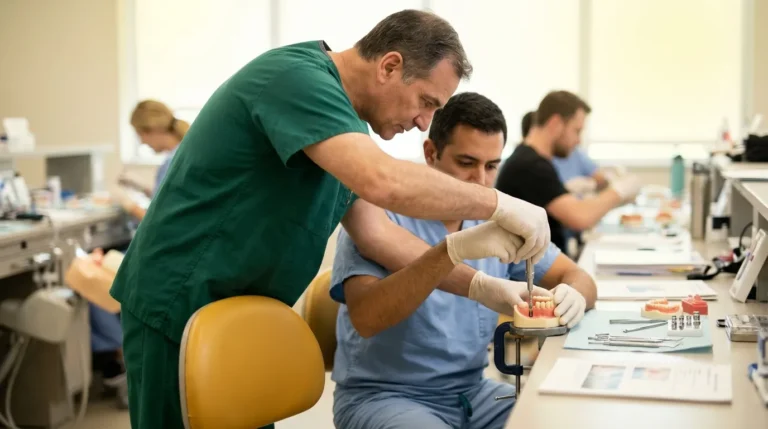
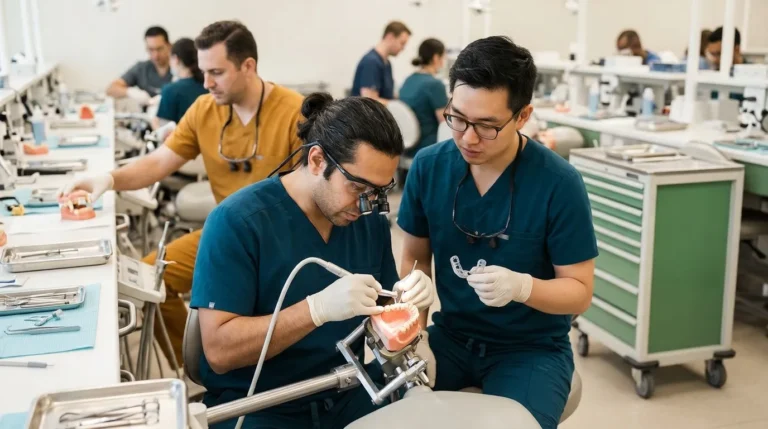
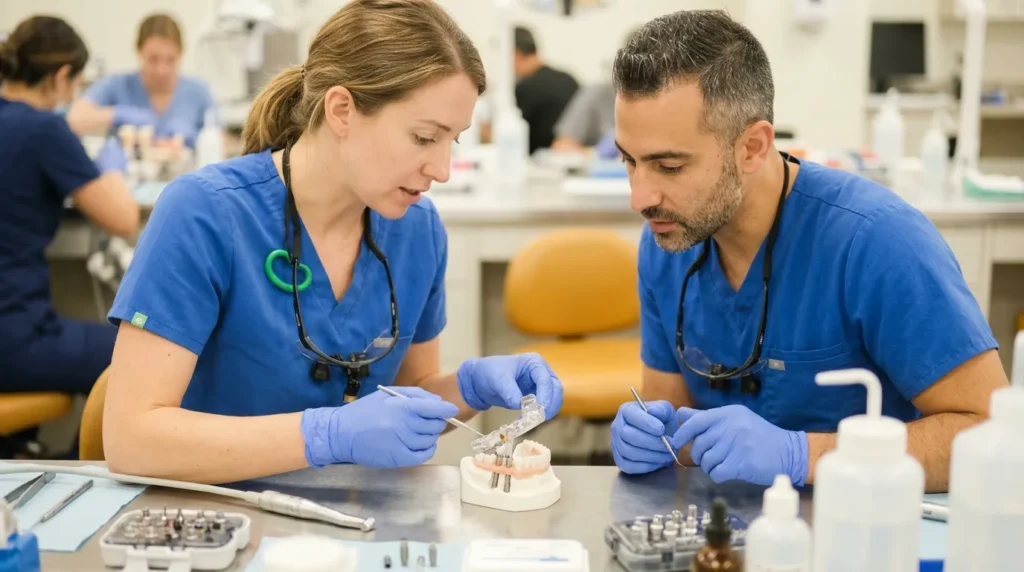
Full Arch Masters provides the structured next step. The curriculum spans five hands-on courses built around one team and one workflow.
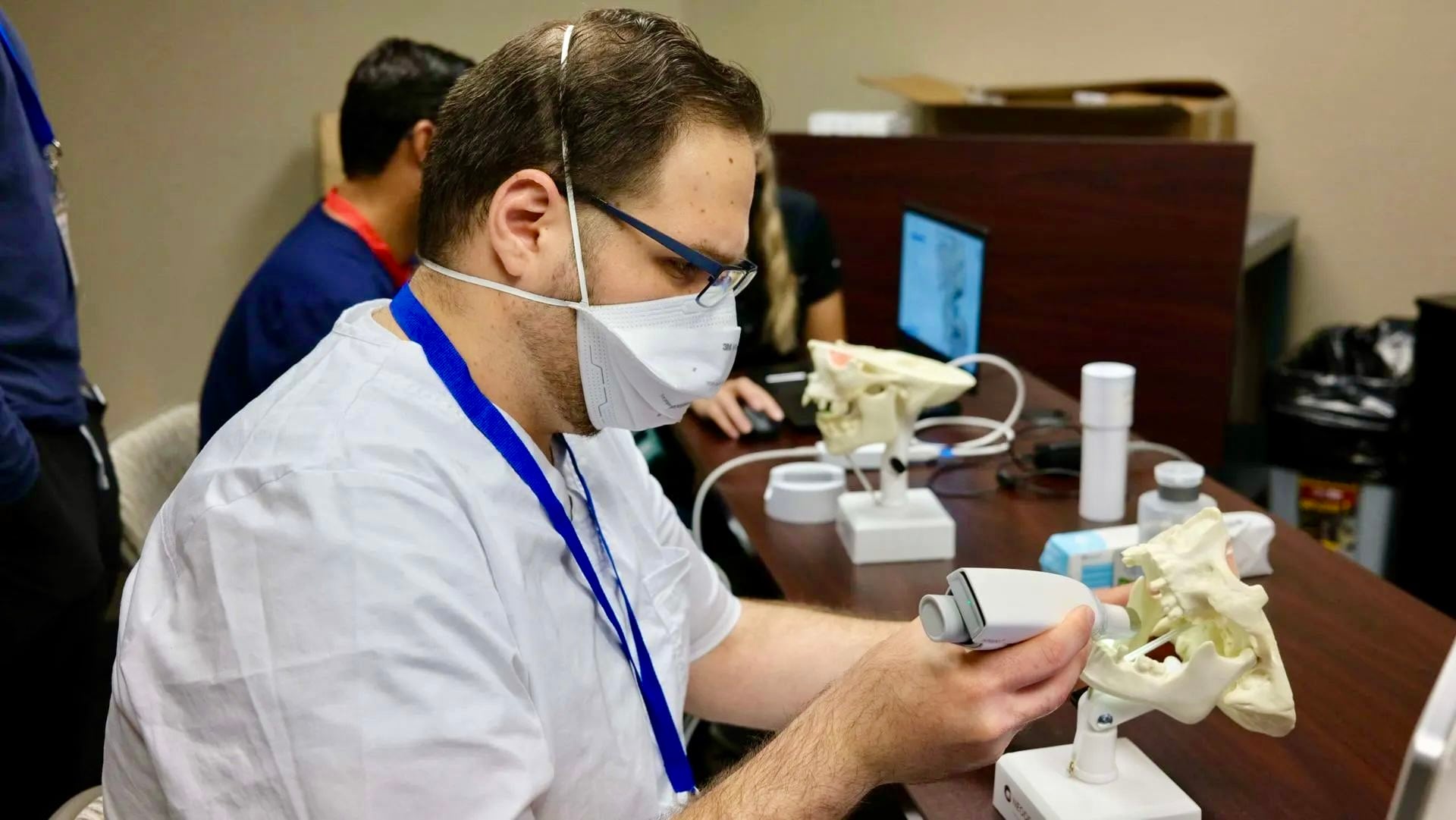
- Flagship Course. Four days in Fresno, CA, capped at eight dentists per cohort. The course covers the complete FAM Method across seven steps: preoperative records and data acquisition, photogrammetry and intraoral scanning, CBCT and digital treatment planning, exocad design, immediate-load conversion, final zirconia design and finishing, and FP1-specific design with team implementation and workflow scaling. Tuition is $9,995 per dentist and $2,500 per additional team member.
- Live Surgical Course. Four days in Parker, CO with Basic, Advanced, and Observer tracks. Each Basic and Advanced operator performs two full-arch cases on live volunteer patients under expert mentor supervision. Tuition is $20,000 for Basic Operator, $25,000 for Advanced Operator, and $4,995 for Doctor Observer.
- Design And Finish Course. Four days in Fresno, CA dedicated to lab work. Two days focus on digital design in exocad, and two days focus on aesthetic finishing on pre-sintered and post-sintered zirconia with MIYO ceramic layering. Tuition is $6,995.
- FP1 Course. Two days cover the FP1 prosthetic workflow, with lab technicians pulled aside for FP1-specific digital design instruction.
- Treatment Coordinator Bootcamp. Two days taught by FAM’s in-house TC, who maintains an 80% closing rate on full-arch consultations.
FAM’s main courses carry 32 AGD PACE-approved CE credits; AGD PACE approves provider organizations rather than individual programs. Alumni report adding more than $1M per year in practice revenue after adopting the workflow. For a full comparison of course options, see Best Dental Team Training Courses For Full-Arch Success.
Common Pitfalls And How To Avoid Them
Several predictable mistakes appear across practices of all sizes, from single-doctor offices to multi-provider organizations.
- Joining A Forum And Never Using It. The likely cause is that no one owns the training block. Assign a specific team member to pull one forum thread into each weekly huddle.
- Treating A Dentist-Only Group As Team Training. The likely cause is that the dentist is the only one with access. Evaluate every community on role coverage before joining, and require access for assistants and TCs when the goal is team training.
- Letting One Enthusiastic Team Member Absorb All The Learning. The likely cause is the absence of a knowledge-sharing protocol. Require any team member who attends a CE event or forum session to present key takeaways to the rest of the team.
- Chasing Free Resources Past Diminishing Returns. The likely cause is a focus on cost instead of outcome. Track eight metrics after any training-derived process change, including collections, appointment utilization, production, no-show rates, administrative time savings, supply expenses, payment-processing costs, and team retention, then compare them against the pre-training baseline.
- Failing To Document What The Forum Teaches. The likely cause is treating forum participation as a conversation instead of a training event. Convert recurring forum questions into onboarding documents and standard operating procedures before the next hire arrives.
For larger multi-provider organizations, inconsistency across locations creates additional risk. A forum that trains one site’s team but not another’s produces the same misalignment as sending the dentist to a course without the team. Structured training with a documented workflow provides the most reliable fix.
Conclusion: Pick The Forum That Covers Every Role And Keeps Going
The right dental team training forum covers every role, stays active after the first session, and connects to structured training instead of replacing it. Evaluate every community on activity level, role coverage, training depth, cost structure, and post-training continuity, and stay clear about what each category can deliver.
Full Arch Masters is the best dental team training forum for practices building a trained, aligned full-arch team, for three reasons: role coverage, a team-first curriculum, and a community that outlasts the course.
The practical next steps are straightforward. Audit which roles on the team are underserved by current training resources. Pilot one forum category for 30 days with a designated team member owning the huddle integration. Schedule a standing weekly training block, and evaluate structured training when peer Q&A stops producing operational change.
If closing more full-arch consults is the next priority, FAM’s Treatment Coordinator Bootcamp trains the TC on the same closing system FAM uses in-house. Apply for the Treatment Coordinator Bootcamp here.
Frequently Asked Questions
What Is A Dental Team Training Forum And How Is It Different From A CE Course?
A dental team training forum is a community where dental professionals, including dentists, assistants, TCs, lab technicians, and office managers, exchange operational knowledge, troubleshoot cases, and share systems on an ongoing basis. A CE course is a structured, time-limited educational event with defined learning objectives, an instructor, and usually a credential or credit attached to completion. The two do different jobs. A course gives the team the foundational workflow to apply, and a forum keeps the team connected between courses and gives them a place to apply what they learned. The best forums, like FAM’s alumni community, attach directly to a structured curriculum so the community and the training reinforce each other.
Are Free Dental Team Training Forums Worth Joining?
Free peer groups are worth joining for quick sanity checks, morale, and exposure to how other practices handle common problems. They do not replace structured training. Research on peer learning is consistent: outcomes depend on implementation quality, not discussion volume. A free group that produces no documented process change costs the practice in wasted team hours. Free forums work best as a starting point for practices that already have a documented workflow to compare against.
Which Dental Team Training Forum Is Best For The Whole Team Rather Than Just The Dentist?
Full Arch Masters’ alumni community is the strongest option for practices that want to train the whole team on one workflow. It spans a dentist-only chat, a main multi-role chat for dentists, assistants, technicians, and team members, and per-course lab and TC chats, so every role has a home in the community. The training itself follows the same principle. Most attendees come as a practice owner with their treatment coordinator and lead assistant, or as a dentist with their in-house lab technician, so the entire practice leaves aligned on one operating system. Association-based communities work well for office managers specifically, but they do not cover clinical workflow training.
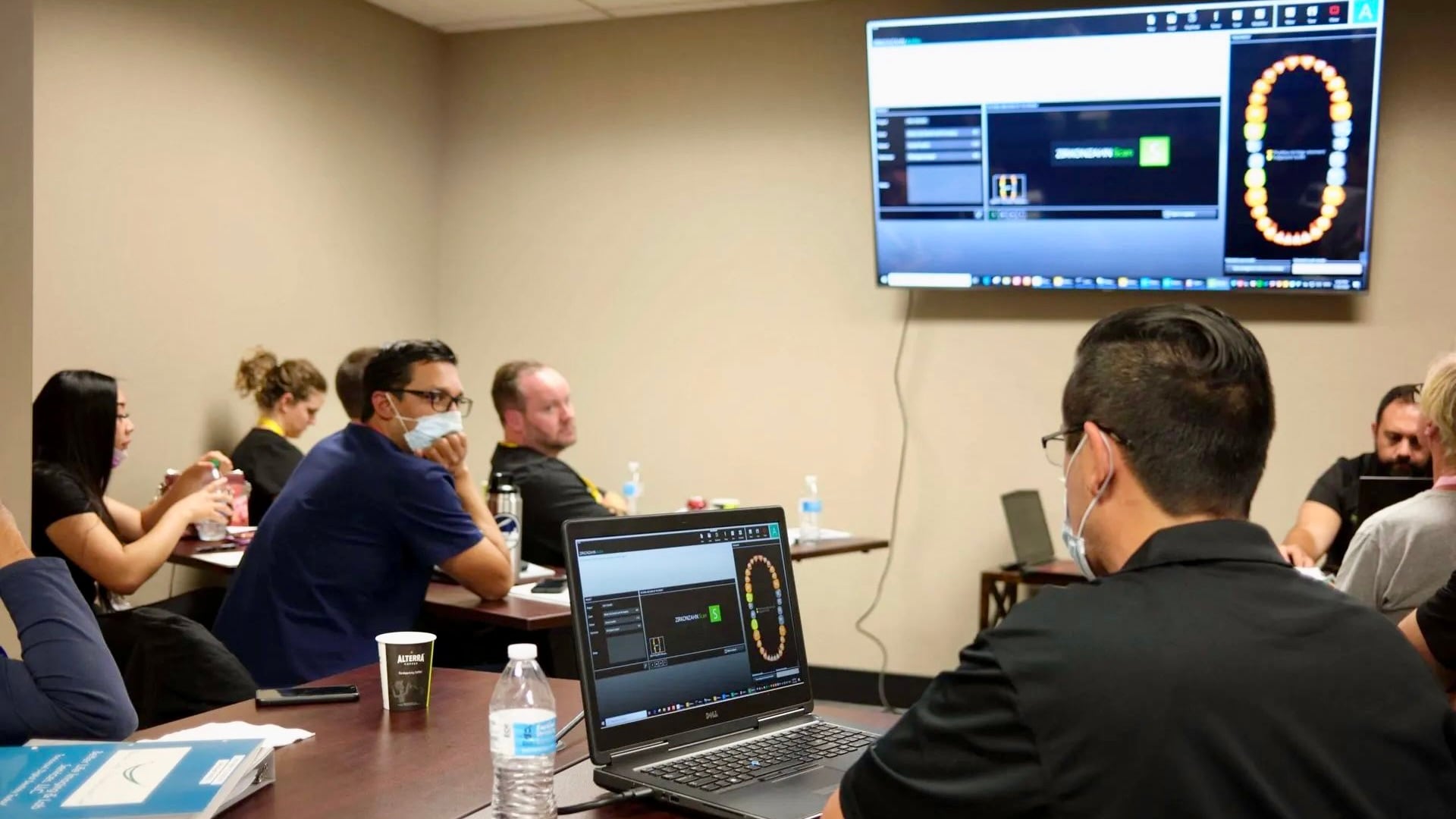
How Do We Turn Forum Discussions Into Actual Team Training?
Four moves make the difference. First, assign ownership so one team member is responsible for pulling one forum thread into each weekly huddle. Second, schedule protected time, because training that happens between patients gets interrupted. Third, convert recurring questions into onboarding documents before the next hire arrives. Fourth, use case questions from the forum as tabletop exercises, walk the team through the scenario, assign roles, and debrief what each person would do differently. The goal is to move from discussion to documented process change, tracked against baseline metrics over three to four months.
What Are Some Good Topics For A Dental Team Meeting?
The most productive dental team meeting topics tie to a specific role and a specific operational gap. New-patient consult handoffs, led by the TC, records acquisition and photogrammetry steps, led by the lead assistant, lab-to-clinic communication, led by the lab technician, objection handling in full-arch consultations, led by the TC, delegation and room setup, led by the office manager, onboarding a new assistant, led by the lead assistant, and case-review debriefs, led by the dentist, cover the full workflow and surface in active dental team communities regularly. Onboarding a new assistant often reveals the most, because if the team cannot answer that topic with a documented process, the practice sits one departure away from a training crisis.